
Tag Archives: Rwanda

DRC/Rwanda Trip: Day 10


October 20, 2011, Kigali, Rwanda

The second day of our conference with NGO caregivers. Today Bishop Nathan Gasatura joined us from Butare. It is always a pleasure to meet with the Bishop. We had a good lunch meeting with him where we discussed future possibilities of counseling/trauma training in his city. I learned why the national university is not in the capitol but 3 hours south in Butare. When Rwanda and Burundi were one country,

The Bishop grooves to some Gospel

the capitol was Butare and thus it made sense to have the national university there. Oh, and another reason it is good to see the Bishop is that he can really dance.

Carol King and I started this morning’s session with a short counseling vignette. I counseled Carol in order to illustrate the skills of bad listening and then good listening, stabilization, and grounding during dissociation. We then talked with them about ways to get another person’s story in bits (rather than all at once) and with their lead (rather than having the counselor pull it out of them). The role play was something that few had ever seen and we had lively discussion afterward, including why I didn’t push Carol (she played a hesitant, fearful counselee) and the issue of exploring emotion. At the end of the conference we learned our role plays were some of the most important parts of the conference.

Later, Josh presented some material on trauma, attachment, and the impact on the brain. To make this presentation practical, we did another role play where I was the counselee and Josh the counselor. We illustrated (in a rather speeded up illustration) portions of the levels of repair: telling the story, re-framing the story (in a wider truth), re-writing the story
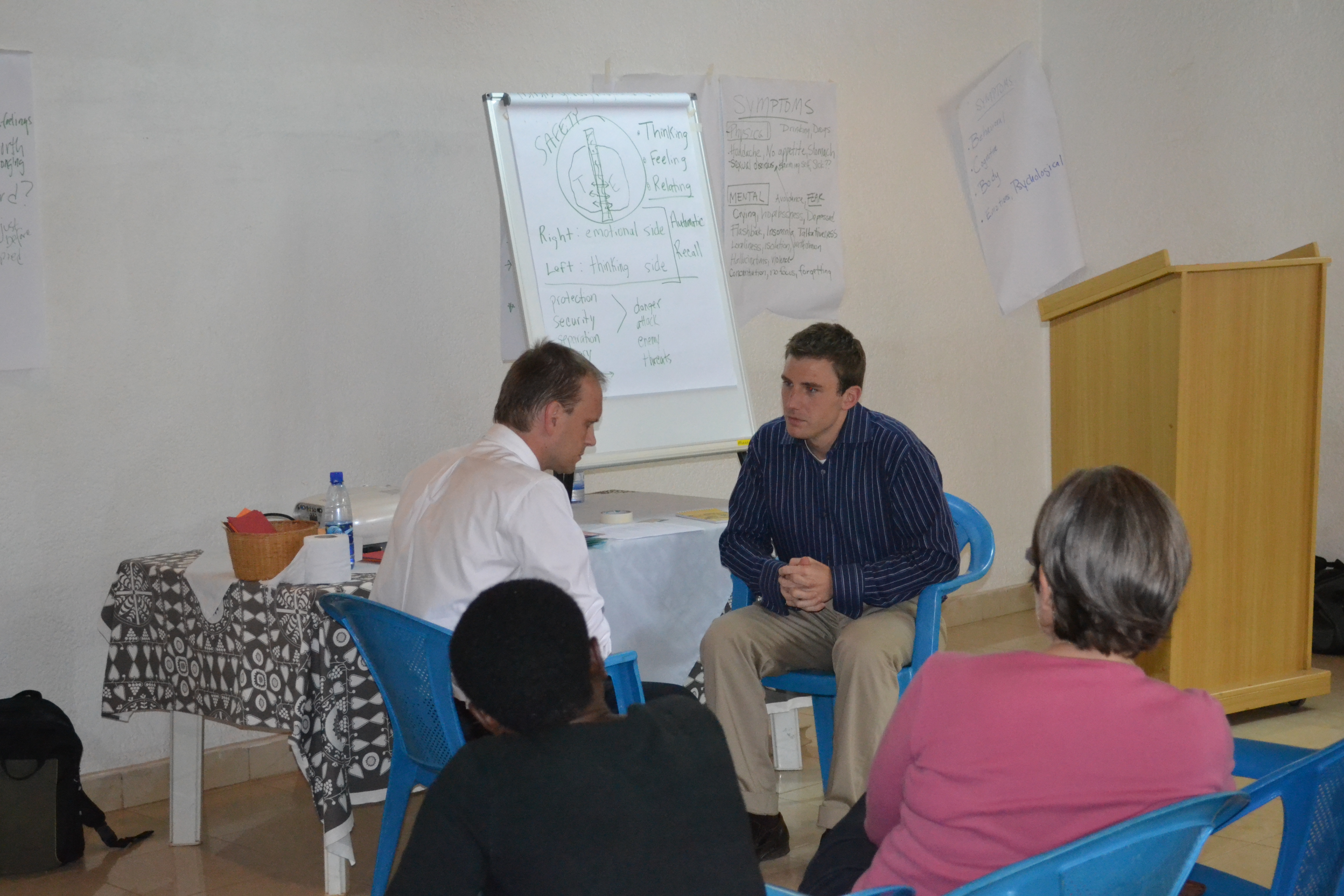
Josh counseling Phil

, and re-connection with others. We concluded this time by having them practice counseling each other with a focus on drawing out emotions in the story. We had another great discussion about culture and emotion as well as the cultural differences between the US and Africa (counseling as listening vs. counseling as advising and solving problems).

The evening concluded with a party and hors d’oeuvres. It was an amazing celebration where many of the women wore traditional attire. We danced (I tried), sang scripture songs, heard silly riddles, and cultural stories. Then, we concluded with a ceremony of giving out the certificates. Normally, we would do this on Friday night at the conclusion of the conference but many wanted to receive their certificate in their traditional dress and we were leaving immediately after the conference ended on Friday so we determined to do this tonight. It was a time full of celebration and joy and a wonderful reminder of one antidote to trauma–communal celebration.

2 Comments

Filed under christian psychology, counseling, counseling skills, Rwanda, Uncategorized

DRC/Rwanda Trip: Day 9


October 19, 2011, Kigali, Rwanda

Finally! Our conference begins. 19 separate group represented here for a total of 42 caregivers. Baraka Unwingeneye (IJM and lay counselor trainer) opened the conference with small and large group discussions on the causes, symptoms, and definition of trauma. The participants were active in discussions. The energy is high! Baraka concluded her section by reminding us all that everyone can be traumatized, even the strong in body and faith. Diane then spoke for 50 minutes or so on the nature of traumatic memory and an overview of the first two phases of intervention. Her voice was a bit weak as she came down with a cold but she delivered it well just the same. Her outline provided a useful reminder of treatment necessity: talking…tears…time. She concluded with some discussion of how having healing relationships, a purpose, and faith all play significant roles in the recovery process.

We ended the morning with a handkerchief project where participants created a depiction of their grief/suffering and then shared it with others. We knew this was going to be powerful and that it would take time. However, we were somewhat surprised at just how powerful it was and how much the participants valued telling others (in dyads and groups) a portion of their trauma story. Several told us that even though they had been counseling others since the genocide in 1994, they had never told anyone their own trauma story.

Our afternoon continued with small and large group activities/discussions and concluded with a question and answer session. The group is hungry for information and we do not have to do much to encourage conversation, discussion, and engagement. Our late afternoon and evening is spent resting, planning for tomorrow’s work and enjoying each other’s company. The food continues to be outstanding at Solace. The only complaint I have is how early the roosters and birds start calling. 4 am is way too early for this. Just outside my window is something sounding like a bird having swallowed a bugle. I later discover it is the gray crowned crane. Here’s a short video I shot from my balcony where I got it to “sing.”  (photos by Joshua Straub)

Leave a comment

Filed under AACC, counseling, counseling skills, Post-Traumatic Stress Disorder, Rwanda, trauma

DRC/Rwanda Trip: Day 8


Tuesday, October 18, 2011, Kigali

Today is our first relaxed day of the trip. We begin the day by having devotions with the staff at IJM. Josh led them in some thoughts from the book of James on themes of justice and justified. The Apostle Paul illustrates the payment (transaction) for justification found in the cross. James points us to the evidence (receipt) of our justification found in our works that prove we have been justified. There is no faith without works.

After devotions, we went to a very American looking cafe to have coffee and to go

Good coffee good colleagues

over the conference plans with IJM employee and counselor Baraka Unwingeneye. She and Josephine Munyeli (WorldVision) are our co-laborers and without them we would not be able to do this work. Our planning helps us nail down tomorrow’s conference efforts. We know we have good ideas for days 2 and 3 but we must be flexible and alter what we want to do for what can be done well.

Walked back to Solace for lunch and then out for a stroll of nearby streets with Carol. Just prior to dinner we received a visit from Rev. Nathan Ndyamiyemenshi at ALARM. He took us to see their retreat property on a lovely hill on the edge of Kigali. A beautiful spot for anyone who would want to take a group to Rwanda. One of the buildings had a plaque stating that it was a donation from Calvary Church of Souderton!

On the return to Solace, we stopped off to by Rwandan coffee beans to bring home. Speaking of home, I am getting homesick. While it is good to have a restful day, I am ready to get on with our conference and go home. Good that we start tomorrow.

2 Comments

Filed under counseling, Rwanda, trauma

Back in the USA after whirlwind trip to DRC and Rwanda


Glad to have the trip to see the trauma recovery efforts and needs in the DRC and Rwanda. Glad to return home. It has been a whirlwind of experiences and emotions. I know many of you were in prayer for our trip so over the next 2 weeks I plan to post daily logs of our trauma recovery trip to the Democratic Republic of Congo (DRC) and Rwanda. I have some pictures and video that I hope to post but am still trying to figure out how to make some edits to the video clips I took each day.

Let me start by making a couple of observations about the things that were most noticeable–both in going to a new culture and in returning home. These are random…

  1. Chaos is the name of the game in the DRC. Nothing works well. Not customs, not roads, not electricity, not UN.
  2. Smooth roads in the DRC are few and far between. In Goma, they are TERRIBLE. Looks like they just carved them out of lava. What a wonderful place to live if you make your living replacing axles and struts.
  3. Electricity is spotty, internet slow…but most in Goma have 2 cell phones each. Why? Because they have two cell providers and at any time, one may be down
  4. The UN soldiers aren’t well liked in the DRC. Seen as either neutral (just observing not helping) or negative (participating in the raping of the Congo). Being a UN soldier may be one of the most mindnumbing job there is. Stand around. Do nothing for most of the time.
  5. Everybody walks everywhere
  6. Rwanda is developing by leaps and bounds. Not sure if all of it is good. On the one hand, massive construction in Kigali. Roads from Goma to the center of the country a delight. On the other hand, there are large sections that used to be slums in Kigali that are now green space/farming/nice properties. Where did those people go?
  7. Stereotyping: Congolese seem more open about their feelings than Rwandans.
  8.  We are so blessed in this country. We can count on our infrastructure.  We do not have to pay bribes. If we work, we probably will get paid.
  9. Despite their poverty, African worship is far more joyful and therapeutic (in a good way) than what we call worship in this country.
  10. I probably wouldn’t invite guests to my house if it were a 2 room board shack with no running water or toilet. Not the case for some in the DRC and Rwanda.
  11. Trauma is everywhere in Africa. Few resources to deal with it there, including the church

Day One: October 10-11; travel to Entebbe, Uganda

6 pm. Lift off on time from Philadelphia International Airport. Diane and I fly overnight to Belgium. It is always a challenge for me to get sleep on a plane so I got a prescription for Ambien to help. Learned that half a pill doesn’t much work for me. The total trip from Philadelphia to Uganda takes 18 hours of flight time. Add in the waits in Philadelphia, Brussels, and Kigali and you have 24 hours of travel, a long and painful trip. Yet, each leg went well and went off as planned. Two minor interesting experiences

  • Recognized a stewardess on the first leg who plied me with a few freebies to make the trip much more pleasant
  • Pretty sure I sat next to French journalist, Jean Hatzfeld, author of Machete Season and the Antelope Strategy on the trip to Kigali. Not sure since his English isn’t that good but he was editing proofs of a new book he said was about him and his role after the genocide. Wished I had determined for sure who he was and told him how I found his books so helpful.

Arrived in Entebbe at 9:45 pm, October 11. After that many hours, you feel rather fuzzy brained. But, we were met by someone from the Ugandan Bible Society who had us wait at the airport with him until Bagudekia Alobeyo, our American Bible Society friend, arrived on his flight some 45 minutes later. Once Bagu (our Congolese pastor/guide and friend) arrived we set off to a nearby hotel, the Imperial Beach Resort Hotel right on Lake Victoria. This turns out to be our best accommodations of the trip. First impressions right out of the airport. The lovely smell of charcoal cooking fires are quite prominent.

Off to sleep in hopes of good rest to be ready for our quick flight into the DRC tomorrow!

3 Comments

Filed under Congo, counseling, trauma, Uncategorized

Trauma Recovery Work in Africa: Itinerary


Those of you interested in trauma recovery work can feel free to pray through our upcoming trip and itinerary (as well as for our families!). Our team (Diane Langberg, Carol King, Josh Straub, Baraka Unwingeneye, Josephine Munyeli, and me) will be providing a 3 day trauma recovery training for Rwandan nationals October 19-21 funded by generous donors from the AACC and WorldVision. Diane and I are leaving early for some assessment work with the American Bible Society and national bible societies in the region.

  • Oct 10-11: DL and PM to Entebbe, Uganda to meet up with African and American Bible Society leaders
  • Oct 12: DL and PM (via MAF plane) to Bunia, DRC to meet with Bible Society workers and those receiving care
  • Oct 13: DL and PM (via MAF plane) to Beni, DRC to meet with seminary/university professionals; then on to Goma, DRC
  • Oct 14-16: DL and PM meeting with Bible Society staff, trauma victims, and trauma recovery workers in Goma, DRC
  • Oct 14: JS and CK to leave for Kigali, RW
  • Oct 17: DL and PM to drive from Goma, DRC to Kigali, RW
  • Oct 18: Meetings, prep for conference
  • Oct 19-21: Conference lead by BU, JM, DL, JS, CK, and PM for WorldVision workers, clergy, educators, and others
  • Oct 21: Leave Kigali
  • Oct 22: Arrive Philadelphia

Pray for health, safety, ability to listen well, to teach well and to be flexible. Pray for our families in just the same way.

Leave a comment

Filed under "phil monroe", AACC, christian counseling, christian psychology, Democratic Republic of Congo, Goma, Rwanda, teaching counseling, trauma

Baking Cakes in Kigali: Book Note


I have just finished Baking Cakes in Kigali, by Gaile Parkin (Bantam Books, 2010). This is BY FAR, the best book I have read this year. I would urge anyone interested in understanding life in Rwanda as well as life of women in much of the world. It is a novel but it conveys in beautiful artistic phrases and tones the experience of a woman who must overcome much adversity, who must understand her world, who must come to terms with her own difficult history and help those in your community overcome their own difficulties.

Read it if you want to see beautiful images of lay counseling, of family and relational challenges, of hope and realistic images of healing. Gaile Parkin is a counselor and it shows. She gets interpersonal relationships, trauma, and how to weave a story together.

Leave a comment

Filed under Abuse, counseling, Rwanda

Off to Nashville!


This marks the 6th trip to the Opryland Hotel for AACC’s World Conference. It is quite the spectacle. I love meeting up with old and new friends. I love the opportunities to teach and learn. I don’t love the Opryland. It is behemoth (though good for exercise) and feels fake after a day or two in the climate controlled indoor bubble. Nice greenery and all but still a bit stifling for my taste.

This year I will be present at the following

  1. 9/27
    1. Speaking to Salvation Army Officers on ministry challenges and spiritual renewal (slides on slides page)
    2. Speaking to golfers at the Project Tuza Golf fund-raiser and dinner about Rwanda and the work we will do there in a few weeks.
  2. 9/28
    1. Presenting with Diane Langberg on Complex Trauma (3 hour pre-conference seminar)
    2. Meeting with the American Bible Society, AACC, and others about supporting global trauma recovery
    3. Meeting with those going to Rwanda to make final plans on our 3 day training of World Vision workers
  3. 9/29 Conference opens!
    1. Attending as many plenary and breakouts as possible
    2. Representing Christian Psychology to counseling students at “Awakenings” event
    3. Pizza with Langberg & Associates staff who will be there!
  4. 9/30
    1. Presenting a 1 hour breakout with Carol King on international trauma recovery (slides on slides page)
  5. 10/1
    1. Making a pitch from the main stage to all attendees during the “ask” for support for Project Tuza.

I think I will be plenty busy. This doesn’t count all the interactions with friends and colleagues I often have. So, I look forward to it and look forward to it being over and returning home to family. Feel free to pray for their stamina as well!

2 Comments

Filed under AACC, christian counseling, christian psychology, Christianity, counseling, counseling skills

Sneak preview: Healing Trauma in International Settings (AACC seminar)


Cascade Atrium, Gaylord Opryland Resort & Conv...

Image via Wikipedia

Just completed preparing my breakout seminar for this year’s AACC World Conference at the beautiful but outlandishly expansive Opryland Hotel in Nashville (Sept 28-Oct 2). This time around I presenting with my colleague Carol King on “Healing Trauma in International Settings: Best Practices.” Carol has had some experience in Rwanda and Goma, DRC and will be with our group in October when we do trauma recovery training in Kigali. Come back to the blog on the 30th and you can see and download the slideshow we will do.

What will we be talking about? 3 main points:

  • Listen…don’t assume you already know trauma or treatment practices
  • Train…don’t do the interventions yourself (train local leaders)
  • Utilize…don’t reinvent the wheel (use existing models)

Now obviously we will be fleshing those points out. Our goal is to help prepare interested counselors to develop short and long-range intervention strategies that utilize the cultural and human resources of the people they will serve. The only way to do this well is to have a listening and collaborative/support role approach. To that end I will talk about hoe to build an effective area case map.  We end by reviewing a few models for trauma recovery (both Christian and secular).

Check back on the 30th for the full set of slides.

Leave a comment

Filed under AACC, Abuse, christian counseling, christian psychology, Christianity, counseling, counseling science, counseling skills, Post-Traumatic Stress Disorder

Psychological rubbernecking?


One of the necessary first steps of doing international trauma work is to listen to the stories of trauma. There are two main reasons. First, it can be healing for the teller to tell their story to someone safe and caring (if those leading the story telling project follow some basic rules). Second, stories often reveal useful information that may determine future trauma recovery intervention strategies.

But let us also admit there can be a downside to getting others to tell their story, especially those who are impoverished and in great need:

  • When “helpers” or journalists helicopter in to hear the stories, the victims may not feel free to not tell their stories because of the help they hope to receive
  • Outside helpers may repeat the stories in such a way as to sensationalize or to gain more money for future trips. While some reasons to tell may be noble and good, does the retelling of the trauma put the victim at risk for retaliation?
  • Getting victims to tell their story may first raise hopes for change and then dash them if there isn’t a plan for follow-up
  • Sometimes outsiders listen only to help themselves feel better (see, we cared enough to listen) but not do anything to help

In less than one month I will be on my way to do just this kind of listening in both the DRC and Rwanda. The challenge for us is to listen and invite story-telling in ways that leaves victims with immediate help and hope and a viable plan for the future (as it pertains to what to do about their trauma).

But we face some hurdles in trying to hear the right (real) or most important stories.
1. Hearing the real stories. Sometimes stories get cleaned up in an effort to tell us what others think we want to hear. Other stories are told with a slant in order to avoid stirring up other trouble.

2. Avoiding our own biases. Some victims may be perpetrators even as they are also victims. It is easy to categorize individuals in such a way that we stop listening to the pain or the recovery. We can fail to see how victims handle temptations for revenge or how perpetrators act humanely.

3. Lost in translation. Most of the stories we will hear are going to be told to us in a language other than English. That means the story we hear may be the words of the translator rather than the victim.

There is a fine line between listening for learning or helping and listening for curiosity. It is not always clear where that line is but pray for us as we seek to listen in ways that bring health and a plan for healing. We do not want to merely rubberneck like those driving past a bad accident, looking but not providing any help.

One sign that we are listening well is that the victim not only recalls the terrible things from their past but that they also recall how they survived and have some sense of being empowered in their present and future.

1 Comment

Filed under christian counseling, DRC, Uncategorized

When some help isn’t better than none


When is some help worse than none? When it creates more problems than might have been there without it. While that is easy to say, determining the line between helpful and harmful is less clear.

If your help saves a life, that seems good. If your help saves lives but creates or supports a system that destroys others, when do you decide to stop helping or to change the help you offer?

This is what Linda Polman raises and a key issue in her The Crisis Caravan: What’s Wrong with Humanitarian Aid? (2010, Metropolitan Books; first published in 2008 in Dutch by the title, De Crisiskaravaan).

Linda tells of a huge problem in the humanitarian aid industry (yes, it is one even if its primary purpose is to provide care for traumatized and displaced peoples). She puts the challenge this way in regard to providing humanitarian aid for those in warzones,

You do what you can for the victims, but soldiers exploit your efforts. They demand money for ever well yo dig and levy sky-high taxes, imposed on the spot, on all the sacks of rice and tents and medicines you arrange to have flown in. They consume a slice of your aid supplies and sell another slice. Among the items they buy with the proceeds are weapons, which they use to drive yet more people into your refugee camps or even to their deaths.

What do you do? Do you conclude that it is no longer possible to cling to the principles of the Red Cross, pack your bags, and leave to help war victims elsewhere? Or do you remain true to your convictions, believing that even if you save only one human life, some relief is better than none? (p. 1-2)

The first 2 chapters detail the problems of the international aid provided to Goma, DRC between July/August 1994 and 1996 when the Rwandan government used their soldiers to force the mass of Hutu refugees and former genocidaires back into Rwanda rather than allow the camps be locations for regrouping of the militias that would try to return to fight the new Rwandan government.

A couple of her observations

1. Not all refugees are the same. Some are truly in need. But a large number of the refugees in Goma brought a treasure trove of materials looted from their own country. Thus, they were less likely pushed there and more likely going there to reconstitute a machine against the RPF in a safe place.

2. The international community came in droves, almost seeming to try to make up for the failures in Rwanda for the past several months. But they didn’t understand that many of these folks were either perpetrators or related to them.

3. Not all of the deaths reported as due to cholera were in fact illness related. There were many that were killed for failing to be loyal enough to the Hutu extremist groups

4. NGOs have to market themselves and thus spend lots of money to get contracts to help more

5. NGOs hide the fact that many of their stuffs were taken by Hutu leaders so the NGOs would raise the number of people they were helping in order cover up that they lost a large percentage of materials/food to theft and corruption

6. Journalists are more likely to get their way paid to cover a crisis by an NGO, thus raising questions about the images they send back. Likely not going to be as objective.

Now, none of this suggests we shouldn’t provide humanitarian aid to refugees in warzones. But it does remind us that our help can also hurt others. Being wise as serpents and harmless as doves is a lot harder than we might expect.

Given our trip to the region next month, I have to remember that our good intentions are not always enough. I’m not sure how our help can hurt but if we don’t ask the questions, we won’t know either. Here are some open questions

1. Does short-term trauma recovery efforts start a healing process but fail to keep it going thus encouraging more hope than discouragement?

2. Does bringing people together to talk about trauma unintentionally trigger trauma or feelings of rage (we won’t know if some people are considered the “wrong kind of people”)?

3. How does taking pictures or filming any part influence the “data” we think we are collecting?

Leave a comment

Filed under conflicts, Congo, counseling, Post-Traumatic Stress Disorder, Rwanda, Uncategorized