
Tag Archives: mental health

Stopping seasonal high anxieties: Some strategies and a better goal


For most people, anxiety is a looped internal conversation. It just keeps starting over even when we don’t want to listen to it anymore.

The Christmas season we’re in can make anyone quite anxious. (Don’t think so, watch this fun video to remind you why.) Those of us naturally anxious and ruminative find the added responsibilities, family stresses, and disappointments just adding fuel to the fire. You try to take a moment to rest but all you can do is think about what is yet to be done or what you tried to do but failed. You pray but before you finish you are back to your worries. You distract yourself but the looped fears keep running in the background.

What helps you decrease your anxieties and repetitive worries? Can you really suppress them? Or should you have another goal in mind than just trying to shut them down? Are there any practical strategies that work?

Practical Strategies?

Daniel Wegner gave a short award address on this topic at the 2011 APA convention (now found in v. 66:8 of the American Psychologist, pp 671-680). In the address he tells us what we already know. It is hard to suppress thoughts in a direct manner (e.g., I won’t think about how much work I have to do). So, Wegner focuses on indirect strategies. Here is a sample of strategies with empirical support:

  • focused distraction
    • pre-planned alternative topic to think about when the rumination starts. Benefit? Avoids mind wandering which will more quickly return to the anxiety. Example: Every time I think about the conflict at work I will focus on a comforting favorite verse or an upcoming happy occasion.
  • Stress and load avoidance
    • Overall reduction of stress helps reduce unwanted/anxious thoughts. Focused distraction helps only to a point. Overwork which may provide some distraction will increase anxious thoughts over time.
  • Thought postponement
    • Choosing to postpone anxiety to a set time can work to reduce the amount of rumination experienced.  Example: I’ll spend time worrying about my visiting in-laws at 4:30 pm.
  • Acceptance
    • Instead of fighting and arguing with fears some find it helpful to observe fears without taking action. There is some evidence that those who accept the occurrence of unwanted thoughts have less distress than those who fight the thoughts.

Wegner goes on to mention other strategies (i.e., planned exposure, mindfulness, focused breathing, self-affirmation, hypnosis, and journaling) for reducing unwanted thoughts.

 A Different Goal?

What if the goal isn’t to remove or end unwanted thoughts and anxieties but to cope with them and not to be dragged along by them? Does this sound like failure to trust God? Failure to be at peace? if the goal is to trust God in the midst of uncertainty and anxiety, what would that look like? How would you know that you were doing well? To do this we would need to give up on the goal of having an absence of anxiety and to reimagine peace as something one can have in the midst of angst. After all, we are not seeking to be absent from this world but to live in the world that is full of chaos and uncertainty.

Here are two goals you might consider:

  • Being okay with things not done to perfection and with the disappointment of others who have come to expect perfection from you
  • Experiencing anxious thoughts as normal and yet savoring moments of rest when they present themselves
  • Using one strategy for anxiety reduction each day

So, how do you measure your seasonal high anxieties and what goal do you seek to reach during this Christmas season?

4 Comments

Filed under Anxiety, Psychology, Uncategorized

Getting confirmation on global trauma recovery plans


Since January I have been trying to articulate the best practices in doing trauma recovery or trauma healing work in international settings. The foundation of this approach to trauma recovery is, (a) Listen first to the needs, resources, and concerns of a community(b) identify local leaders who can be trained to be the primary trauma recovery workers (rather than outsiders being the primary clinicians), (c) tailoring interventions to the needs of  the community, and (c) above all…do no harm by over-promising, under-delivering, etc.

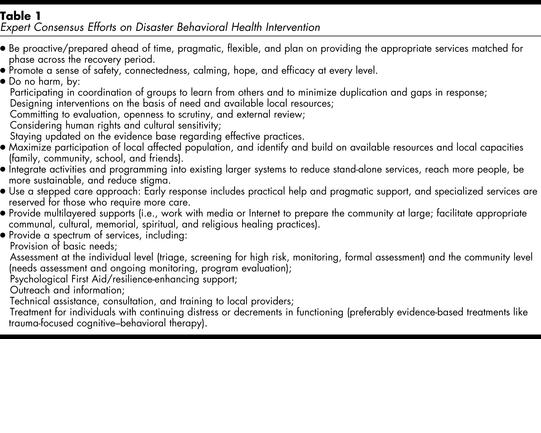
Today, I opened up my most recent American Psychologist (66:6, September 2011) and found my thinking confirmed in Watson, Brymer, and Bonanno’s Postdisaster Psychological Intervention since 9/11 (see citation at the bottom of the page). On page 485 they list what experts consider an appropriate steps to take in postdisaster behavioral health interventions. Now, most of you don’t probably get excited about research articles like this but I can tell you I did. Here’s the chart (click to see a larger image)

It is nice to find confirmation for something I was thinking but hadn’t read elsewhere.

From: Watson, P. J., Brymer, M. J., & Bonanno, G. A. (2011). Postdisaster psychological intervention since 9/11. American Psychologist, 66(6), 482-494. doi:10.1037/a0024806

1 Comment

Filed under Abuse, counseling science, Post-Traumatic Stress Disorder, Psychology, trauma, Uncategorized

Safe churches for sufferers of PTSD?


A friend recently asked me about the characteristics of the kind of church someone with PTSD should seek out in looking for a safe place to heal. I’d like to ask that of my readers. What special characteristics might someone look for as a good church family when they suffer from hidden damage? If YOU were looking for a church and wanted to find a safe, compassionate, sensitive church, what would you look for? What characteristics would tell you that the church was what you wanted?

Preaching and teaching? Interpersonal characteristics? Resources? Characteristics of leadership?

36 Comments

Filed under Abuse, pastors and pastoring, Post-Traumatic Stress Disorder, Psychology

Heal thyself? Do we have the capacity?


Those who follow the Christian faith wholeheartedly believe that God is the “great physician” and eschew the belief that humans heal themselves. As a result of this belief, Christians sometimes react rather strongly to humanistic language of “self-healing.”

But before you do, consider this: if we assume that God is indeed the creator of all things, then we must also assume he puts into place the many corrective features found in the body. The liver and kidneys remove toxins from the body; blood clots when we cut ourselves; we sneeze to get rid of irritants; we sleep to rejuvenate what has become run down. In better words, Richard Mollica says,

This force, called self-healing, is one of the human organism’s natural responses to psychological illness and injury. The elaborate process of self-repair is clearly seen in the way physical wounds heal. At the moment of injury, blood vessels contract to staunch bleeding. Chemical messengers pour into the tissue, signalling a multitude of specialized cells to begin the inflammation process. White blood cells migrate into the wound within twenty-four hours, killing bacteria and triggering a process of cleansing and tissue repair. A matrix of connective tissue collagen is then laid down, knitting together the ragged edges of the wound in a repair that may not be perfect but is highly functional. (p. 94)

He goes on to say,

The healing of the emotional wounds inflicted on mind and spirit by severe violence is also a natural process.

I find his writing on this subject rather helpful. Sometimes we look passively to God to resolve our traumas, as if it were entirely up to Him. Other times we either resist what we can do or attempt what is not healthy for us. Dr. Mollica (an MD) provides many examples in his book of how the body naturally tries to heal/respond to trauma (e.g., DHEA counteracts toxicity of too much cortisol), where the system goes wrong, and what we can do about it from a therapeutic standpoint.

Dr. Mollica is right in that our bodies are designed to respond well to traumatic experiences. However, I’m pretty sure he also agrees that we are not designed to do this unassisted. The community must participate in the process. We are social beings and thus our healing must be socially situated.

Two Toxins: Emotional Memory and Poor Storytelling

Part of the problem, says Dr. Mollica, is the emotional memory system. When we experience a trauma, our cortex forms declarative memories of the event. These are where we store the “facts” (where we were, what we felt, and how these events connect to previous experiences). But there is another memory system, one he calls “emotional memory” (p. 96). Declarative memory involves the cortex and hippocampus while emotional memory involves the amygdala.

The amygdala is the fear-response command center of the brain, and it does not wait around for the conscious mind, located in the cortex, to decide if a threat is real or not. The amygdala can activate an emergency response throughout the body within milliseconds by calling the stress-response system into play.  (p. 96)

Unfortunately, traumatic events can create emotional memories in the amygdala that keep on replaying and are difficult to extinguish over time. (p. 97)

Another toxin is the re-telling of the trauma story in a way that retraumatizes the victim. Dr. Mollica, in chapter 5, describes the problem of poor storytelling. Poor storytelling evokes only the trauma, the shame, the degradation experienced. Storytelling should cause us to form images in the teller and listener’s minds. These images need to symbolize the whole person/story and not only the most damaging details. The problem is we tend to tell stories that fixate on the intense emotions and thus elicit toxic emotions and maintain the experience that the trauma is still ongoing.

Many traumatized persons are plagued by the two poles of humiliation–sadness and despair on one side, and anger and revenge on the other. (p. 122)

Assisted Self-healing?

Mollica says, “A proper clinical approach to emotional memory avoids triggering the emotions stored in the amygdala and enables the cortex to assert conscious control over the recollection of traumatic events. (p. 97)

How do you do this? With the help of a storytelling coach, a person tells their story in a factual, direct, but not grotesque way that would cause the listener to turn away. Why does this matter? Because part of the healing process is to be heard, seen, and empathized with. Fixating on the most grotesque details only enhances the emotional memory system and pushes others away. Good storytelling still tells the truth but does so in a way that reconnects people with the world, enables them to feel sadness but in community with others, and helps them see that their lives are not solely defined by the traumatic events. Further, good storytelling points to larger values that are still held and not lost due to the evil done by others. Surely trauma does shape and change us. Recovery and healing to the point of living as if the event did not happen would be to live in a world of denial and self-deception. But good storytelling reminds us that we are not ONLY defined by and/or limited to being victims. And good storytelling reminds us of God’s sustaining power that is greater than those who can only destroy bodies.

Dr. Mollica summarizes this chapter this way,

Strong emotions comprise the traumatic memories that are imprinted in the survivor’s brain. One of the mind’s key tasks after trauma is to take these strong emotions and gradually reduce them over time through good storytelling. A poor storyteller tells a toxic trauma story, unhealthy to mind and body with its focus on facts and high expressed emotions. In our society situations that demonstrate this type of storytelling are common, including superficial, sensational media reporting of tragedies and debriefing therapy by misguided mental health workers. In contrast a good storyteller is able to express tragic emotions with the artfulness of a musician playing an instrument, engaging the listener’s interest and involvement. (p. 133)

I commend to you the book. He discusses both good and bad dreams, the role of “social instruments” of healing and a call to health. Very helpful book if you are interested in international trauma recovery.

7 Comments

Filed under Abuse, counseling science, counseling skills, Post-Traumatic Stress Disorder, Psychology, ptsd, Uncategorized

What does a counselor’s office tell you?


What does the decor of your counselor’s office tell you about the person? Or, if you are the counselor, what does your office tell your clients about you?

In the July issue of the Journal of Counseling Psychology (58:3, 2011, 310-320), Jack Nasar and Ann Sloan Devlin published, “Impressions of Psychotherapists’ Offices.” In their study (showing pictures of counseling offices) they found a couple of interesting facts:

“Studies 1 and 2 found similar patterns of response in relation to ratings that assessed feelings about the office and the therapist. As perceptions of softness/personalization and order increased, so did expectations about quality of care, comfort, boldness, and qualifications of the therapist. Perceived friendliness increased with increases in softness/personalization.” (p. 314)

This finding isn’t related to gender, age, or prior experience with counseling.

What should counselors avoid? Chaotic, cramped, messy, hard impersonal offices. Put your papers away. The lack of organization and the lack of personalized touches and softer seating may make your clients feel less safe and therefore experience less therapeutic gains.

So, what does your office say to your clients? I recall an office I had in community mental health (shared by several other counselors on a sign-up basis) was sparse, cold, and completely lacking any personalization, art, etc. No wonder many clients preferred talking to us on the street over the office.

My current office contains a love seat, a couple of other chairs, books in a bookcase, a warm wooden desk (that is usually neat in contrast to my academic office), one nice piece of artwork and another that is ugly, some beanie babies, and a blanket. While this office was set up by someone else, I think I’m going to change one bookcase that is in the eyesight of clients. It is a bit messy with various papers, books, and other junk.

5 Comments

Filed under counseling, counseling science, counseling skills

Multiple relationships: Just how many is too many?


Last night in our ethics class we took up the issue of multiple or dual relationships. For those of you who haven’t heard of either term, it refers to the situation where a counselor is not only a person’s counselor but they also have another relationship with the client as well: counselor and pastor, counselor and friend, counselor and business partner, counselor and friend of a child, and the like.

Every professional ethics code (secular or not) raises concerns about dual relationships given their potential for causing harm to the client. The AACC code recognizes that dual relationships are a given in Christian communities and something not to be banned outright. But even this code suggests that forming a dual relationship is a breakdown of professional relationships.

Over the years, I would estimate that 2/3 of the students in my program come thinking that dual relationships are good, even optimal and that those who would outright refuse more influenced by old psychotherapy models. So, part of my class is to talk about the benefits and liabilities of dual relationships. There are success stories and horror stories. But what is the value behind limiting these kinds of counseling relationships? It is to, “Do no harm,” to work for the client’s best interest and not one’s own.

Here’s what I asked my students last night. In an area filled with counselors, why would you think YOU ought to engage in a dual relationship? I want to push them to consider their reasons. Is it people pleasing? Is it to feel valued? Is it arrogance that no one else can help?

I am not against dual relationships and have engaged in some superficial one’s myself. But I do think we ought not engage in them without having forced ourselves to consider that maybe the reasons we do so are not really for our client’s best interests.

What do you think?

Of course, the answer to my title question is this: Even one unexplored dual relationship (exploring reasons why, options not to, possible dangers, informed consent, etc.) is too many.

3 Comments

Filed under AACC, ethics

Physiology of fear


Regions of the brain affected by PTSD and stress.

Image via Wikipedia

Had a conversation regarding fear and anxiety with someone yesterday. In light of that I am resurrecting a post I wrote from 2007 (with a few edits) regarding the physiology of fear. We often view fear as only a spiritual or faith problem. But for those who want to know what is going on in their bodies when they experience fear, consider the following:

(Those interested in other posts on anxiety can search that and related terms in the search box at the upper right hand of this blog)

Am teaching on anxiety, panic, and OCD tonight. Definition of anxiety: Responding to ambiguous stimuli (life situations) by reading them in the worst or most dangerous possible light. The Scriptures teach us that fear and worry are not good things. Time and time again God tells his people not to be afraid. We see that God wants us to see life through a different set of eyes, much as Elisha wanted his servant to see the army of angels instead of their enemies (2 Kings 6). But given the numerous encouragements to not give in to fear, we must admit it is a common struggle for every human being. Some struggle more than others.

What is going on with those whose lives are filled with worry and fear? Are they less spiritual? More sinful? It is easy to say, “buck up” to folks who are anxious–and entirely unhelpful to most. Logical challenges to fear (e.g., really, what is the chance you will die in a plane crash today?) may help some in the moment, but usually don’t get to the root of the matter. Jesus encourages fearful people by pointing them to see life from 40,000 feet. He doesn’t deny risk and suffering but encourages folks to keep their eyes on him. And with Peter, he reaches out to grab him even when he does start looking at the waves.

But what of the physiology of anxiety? What do we know and how does the christian counselor make use of the data?

  1. Fear responses are quickly learned and seemingly etched into the amygdala. One bad experience of food poisoning from a turkey sandwich at Applebees means my stomach tenses a little when I see deli turkey, even without remembering the food poisoning. Imagine what happens if you suffer repeated assaults or worse! The earlier the person is exposed to deep fears, the more likely they suffer from hyperarousal and startle responses.
  2. Neurotransmitters are involved which means you act first and think later. There’s little conscious cognitive processes involved until after anxiety is under way. Fear inducing stimuli lead to immediate neurotransmitter changes that then divert blood from organs to muscles. Tension builds, shallower, less effective breathing begins. Carbon Dioxide levels decrease in the blood stream which in turns creates pain, numbness, and a sense of danger. And so the cycle continues. During and after, we make attributions and so enhance the connections of the feared stimuli and our flight response. The higher the perception of pain, the greater fear/flight response. Despite medical advances, most of our medications either shut down the feed-back loop (beta blockers, anti-anxiety meds like xanax) or attempt to increase the available neurotransmitter serotonin associated with positive outlook.
  3. OCD, in particular, has some probable links to early exposure to viruses such as Strep and Flu. There is a higher incidence of OCD in people born during winter months and who live in colder climates. The link is not clear.
  4. PTSD patients have higher right hemisphere brain activity (than do non-PTSD individuals) when exposed to anxiety provoking stimuli. Further, it appears that trauma patients have greater difficulty coming back to “center” after a trigger. Likely the hypothalamus and other brain structures are overactive in the stress response and do not “cool” down quickly.

That’s just a few things we think we know about the physiology of fear. Now, what do we do with fear from a spiritual standpoint?

  1. Worship. Worship/meditation on other things takes our attention away from the fear stimulus. It forms habits and relationships as we repeat what we want to believe until we actually own it and believe it on its own merits.
  2. Fight. We do challenge our thinking as soon as we can. Yes, the fight/flight chemicals are coursing through our veins but we challenge just the same so we can break some of the connections and the ways we reinforce our fears. One other way we fight may seem a bit odd. We admit there are real things that are scary and overwhelming out there. We do not try to deny the reality of suffering (past or future) but admit it over and over. It is scary to die. I was assaulted in that alley. I am in pain and more may be coming. But, God is with me and it is good to call on him and ask him tough questions about his protection of me.
  3. Stay Present. Being present in the moment is essential to avoiding living in the fear of the past or the future. Some fear is indeed in the present but most are not. When I am able to focus or describe the now, I am less likely to be imagining a future feared event. “Right now I am sitting at my desk and looking at a picture of my children and enjoying the smiles on their faces. Right now I am getting ready for bed and working on a sudoku puzzle and noticing that I am getting tired.”
  4. Work. Building habits where I do not allow myself to run from the feared situations (where appropriate!). Moving myself closer to some of the feared scenarios in a slow and consistent manner. No, this is not flooding (where you are dumped in the pit of snakes because you have a phobia of snakes…). Allow the work to take the time to reorient the deep recesses of the brain. Don’t expect or look for immediate change!

16 Comments

Filed under Anxiety, biblical counseling, christian counseling, christian psychology, counseling science, counseling skills, Mindfulness

Lithium in your water? Might it be beneficial?


Here’s an interesting finding. A research team compared the top ten lithium-enriched regions of Austria (areas with naturally occurring lithium in the water) to the top ten lithium depleted regions of the same country. Those regions with greater naturally occurring lithium levels had statistically fewer suicides than those regions that had low naturally occurring lithium. The research does not prove a causal link between suicide levels and lithium levels in the water. It could be that there are better treatments or facilities in those regions. But, it does give you pause.

Lithium is, you may recall, a salt which is used to treat affective disorders like bipolar disorder. For many years doctors considered it the gold standard treatment. Many still do even though compounds like Wellbutrin and some anti-psychotics are also used to treat bipolar disorder.

While NO ONE is considering prophylactic use of Lithium (like we do now with fluoride in the water), this research does beg the question: at what point would preventative Lithium be appropriate? In other words, how many lives would need to be saved to make it something that we would want to give to everyone? Or, should we only give it to those who are deemed at-risk?

Assume for a moment that the cause for the lower suicide rate is the presence of Lithium in the water. Further assume that the research data is accurate in finding that the suicide rate in the Lithium enriched areas is 11:100,000 while the suicide rate in the depleted area is 16:100,000. I doubt that anyone would promote public distribution in order to save 5:100,000 but I do wonder what the number would need to be before anyone would recommend blanket addition to the water supply.

1 Comment

Filed under Psychiatric Medications, Psychology

What causes mental illness and do you have any choice?


The common medical assumption is that mental illness is the result of multi-faceted vulnerabilities in combination with stressors. A person may have some vulnerability markers but those alone are not likely to result in mental illness without biologic, social, or environmental stressors “turning on” the markers.

If you want to see this model in action, you should watch a most troubling episode of “Independent Lens” on your local PBS channel. It aired in Philadelphia last night. You can find more about the episode here on their website and watch clips of the show.

The hour long episode follows a 16 year old girl, Cyntoia, facing life for murder. You will see extended conversation with the girl, her adoptive mother, her biological mother (who she never really related to). Her bio mother drank throughout her pregnancy, smoked crack and prostituted herself. Cyntoia was being prostituted and was at a “john’s” house when she shot him thinking he was going to kill her.

You can see that Cyntoia probably meets criteria for Borderline Personality Disorder. Watch her mother for a bit and you can see that she comes by it quite naturally. They both have a similar pattern of speech and attitude. There is a long history of suicide and paranoia in the extended family. Very interesting to see how this young woman talks to the forensic psychiatrist.

Choices?

Watch and wonder how Cyntoia could have avoided her predicament. She started out with poor genes, alcohol exposure and poor attachment opportunities. She lists 36 people she had sex with (she felt obligated to have sex with those who wanted her). The issues are legion.

Even more brutal is to watch the interviews with her adoptive mother who is trying to wrap her head around the facts that come out during the investigation. Watch also how Cyntoia talks about her and to her. Notice that there is love.

Very rarely would you get this kind of information from 3 generations of rape and sexual abuse (and adoptive mother’s story).

Watch the episode and consider this question: just how much choice do some people have? Even with her incredible insights (e.g., “everybody wants admiration, everybody wants to be desired. That is my **** problem too.”), this young woman had 3 strikes against her.

The truth is we often believe people have easy choices to avoid trouble. Cyntoia’s story reminds us that trouble begins generations before some people are conceived.And even when we acknowledge that Cyntoia could have made choices to tell adults about her abuse or to escape her pimp, we are left with the gnawing question, would we have made any different choice if in her place? For the record, I am a firm believer in that we do have choices to make. But some have a whole lot more than others and the roadsigns to better choices are bigger for some of us than others.

Challenging story which also pulls on your vision of redemption, restoration and appropriate punishment for minors who commit murder.

5 Comments

Filed under Abuse, addiction, cultural apologetics, Psychology, stories, suffering

One treatment protocol for many DSM diagnoses?


Could we devise one mental health treatment for many counseling problems? Given that so many problems have similar symptoms (anxiety, mood dysregulation, vigilance, intrusive and unwanted thoughts, etc.) and appear to involve common neurobiological processes (limbic systems), might we be able to find a single treatment for multiple expressions of problems?

David Barlow and others say yes.

The Renfrew Center (an eating disorder clinic) publishes Perspectives: A Professional Journal of the Renfrew Center Foundation, a free journal. In their Winter 2011 issue they have a brief article by David Barlow and Christina Boisseau about a new “transdiagnostic unified treatment protocol” (UP) that can be applied to all anxiety and depressive (and eating) disorders. Let me summarize a few points from the article:

  • 70 to 80% of clients with eating disorders also have anxiety disorders, 50% meet criteria for depression
  • A number of anxiety and depressive disorders have emotional dysregulation as a central theme
  • Etiology of these diagnoses may be best accounted for by “triple vulnerability theory”: biological vulnerability to negative mood…early negative childhood experiences due to attachment issues or unpredictable environment leading to an elevated sympathetic nervous system…and psychological learning from an event focusing on a particular issue (anxiety, panic, observation of parent’s panic, etc.)
  • The Unified Protocol (UP) focuses on “the way that individuals with emotional disorders experience and respond to their emotions” (p. 3). UP consists of 5 core modules
    • emotional awareness training (focus on “nonjudgmental present-focused awareness”)
    • cognitive reappraisal (“identifying and subsequently challenging core cognitive themes”)
    • emotion driven behaviors (EDB) and emotional avoidance (identifying maladaptive EDBs, learn new responses and avoid avoiding emotions)
    • awareness and tolerance of physical sensations (self-explanatory…as they relate to emotions)
    • emotion exposure (“…goal is to help patients experience emotions fully and reduce the avoidance that has served to maintain their disorders(s)”)
  • These modules are flexible and shaped to the individual needs of the client

Obviously, there is much work to be done to validate this protocol but it makes sense. You can see the CBT foundation but also a greater focus on emotion rather than cognition.

Those interested in the full text and references can find it here!

3 Comments

Filed under Anxiety, counseling, counseling science, cultural apologetics, Doctrine/Theology, Psychology