Am I doing this trauma healing thing right? Part 2, Myths about healing that hinder recovery


In my previous post, I explored how chronic trauma responses lead many of us to think we are doing something wrong and are the reason why we are not getting better fast enough. We named some foundational principles for recovery, landmarks by which to navigate the journey of healing.

  1. Take care of your body.
  2. Look for stability in a triggering world.
  3. Begin (again and again) to tell the story of you.

These three steps are seemingly simple and yet they take every fiber of our being and the help from friends to keep fighting for healing day after day.

Unfortunately, there are some beliefs about healing—myths—that can hinder our recovery journey. As you read my shortlist of 4 misguided views about suffering and healing, consider what beliefs and ideas you have had about healing (or heard from others) that might create an extra barrier in your own journey.

Myth: Complete healing is possible and likely

There is a myth that healing from trauma means that I will no longer be bothered by things that used to trigger me. Healing means, in this belief, that memories will not be painful or show up at surprising times. If I continue to have triggers, these reactions are signs of failure to heal, to trust, to have faith in God.

Sadly, I see many who have found considerable healing after trauma to believe this because they have surprising triggers that knock them off their feet from time to time.

Consider this analogy, Your body has changed as much as if you were hit by a car. If you had been an elite athlete prior to the accident, you might need to accept you could no longer be an athlete as a result. It would not be a sign that you had failed to heal but that in healing, life is now different. When we believe that something is wrong with us since we bear scars (e.g., trauma triggers, bodies that are on higher alert, limitations to what we can now do) we add to our pain by accusing ourselves of not healing.

It doesn’t help when we see others who seem to have found more healing. Stories of “heroes” like Corrie Ten Boom or Malala Yousafzai seem to tell us that some people are truly healed. And since we know we are not, there must be something wrong with us. Truth? While post-traumatic growth is a real thing, there is ample evidence that these heroes still suffer with their invisible wounds. Growth does not eliminate injury.   

Myth: Healing should mean no longer in grief

Grief and growth will co-mingle, and one does not eliminate the other. Loss is loss. When we experience trauma, we also suffer loss. And loss means grief. These losses include safety, predictability, identity, voice, as well as other more physical and spiritual losses. We may lose family members, community, and capacities we once had (recall the elite athlete image above).

We don’t imagine that if you lost a close loved one that you should no longer feel something when reminders of their loss are present. Grief shows up like waves at the ocean. They may be big and knock us down. They may be small and less obvious to us. No matter the size, they are always present. And something will likely trigger a larger wave when we least expect it.

Myth: My faith should be able to be what it was

The story of you has changed as a result of trauma. It impacts every part of your story, including your faith and spiritual experiences. By every definition, you are now different because your story includes something that is difficult, if not impossible, to integrate into the way life was or is supposed to be.

Consider the Psalmist in the Bible. Psalm 42 and 43 tell us this fact in poetic form. The writer struggles to make sense of the loss of his capacity to lead the worship procession. He remembers how led the way to worship but now all he feels is isolation and the sting of those who mock him. He cannot find his way back to who he was and his efforts to press himself to trust God seem not to work. In the end, he is left with big questions for God.

If your trauma happened within your faith community, you may not be able to return or to worship in the same way. Even if you do return to your faith community, joy will likely be tinged with grief. Because you, like the psalmist, are trying to integrate a new disconcerting reality into your story. This new struggle is not a sign of failure to heal. It is a sign that things are now different. And remember, this struggle does not mean you do not have faith or trust God. The act of lament is just as faithful and worshipful as singing praise songs with a crowd. (To read more about lament, try this short essay.)

Myth: Suffering is God’s way of strengthening me

A common myth in Christian circles is that God has some master plan that includes suffering and without it, God could not prepare you for greatness or strengthen you. I see this myth at play when people minimize their suffering and try to whitewash it with phrases like, “but it is all for the glory of God.” Yes, God does get glory when his people seek him and honor him. And, suffering may indeed strengthen new parts of your being, in time. You may thank God for his presence in suffering and for his various ways of showing up in hard times. You may find hidden treasures in dark places (Is 45:3) and discover new strengths you did not know you had.

However, God’s heart for hurting people tells us that suffering is NOT his master plan. When suffering entered the world, God’s master plan was to pursue lost people (Gen 3:9, 21) and to care for them.

Suffering is suffering. Evil is evil. It is never good even if you find something good along the way to recovery. And no such positive outcome dismiss the suffering you have gone through. Our pain and our healing is not some balance sheet looking for a positive tally.

What are some of your beliefs that add to the pain and shame you are now experiencing? What can you release or begin to doubt? If you have a close friend who will listen and ask good questions, consider talking to them about some views on healing that might be holding you back.

A final thought about healing

Healing happens little-by-little. Of course we want it to happen now. You are not alone to long for more healing and less pain. There are things that can help and we will cover that in a future post in this series. I want to leave you with a garden analogy. In front of my office, there has been a lovely Japanese Maple tree. The leaves have been exquisite every fall. But this year, a big portion of it died and so had to be cut down. The spot there is now bare. I feel it’s absence every day. the building looks exposed now. Some small shrubs have been planted in the spot and lovely as they are, they cannot replace what was lost. And yet, when I stand there, I can see small growth and beauty of a different kind. The story of the building is certainly different. I see the stump and the growth that is happening.

You are a garden that had many beautiful things in it. Something happened to the garden of you and now the losses overwhelm any sense of goodness. You must now reconsider what the garden will be like going forward. Give yourself time to grieve what is no more and take time to notice what life is possible in you.

What’s next?

In part 3, we will explore another barrier we face on this journey of healing: the harmful actions of “helpers” and guides. We will look at some red flags you might see in your counselors, therapists, and spiritual guides.

Read more about healing on this site using the search bar. Try this video. Reconsider the language of healing. Would “integration” be a better way to describe recovery after trauma?

2 Comments

Filed under Post-Traumatic Stress Disorder, Psychology, trauma, Uncategorized

Am I doing this trauma healing thing right? Part 1, an overview


I spoke last week at #Restore2023 hosted by the julieroys.com. This was their third such conference and the second I have attended. I decided to present on this question in the title because so many ask me about their healing journey with the assumption that they must be doing it wrong. Why? Because they are continuing to struggle with triggers and can’t seem to “move on.” This very question often adds to their pain because of the assumptions of failure.

Trauma is a deep wound of the heart and it hurts every part of our being–our hearts, minds, and bodies. It disconnects us from ourselves, our friends/family/community, and from our faith. We are often are left with two enduring questions: Why did this happen and how can I get out of this hell? Sadly, we end up believing that WE are likely the cause of why we are traumatized and that WE are likely the reason why we aren’t better yet. Trauma triggers and responses are impossible on their own. But the overwhelming sense that we are the reason we aren’t getting better only amplifies the pain. And when our “helpers” add to our own self-criticism by saying or inferring we aren’t doing it right, we feel even more sure that we are alone and forever trapped in a death spiral.

In this little series I want to explore some features of this necessary but unwanted journey of healing. We’ll start by orienting with a small “map.” In later posts we will explore some barriers to recovery and red flags to take note of regarding your helpers or counselors. We will end the series by considering what model of therapy and therapist might be best for you.

The journey you never imagined you would have to take

When you begin a journey these days, one of the first things you want to have is your turn-by-turn directions on your smart phone. But this journey is going to be a bit more old-school since google maps has yet to give us the quickest route. Before cell phones, we had to have a paper map and/or some scribbled directions to remind us key landmarks that would help us find our way to our destination. True old school would be orienting by sun and stars and this may be the best image to keep as you navigate your own path of healing.

So, what are some landmarks (aka, basic reminders) that help us stay on the right path? Consider these three:

Take care of your body.

Our whole beings have been damaged—it is not just in our mind! So, we need to take care of our bodies. Part of caring for bodies means understanding them and having non-judgmental curiosity about how your body works. For example, your body is designed to protect you. You sweat when you overheat. and shiver when cold. Your body defends against viruses and germs. The trauma response you experience in your body is an attempt to protect you. So, do your best not to think ill of it. Recently, I suffered a back injury and spent a few days immobilized due to spasms. My back muscles, even my whole body, tried to keep from feeling those spasms. We call that guarding. I was able to get help and began some PT a few days later. The protective muscles had done their job but now needed reminders to go off duty as their protection was not needed anymore. The therapist gently reminded me to relax my glutes and calf muscles as we worked on my back.

For many of you, your body has been guarding from a long trauma in your life. No wonder it responds the way it does. Acknowledge its effort and give thanks for its amazing capacities. Use gentle reminders and compassionate care.

Look for stability in a triggering world.

Part of caring for our bodies it to develop a curiosity about what helps us find stability in a triggering world. If you are continually attacking yourself for having a fight/flight/freeze response it will be hard to develop curiosity about what helps you recover that sense of security and stability.

What helps you experience just a little more ease after a trigger? Maybe for you it is movement. For another, it may be a specific breathing exercise or a focus on one of the senses. Or, maybe it is a distracting conversation with a friend. Figure out what helps even just ten percent and develop a list of things you can try when distressed. Don’t beat yourself up if you can’t remember what to do but find ways to write it down so that it is easier to remember. Something might work once and not another time. Again, just take note of it without judging your capacity to calm yourself.

Begin to tell the story of you again.

A key feature of recovery is the practice of beginning to tell (and write new chapters) the story of you to yourself and others. Trauma has a way of stealing our voice and power. It has a way of distorting our story and giving us false names for what we have experienced. “If only I was stronger I could have resisted him…I must have asked for this abuse…”. The journey of healing is a journey of making some sense of the insensible and reframing who we are in the world. This takes time and needs lots of care. it ought not be rushed but done little-by-little. However, even when you go out with friends and do a small but brave thing, you are writing a new chapter in your story. Make sure you aren’t missing this important fact.

three simple steps, right? Not really. Exhausting? Absolutely.

In our next post we will get into greater detail about this journey towards healing. But, first, there are some barriers to the journey that can hinder our progress. These are things we and others believe and some things others do that get in the way of our making progress. Some of these myths really delay or disrupt. We’ll cover some of the myths about the healing journey in our next post.

For more reading on this site, search the word “trauma” or start with this post.

2 Comments

Filed under Post-Traumatic Stress Disorder, trauma, Uncategorized

Hope for the hurting: A conversation about mental health and faith


In January I had the privilege of presenting at Springton Lake Presbyterian Church about mental health and faith. Here are the posted videos of that conference. First session: What do I do with my painful emotions? Second Session: How does my faith influence my mental health?

Leave a comment

Filed under Uncategorized

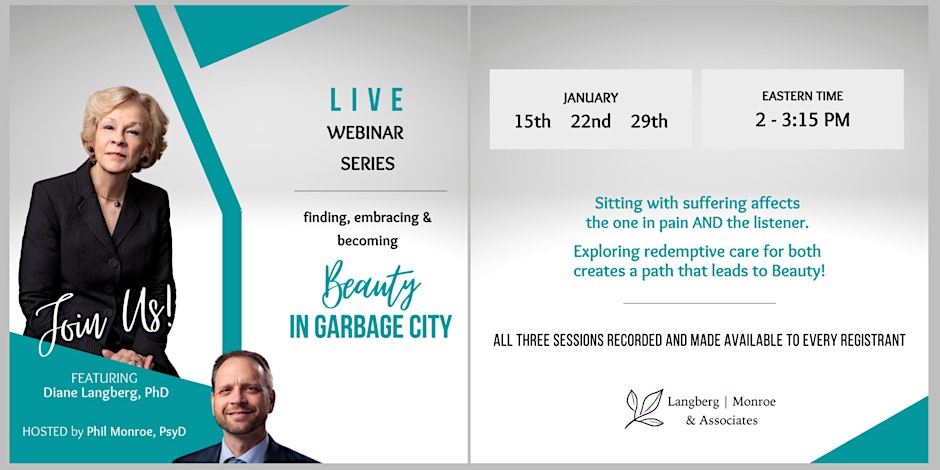
Beauty in Garbage City: A Webinar Series with Dr. Diane Langberg


I want to let you know about an opportunity to engage with Dr. Diane Langberg and myself, designed especially for people helpers–mental health professionals, pastors, caregivers, and friends of those who are traumatized. Please read on if you are interested (link to register here):

The work of counseling and pastoral ministry is not “nice.” If you follow Jesus into the hard places of others’ lives, expect it to have an impact on you; to challenge your strongest held beliefs about God and the Church, your views on mental or emotional health, and your personal well-being. Join Dr. Diane Langberg and host Dr. Philip Monroe and learn from Dr. Langberg’s five decades of work with hurting people and broken systems. Listen as she talks about what has sustained her and answers your questions about what has helped her grow.

How do we continually sit with trauma and survive its impact? We will explore a specific concept during each of the three webinars:

January 15: Finding beauty means opening your eyes to the problems that are inherent as caregivers in the work of trauma. Followed by Q&A.

January 22: Embracing beauty is developing your primary helping tool: character and learning. Followed by Q&A.

January 27: Becoming beauty is applying what we have learned to trauma recovery work that leads to becoming the beauty of our Savior amid the piles of rubble and ruins we encounter every day. Followed by Q&A.

The 3 webinars will be three Sundays in a row, January 15th, 22nd, and 29th, 2:00pm-3:15pm Eastern Time. These webinars will include a Q&A portion, giving the audience an opportunity to ask Diane questions.

Cost and registration includes access to all 3 webinars. Registrants will have access to the Zoom webinar login information by January 9th, either via email or by visiting the online event page. Early Bird ticket price is $30 before December 25th, and $50 after that date.

NOTE: All three sessions will be recorded and emailed to every registered participant.

Leave a comment

Filed under "phil monroe", Abuse, christian psychology, continuing education, Counselors, Diane Langberg, Post-Traumatic Stress Disorder, trauma

Healing from trauma: Where do we begin?


Restore 2022 Plenary Presentation

Leave a comment

Filed under "phil monroe", Abuse, Post-Traumatic Stress Disorder, ptsd, trauma, Uncategorized

Look Up Conference on Faith and Mental Health


Today, I will be making two presentations here in Fort Wayne, Indiana at the Look Up Conference on Faith and Mental Health hosted by the Lutheran Foundation. For those interested in the slides, here they are:

Trauma Healing and the Church: Rebuilding Hope after Tragedy

What is Generational Trauma? The Role of the Church in Healing the Racial Divide

Leave a comment

Filed under Uncategorized

Considering Criteria for Spiritual Abuse


I’ve read a lot of discussion recently about the difficulty defining spiritual abuse of adults by faith leaders in positions of power. It seems most debates center on whether to believe victims who report such abuse and whether there is a culture of victimhood. Behind these discussions is the question of whether we can operationally define spiritual abuse.

For some, since there isn’t consensus on a definition, then there is little to no value in discussing its reality. “It is too subjective and can’t be known.” For others, “too many good leaders will be hurt by false allegations” is reason enough to doubt an accuser’s experience.

Permit me two small historical sidebars to give context on these kinds of debates. 15 years ago I gave a lecture at a denomination’s general assembly on the problem of child sexual abuse. In the room were 300 or so pastors. The very first question asked from the floor was whether it was biblically proper to accept a child’s report of abuse against an elder if there wasn’t a second witness. The second comment from the floor was a statement expressing concern that false allegations would ruin the ministries of many good pastors. The third question amounted to, “Why do we call it abuse, can’t we just call it sin?”

My second historical point goes back a bit further. In the mid-1800s doctors did not routinely wash their hands or instruments after doing cadaver work. As a result, when they delivered babies, mothers and infants died at alarming rates, especially when compared to mortality rates of mid-wife deliveries. When the medical community began speaking about microbes and the need to wash, doctors often resisted. The renowned Dr. Oliver Wendall Holmes was castigated for speaking about the need for better hygiene and some New York doctors wrote letters expressing that such practices would harm their business and the public’s trust of their guild.

In both examples, the primary concern seemed to be to protect the guild, much like our current discussion.

Two criteria for determining spiritual abuse

Consider the case of child abuse. There are two accepted criteria used in defining child abuse that can be helpful here: 1. Actions that result in abuse, and 2. Impact on victim. For example, refusing to take a sick child to the doctor may be found to be abuse/neglect whether or not the child recovers. Or, in another example, one parent routinely expresses paranoia that aliens are trying to hurt them. One child appears resilient and unbothered while the other child becomes suicidal. The impact on the second child is what may lead to a finding of abuse. Note that intentionality is not a criteria for whether a finding of abuse is valid.[1]

So, try on some of these action words for size. How do they fit for criteria of spiritual abuse? Rejecting…terrorizing…isolating…ignoring…corrupting…verbally assaulting…over pressuring.

Let’s apply to a specific case. A man pressures his wife daily for sex and when she does not comply (she often does) he gives her the cold shoulder and refuses to speak to her. When he does talk to her, he quotes bible passages and tells her she is sinning and may be responsible if he looks at porn. This woman comes to her pastor for help and to tell him that her therapist has encouraged her to leave to preserve her emotional safety. In this hour-long meeting, the pastor asks no further questions about her experience even though he does express some empathy for her pain. Because he does not ask questions, he does not find out that she being raped, that she regularly wakes up in the night to find her husband trying to penetrate her. Instead, this pastor tells her to be wary of leaving as it will lead to divorce and potentially harm the husband’s reputation as head of a Christian non-profit ministry. He also wonders aloud if her therapist is giving Godly counsel. As the meeting ends, he asks her to come back next week to talk further and gives her homework to identify the log in her own eye. She leaves confused, sad, afraid, and wondering if she is the problem in her marriage.

Now, has the leader committed spiritual abuse? Quite possibly. Is talking about sin and divorce spiritual abuse? No. But, it also is naïve and poor spiritual leadership. As far as actions go, he ignored her pain, he implicitly isolated her by questioning her therapist, asking her to stay, and showing undue concern for the husband’s reputation. She leaves feeling he has rejected her concerns.

If they continue to meet and he continues to emphasize her need to bear up under this burden and to examine her own heart, then he is likely overpressuring (aka coercing) her. Let’s assume the pastor does not want to harm the wife and believes his counsel is helpful. There is no intention to commit spiritual abuse. But, using his spiritual position and wrapping his counsel in biblical and doctrinal language, the pastor has indeed begun to spiritually abuse his parishioner. The abuse could be averted with some basic education if the pastor was open to learning. But ongoing mild to moderate use of these actions would constitute spiritual abuse for this woman. Another woman might just tell the pastor off on the first visit and walk away. In this case it wouldn’t be spiritual abuse. It would be incompetent pastoral care. But in our imaginary case, this woman stayed because (a) she had been raised to always trust pastors, (b) her husband’s chronic belittling had convinced her that she was in the wrong, and (c) she was already rather isolated. What was incompetent care becomes spiritual abuse due to action AND impact.

Why call it spiritual abuse?

Recall the question posed at the beginning of this essay: Why not just call it sin (or bad care in this instance)? Why call it (spiritual) abuse? I would argue that this question comes from a cultural sense that abuse label means the person who committed it is an ABUSER and therefore unable to change and worthy of being cast out of society. Sin feels better because it can be just a “one off” misbehavior. The problems with calling it sin are several. It reveals we are likely far too comfortable with sin. It denies patterns that need attention. It favors the one who has done the wrong and minimizes the impact on the victim. We seem more focused on propping up the careers of those with certain leadership capacities than recognizing the numerous examples in the bible of how God handles those who misrepresent him (e.g., Job’s friends, bad shepherds (Eze 34), blind guides and white-washed tombs, false teachers in Jude).

Labeling certain behaviors as spiritual abuse helps us focus on those actions that crush spirits. Just as labeling the failure to wash hands may cause infections. Identifying spiritual abuse and its impact helps us focus on consequences rather than intentions.   

Want to read more on defining spiritual abuse?

Check out this and this link for definitions of spiritual abuse.


[1] This essay concisely describes the action and impact criteria for child abuse. Some actions are not per se abusive but create a negative impact. These behaviors, if not stopped, could however be labeled abusive in the future if the parent does not respond to corrective education.

1 Comment

Filed under Abuse, Christianity: Leaders and Leadership, pastors and pastoring, Spiritual abuse, trauma

Helping Children Cope with Anxiety at Christmas


With COVID cases rising yet again, families are again needing to evaluate whether to spend the holidays with family. Even if plans are set, there may be tension in the air as news, politics, and opinions also rise with the rate of infection. This means that children listening in may experience more anxiety in the coming days. Here’s an Op Ed piece I contributed for the American Bible Society and published in the Christian Post: Helping Children Cope with Anxiety During the Holidays.

Leave a comment

Filed under Family, Uncategorized

No, how are you REALLY doing?


Most of us say, “fine” even when we are not all that fine.

Check out this op ed in the Christian Post written by me. What would you add as additional things we can do to thrive in seasons that can be very hard?

Are you thriving? How would you know?

Leave a comment

Filed under Uncategorized

You are NOT alone webinar, 5.19.21


May is Mental Health Awareness month and so it is a good time to talk about how the church can be a place of safety for the millions of Americans who are facing emotional and mental health challenges, whether a result of COVID or other chronic conditions. Did you know, when individuals are part of supportive faith communities, they tend to recover more quickly than those who are isolated and alone?

Join me as I talk with Rev. Dr. Nicole Martin and Toni Collier about improving how we care well for wounded people. I’ll be unveiling some brand new, easy-to-use tools to help Christians bring healing and hope to their communities

Leave a comment

Filed under "phil monroe", Christianity, Psychology