Category Archives: Post-Traumatic Stress Disorder

Trauma recovery? Healing? Integration? Which words communicate a good outcome to you?


Recovery. Healing? Restoration? These words contain both information, movement, and emotion. What words do you like to use when describing the process of getting better after a traumatic experience? How do you communicate that you are better but not so much better that you have no more bad memories; that you have no more nightmares; that you are not triggered into panic when you see someone who abused you?

What words do you shy away from?

Let’s consider healing first.

I was and am being healed?

Some hear healing language as a completed task. “I have been healed.” Past tense. If I was in a wheelchair but now I walk…would I say I have been healed if I walk with a limp or need a walker to get around? Do you ever hear someone say, “I was healed, in part.” Would it be better to say I am being healed or I am recovering. Compared to Greek verb tenses, our English language doesn’t communicate well the ongoing state of something. In Greek, we can communicate a present perfect tense such as, “I was and am currently being healed” all in one verb form. But in English, we cannot communicate such an ongoing process without more words. Thus, when we use the shortcut, “I am healed,” it sounds like a finished job.

Recovery?

What about recovery? Restoration? Renewal? Recovery words are popular amongst former addicts. For them it connotes that they are no longer using but making the daily choice for sobriety. However, they recognize the danger exists of falling back into drunkenness and so they communicate that they are in a lifelong process. For some, however, recovery sounds like a failure–failure to find victory and failure to accept a new identity.  The truth is, few people outside of AA use the word recovery in every day speech. The other “r” words are more likely used in Christian circles but not so much in discussion of life after trauma.

Can you integrate trauma?

I have just finished reading Wounded I am More Awake: Finding Meaning after Terror by Julia Lieblich and Esad Boskailo (2012, Vanderbilt University Press). Julia helps tell Esad’s (a Bosnian doctor) experience of being held in 6 different concentration camps. He is now a psychiatrist in the US and works with trauma victims. However, he faced much brutality in being treated worse than one would treat an animal and so was not in good physical or psychological shape when he came to the U.S. I commend the book to those who want a basic understanding of trauma and of this thing we are trying to call healing and recovery. Listen to these quotes from Boskailo the psychiatrist,

 I can’t take away what happened” [said to another survivor]. But [I] can help [you] imagine a better future.

“You are fifty, not twenty-five. You will never be the person you were twenty-five years ago. Even if you didn’t have trauma, you would not be the same.”

What Boskailo is arguing for is integrating trauma into one’s present life. One cannot go back and recover what was lost. A trauma survivor is never going to be free from losses suffered. To do so would be to deny truth. Integration means allowing the reality of trauma and its losses while finding meaning and value to live in the present with hope and even joy. Integration requires acceptance and willingness to look for meaning and purpose.

I like the connotations of integration. But, I am not sure I like the word integration since it also doesn’t connote some level of arrival at a good enough place. What word would you use?

17 Comments

Filed under Abuse, counseling, counseling science, counseling skills, genocide, Post-Traumatic Stress Disorder, Psychology, ptsd

Global Trauma Recovery Institute Launched! Dr. Langberg Joins Biblical Faculty


American Bible Society

American Bible Society (Photo credit: Wikipedia)

It is my pleasure to announce that I and Biblical Seminary are the recipient of a sizeable grant to launch our new Global Trauma Recovery Institute–training for lay and professional recovery experts in the US and around the world. The grant (from an anonymous donor and the American Bible Society) funds the Seminary’s collaborative program with ABS to provide deeper training for those active in both trauma recovery efforts in the US or in training local facilitators in east/central Africa.

Why collaborate with a bible society?

ABS is involved in a trauma healing/scripture engagement project, focused in Africa but with other works going on around the world. This project has been under the work of ABS’ She’s My Sister initiative in the Congo. The bible societies were founded on bringing scripture to bear on the current issues of the time–specifically slavery. So, it make sense that ABS is interested in helping traumatized individuals recover from wounds by showing how God cares and is active in their recovery. Through connections with a few of my students, I and Diane Langberg have become co-chairs of the advisory council to the above-named initiative.

What does this mean for Biblical?

The generous grant will enable Biblical to do the following

  • Commission a research study of the psycho-social impact of trauma in the African context
    • in collaboration with Wheaton College’s Humanitarian Disaster Institute
    • WHY? We need better understanding of the scope of the problem and what locally led interventions will be the most effective (both in terms of success and sustainability)
  •  Develop introductory and advanced global trauma recovery courses that enable MA and postgraduate students to develop specialization in training local trauma recovery facilitators here and around the world
    • These courses will be delivered in a hybrid format starting late 2012; delivered in hybrid system (on-line and in-person)
    • Mental health continuing education credit will be possible
  • A hands-on practical experience under the direction myself and Dr. Langberg will be the capstone experience for students who complete the entire training
    • Likely 2013 in an African context
  • A website providing free and homestudy CE materials for those unable to come to the Philadelphia area
  • Consultation groups formed for those seeking help with cases and projects in domestic and international trauma recovery

How is Dr. Langberg involved?

Dr. Diane Langberg is the leading Christian psychologist with expertise in trauma recovery. Her teaching has taken her to South America, the Caribbean, Africa, Asia, and Europe. Her books on sexual abuse remain popular with both clinicians and victims. She joins Biblical Seminary as a Clinical Faculty member (clinical faculty are practitioners who also lecture and train) and will have a leadership role in the shaping and delivery of the curriculum and trainings. It is safe to say that the counseling department has been most influenced by Dr. Langberg’s training and supervision.

How can I find out about these courses and consultation groups?

Until we launch the institute website, the best way to keep yourself informed is to do one of the following: subscribe to this blog where I will be posting updates; keep checking with www.biblical.edu for more information, or email me at pmonroeATbiblicalDOTedu and I will put your name on a growing list of those who want to be on our mailing list.

Leave a comment

Filed under "phil monroe", Abuse, Africa, biblical counseling, Biblical Seminary, christian counseling, christian psychology, Christianity, counseling science, counseling skills, Post-Traumatic Stress Disorder, trauma

Military trauma: an opportunity for the church?


There were several military (Army) personnel on our flight to Charlotte yesterday. They announced over the loudspeaker that these men were returning home from a tour of duty in Afghanistan. The cabin filled with applause and many passengers personally thanked them for their service to the country. A couple of people in first class gave up their seats so some could ride in style on their journey home. Most of us felt warm and fuzzy. Certainly this is a better “welcome home” than Vietnam veterans received.

But beneath the good feelings are many trauma wounds that most of us cannot see. As the information trickles out about the rampage killing of Afghanis, we come to find out that the alleged shooter was on his 4th tour of duty and had suffered injury in 2 of the previous tours, including a traumatic brain injury. On top of that he may have been having some marital problems (4 tours could do that to nearly any marriage!).

While nearly all military vets do not go on shooting rampages, we do see that suicide rates have markedly increased, especially among females and reservists in active duty. One newspaper reported that an US vet kills him/herself every 80 minutes–but Iraqi vets do so every 36 minutes. Startling!

One barrier to getting help for symptoms of PTSD is that veterans are less likely to talk to civilians about their struggles. If you haven’t had to kill, it feels like you can’t understand what it is like to live with guilt, memory, of killing. This is understandable–even though civilians willing to listen can be of great help. Thus, it makes sense for every church with active military (or recently discharged) to find someone with street cred to take up the cause of talking to vets as well as their families. Most likely, someone on the front lines comes home significantly changed. If married, you can imagine how that would stress a family. This “chaplain” to vet families could be that person who is able to hear the struggles, point to God’s handiwork, and point to local services when needed.

PTSD is a destructive disease of the whole person. But, it can be treated, managed, and coped with. There are a couple of newer forms of treatment (Prolonged Exposure) that hold much promise. Let us not let these men and women continue to suffer silently. A first class seat can be a wonderful present but an ongoing presence and pursuit once home will have more lasting results.

12 Comments

Filed under Post-Traumatic Stress Disorder, Uncategorized

Year-end giving opportunities for trauma recovery


Friends,

Just a few days before the end of 2011 some of you may be considering year-end charitable giving ideas. You may not 11.5 million dollars to give away (like Google did to orgs like IJM!) but every dollar counts. Below are some of my suggestions if you are looking to give to trauma recovery efforts both here and around the world. I am absolutely sure there are many more good places that are excellent choices than I list here but I include my favorites and you can feel free to add your favorites in the comments section. I also admit that the first two choices might just directly benefit the work I do.

1. Trauma Training Ministry

A. Biblical Seminary. Yes. Biblical Seminary is involved in global trauma recovery efforts. Readers here will remember my posts about our trip to the DRC and Rwanda this fall. We will be launching trauma recovery training in 2012 (continuing education and graduate studies) by the summer. Look for more info on this site. Read Biblical’s December 2011 appeal letter by me sent to Biblical’s friends and family (sorry didn’t have a pdf version with letterhead). Gifts will support training costs and research.

2. East African Trauma Recovery 

A. She’s My Sister. The American Bible Society is using Scripture to engage individuals and communities suffering through the trauma of ethnic violence, especially women having been raped in the region. Their trauma healing workshops trains pastors and local leaders to be trauma healing facilitators in their own communities and in their own language. I can attest that those who go through the trainings are both active in giving away what they received and changed by what they learn. Click the “give” button on the side and choose how many women you wish to help.

B. DOCS Hospital. A medical ministry providing needed surgeries to women with fistulas as the result of rape in the DRC. They are doing fine work there and are serving many women who cannot control their urination without the repairs being done.

3. Domestic Trauma Recovery

A. The Place of Refuge. A counseling ministry to North Philadelphians. Specializing in trauma counseling work. I have known Elizabeth Hernandez since we first met in a counseling class in 1988. She is a fine woman, expert counselor, and an upright and godly person. Donations to Refuge will absolutely extend their ministry to many abused individuals.

B. GRACE. GRACE is a ministry to educate the christian community about the scourge of sexual abuse. GRACE is also involved in providing direction for victims of abuse and in bringing light to abuse cover-ups. As a board member I can attest to the fine work GRACE does with those reaching out for help in knowing what to do in preventing and responding to abuse in Christian settings.

4. Global Recovery Efforts

A. International Justice Mission. They may have received a large donation from Google for work done in India but they are fighting for freedom and justice for enslaved peoples around the world.

Whether you choose one of these fine ministries or one of your own, consider giving to trauma recovery projects this year.

1 Comment

Filed under Abuse, Post-Traumatic Stress Disorder, Uncategorized

DRC/Rwanda Trip: Day 9


October 19, 2011, Kigali, Rwanda

Finally! Our conference begins. 19 separate group represented here for a total of 42 caregivers. Baraka Unwingeneye (IJM and lay counselor trainer) opened the conference with small and large group discussions on the causes, symptoms, and definition of trauma. The participants were active in discussions. The energy is high! Baraka concluded her section by reminding us all that everyone can be traumatized, even the strong in body and faith. Diane then spoke for 50 minutes or so on the nature of traumatic memory and an overview of the first two phases of intervention. Her voice was a bit weak as she came down with a cold but she delivered it well just the same. Her outline provided a useful reminder of treatment necessity: talking…tears…time. She concluded with some discussion of how having healing relationships, a purpose, and faith all play significant roles in the recovery process.

We ended the morning with a handkerchief project where participants created a depiction of their grief/suffering and then shared it with others. We knew this was going to be powerful and that it would take time. However, we were somewhat surprised at just how powerful it was and how much the participants valued telling others (in dyads and groups) a portion of their trauma story. Several told us that even though they had been counseling others since the genocide in 1994, they had never told anyone their own trauma story.

Our afternoon continued with small and large group activities/discussions and concluded with a question and answer session. The group is hungry for information and we do not have to do much to encourage conversation, discussion, and engagement. Our late afternoon and evening is spent resting, planning for tomorrow’s work and enjoying each other’s company. The food continues to be outstanding at Solace. The only complaint I have is how early the roosters and birds start calling. 4 am is way too early for this. Just outside my window is something sounding like a bird having swallowed a bugle. I later discover it is the gray crowned crane. Here’s a short video I shot from my balcony where I got it to “sing.”  (photos by Joshua Straub)

Leave a comment

Filed under AACC, counseling, counseling skills, Post-Traumatic Stress Disorder, Rwanda, trauma

Diane Langberg on 9/11 “heap” experience


I know, 9/11 remembrances have come and gone. However, this reflection from Diane Langberg speaks to the struggle of the workers on the “heap” and her experience with them while they were uncovering their colleagues who had died trying to save others. As usual, Diane has a way of seeing God in the midst of death.

Here’s the link.

2 Comments

Filed under Doctrine/Theology, Post-Traumatic Stress Disorder

Sneak preview: Healing Trauma in International Settings (AACC seminar)


Cascade Atrium, Gaylord Opryland Resort & Conv...

Image via Wikipedia

Just completed preparing my breakout seminar for this year’s AACC World Conference at the beautiful but outlandishly expansive Opryland Hotel in Nashville (Sept 28-Oct 2). This time around I presenting with my colleague Carol King on “Healing Trauma in International Settings: Best Practices.” Carol has had some experience in Rwanda and Goma, DRC and will be with our group in October when we do trauma recovery training in Kigali. Come back to the blog on the 30th and you can see and download the slideshow we will do.

What will we be talking about? 3 main points:

  • Listen…don’t assume you already know trauma or treatment practices
  • Train…don’t do the interventions yourself (train local leaders)
  • Utilize…don’t reinvent the wheel (use existing models)

Now obviously we will be fleshing those points out. Our goal is to help prepare interested counselors to develop short and long-range intervention strategies that utilize the cultural and human resources of the people they will serve. The only way to do this well is to have a listening and collaborative/support role approach. To that end I will talk about hoe to build an effective area case map.  We end by reviewing a few models for trauma recovery (both Christian and secular).

Check back on the 30th for the full set of slides.

Leave a comment

Filed under AACC, Abuse, christian counseling, christian psychology, Christianity, counseling, counseling science, counseling skills, Post-Traumatic Stress Disorder

Getting confirmation on global trauma recovery plans


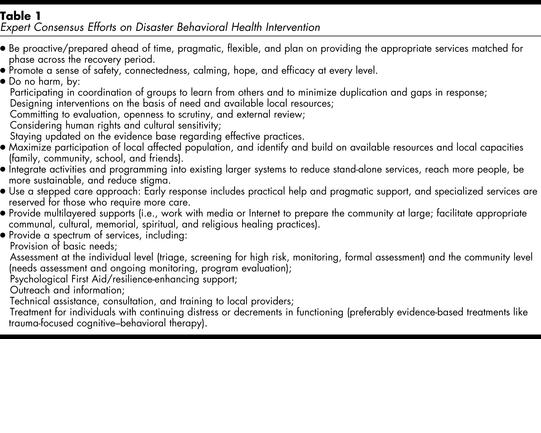
Since January I have been trying to articulate the best practices in doing trauma recovery or trauma healing work in international settings. The foundation of this approach to trauma recovery is, (a) Listen first to the needs, resources, and concerns of a community(b) identify local leaders who can be trained to be the primary trauma recovery workers (rather than outsiders being the primary clinicians), (c) tailoring interventions to the needs of  the community, and (c) above all…do no harm by over-promising, under-delivering, etc.

Today, I opened up my most recent American Psychologist (66:6, September 2011) and found my thinking confirmed in Watson, Brymer, and Bonanno’s Postdisaster Psychological Intervention since 9/11 (see citation at the bottom of the page). On page 485 they list what experts consider an appropriate steps to take in postdisaster behavioral health interventions. Now, most of you don’t probably get excited about research articles like this but I can tell you I did. Here’s the chart (click to see a larger image)

It is nice to find confirmation for something I was thinking but hadn’t read elsewhere.

From: Watson, P. J., Brymer, M. J., & Bonanno, G. A. (2011). Postdisaster psychological intervention since 9/11. American Psychologist, 66(6), 482-494. doi:10.1037/a0024806

1 Comment

Filed under Abuse, counseling science, Post-Traumatic Stress Disorder, Psychology, trauma, Uncategorized

When some help isn’t better than none


When is some help worse than none? When it creates more problems than might have been there without it. While that is easy to say, determining the line between helpful and harmful is less clear.

If your help saves a life, that seems good. If your help saves lives but creates or supports a system that destroys others, when do you decide to stop helping or to change the help you offer?

This is what Linda Polman raises and a key issue in her The Crisis Caravan: What’s Wrong with Humanitarian Aid? (2010, Metropolitan Books; first published in 2008 in Dutch by the title, De Crisiskaravaan).

Linda tells of a huge problem in the humanitarian aid industry (yes, it is one even if its primary purpose is to provide care for traumatized and displaced peoples). She puts the challenge this way in regard to providing humanitarian aid for those in warzones,

You do what you can for the victims, but soldiers exploit your efforts. They demand money for ever well yo dig and levy sky-high taxes, imposed on the spot, on all the sacks of rice and tents and medicines you arrange to have flown in. They consume a slice of your aid supplies and sell another slice. Among the items they buy with the proceeds are weapons, which they use to drive yet more people into your refugee camps or even to their deaths.

What do you do? Do you conclude that it is no longer possible to cling to the principles of the Red Cross, pack your bags, and leave to help war victims elsewhere? Or do you remain true to your convictions, believing that even if you save only one human life, some relief is better than none? (p. 1-2)

The first 2 chapters detail the problems of the international aid provided to Goma, DRC between July/August 1994 and 1996 when the Rwandan government used their soldiers to force the mass of Hutu refugees and former genocidaires back into Rwanda rather than allow the camps be locations for regrouping of the militias that would try to return to fight the new Rwandan government.

A couple of her observations

1. Not all refugees are the same. Some are truly in need. But a large number of the refugees in Goma brought a treasure trove of materials looted from their own country. Thus, they were less likely pushed there and more likely going there to reconstitute a machine against the RPF in a safe place.

2. The international community came in droves, almost seeming to try to make up for the failures in Rwanda for the past several months. But they didn’t understand that many of these folks were either perpetrators or related to them.

3. Not all of the deaths reported as due to cholera were in fact illness related. There were many that were killed for failing to be loyal enough to the Hutu extremist groups

4. NGOs have to market themselves and thus spend lots of money to get contracts to help more

5. NGOs hide the fact that many of their stuffs were taken by Hutu leaders so the NGOs would raise the number of people they were helping in order cover up that they lost a large percentage of materials/food to theft and corruption

6. Journalists are more likely to get their way paid to cover a crisis by an NGO, thus raising questions about the images they send back. Likely not going to be as objective.

Now, none of this suggests we shouldn’t provide humanitarian aid to refugees in warzones. But it does remind us that our help can also hurt others. Being wise as serpents and harmless as doves is a lot harder than we might expect.

Given our trip to the region next month, I have to remember that our good intentions are not always enough. I’m not sure how our help can hurt but if we don’t ask the questions, we won’t know either. Here are some open questions

1. Does short-term trauma recovery efforts start a healing process but fail to keep it going thus encouraging more hope than discouragement?

2. Does bringing people together to talk about trauma unintentionally trigger trauma or feelings of rage (we won’t know if some people are considered the “wrong kind of people”)?

3. How does taking pictures or filming any part influence the “data” we think we are collecting?

Leave a comment

Filed under conflicts, Congo, counseling, Post-Traumatic Stress Disorder, Rwanda, Uncategorized

Trauma Recovery Work in the DRC and Rwanda


Location map of Rwanda

Image via Wikipedia

It is official. Diane Langberg and I have our tickets for our upcoming trip to the Congo (DRC) and Rwanda where we will be interacting with trauma victims, pastors (who are also trauma victims), Bible Society and World Vision workers, and probably medical and education officials as well.

We leave on October 10 and arrive in Uganda on the 11th. We will be traveling into the DRC in the northeast quadrant (picture tiny plane!) near Bunia and also to Goma, on the shores of Lake Kivu and under the shadow of a large and active volcano. There we will be observing the work of the American Bible Society and She’s My Sister as well as meeting with rape and trauma survivors.

On the 17th, Lord willing, we’ll drive from Goma into Rwanda to Kigali. There we will be joined by colleague Carol King (Langberg & Associates therapist) and Josh Straub of the AACC and our Rwandan compatriots Josephine (WV) and Baraka (IJM) and will lead a  three-day training seminar re: trauma recovery resources and best practices. The plan is to return home via Kenyatta airport and Brussels on the 22nd.

Prepping for the trip includes everything from shots to planning who does what training segments. Those of you inclined to do so, pray for the logistics there as World Vision Rwanda puts the final touches on the location of training and invitees. A lot of work must happen for this to go smoothly. Also, there is an effort to raise funds for this (Project Tuza) at the AACC World Conference in Nashville the last week of September. Pray that attendees will catch a vision and support us as they can.

Anyone wishing to donate can here.

Leave a comment

Filed under Congo, counseling, counseling science, Post-Traumatic Stress Disorder, Rwanda, trauma, Uncategorized