Category Archives: christian psychology

Characteristics of a competent counselor?


I’ve published another blog post on the Seminary’s faculty blog site. This time, I’ve written a bit on 7 characteristics of a competent counselor. Readers here may remember there was a famous book  by Jay Adams by the title, “Competent to  Counsel”. I’m not trying to compete with that title but rather to focus on the character of the counselor. Too often we worry about the beliefs of the counselor. While beliefs, assumptions, models are very important, they are secondary to the character of the counselor. Having the right model but unable to be kind is a counseling fail. Frankly, choose the kind and humble counselor over the “right” thinking counselor if you have to make the choice between the two. The humble counselor is more likely to keep out of the way of the Spirit’s work in your life.

What are the seven characteristics I look for in my students and that I hope I exude in increasing measure? Read on here.

3 Comments

Filed under christian counseling, christian psychology, counseling, counseling science, counseling skills

Bookend sins?


Human moral frailty is never singular. Meaning, we don’t sin with just one sin. Every moral failing includes at least 3 parts: deception, action, cover-up. Think of deception and cover-up as bookends and the specific behaviors as the books in the middle. And just as it is hard to keep books on a shelf without bookends, it is hard to do what we know is wrong without deception of self and cover-ups.

What are your versions of bookends that give you “permission” to hate, to excuse, to overlook your faults?

Knocking down the bookends goes a long way to defeating outward sins like abuse as well as inward sins like festering bitterness.

1 Comment

Filed under christian counseling, christian psychology, Christianity, Uncategorized

DRC/Rwanda Trip: Day 10


October 20, 2011, Kigali, Rwanda

The second day of our conference with NGO caregivers. Today Bishop Nathan Gasatura joined us from Butare. It is always a pleasure to meet with the Bishop. We had a good lunch meeting with him where we discussed future possibilities of counseling/trauma training in his city. I learned why the national university is not in the capitol but 3 hours south in Butare. When Rwanda and Burundi were one country,

The Bishop grooves to some Gospel

the capitol was Butare and thus it made sense to have the national university there. Oh, and another reason it is good to see the Bishop is that he can really dance.

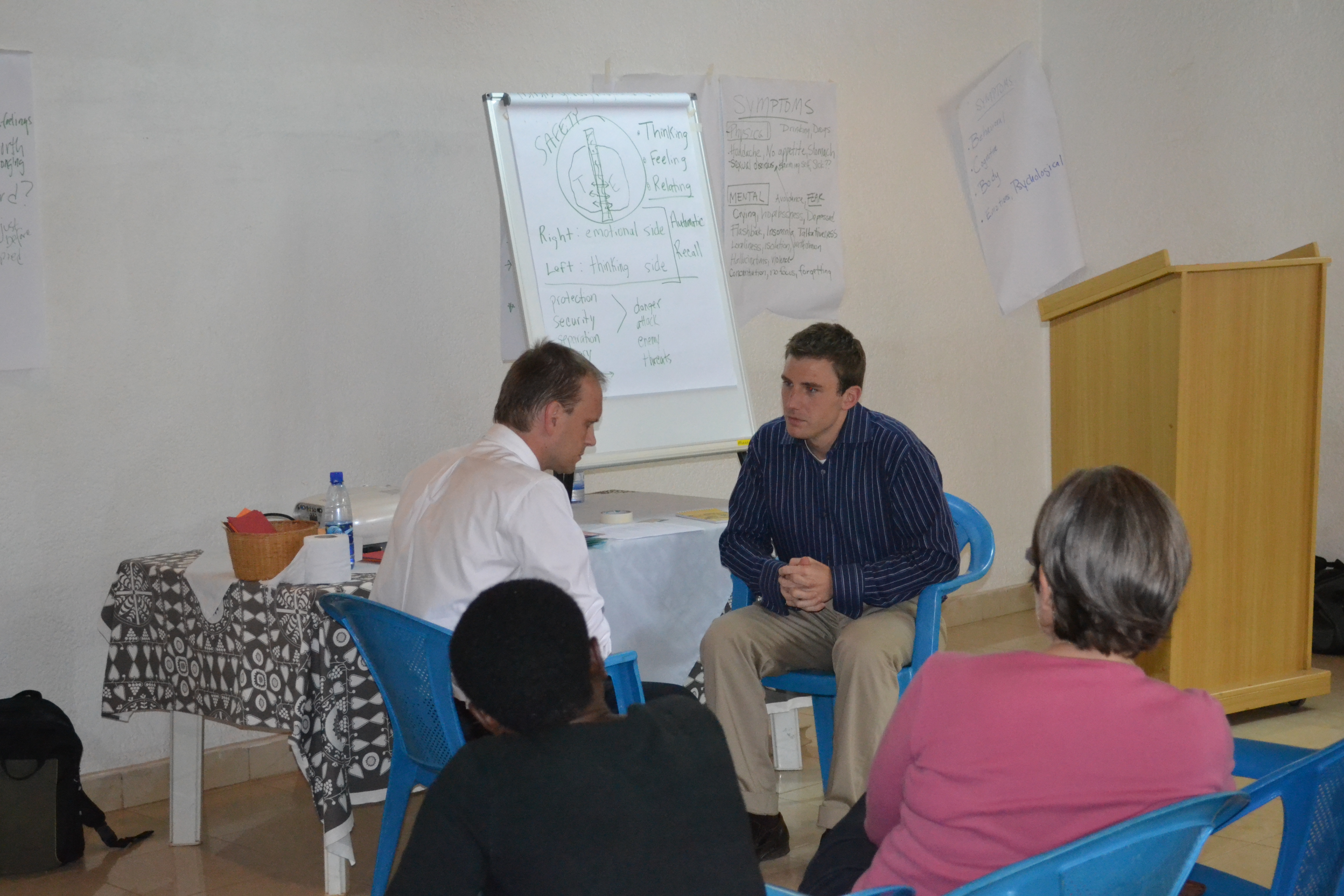
Carol King and I started this morning’s session with a short counseling vignette. I counseled Carol in order to illustrate the skills of bad listening and then good listening, stabilization, and grounding during dissociation. We then talked with them about ways to get another person’s story in bits (rather than all at once) and with their lead (rather than having the counselor pull it out of them). The role play was something that few had ever seen and we had lively discussion afterward, including why I didn’t push Carol (she played a hesitant, fearful counselee) and the issue of exploring emotion. At the end of the conference we learned our role plays were some of the most important parts of the conference.

Later, Josh presented some material on trauma, attachment, and the impact on the brain. To make this presentation practical, we did another role play where I was the counselee and Josh the counselor. We illustrated (in a rather speeded up illustration) portions of the levels of repair: telling the story, re-framing the story (in a wider truth), re-writing the story

Josh counseling Phil

, and re-connection with others. We concluded this time by having them practice counseling each other with a focus on drawing out emotions in the story. We had another great discussion about culture and emotion as well as the cultural differences between the US and Africa (counseling as listening vs. counseling as advising and solving problems).

The evening concluded with a party and hors d’oeuvres. It was an amazing celebration where many of the women wore traditional attire. We danced (I tried), sang scripture songs, heard silly riddles, and cultural stories. Then, we concluded with a ceremony of giving out the certificates. Normally, we would do this on Friday night at the conclusion of the conference but many wanted to receive their certificate in their traditional dress and we were leaving immediately after the conference ended on Friday so we determined to do this tonight. It was a time full of celebration and joy and a wonderful reminder of one antidote to trauma–communal celebration.

2 Comments

Filed under christian psychology, counseling, counseling skills, Rwanda, Uncategorized

Counseling as Global Mission of the Church


A few days ago I wrote this for our seminary’s blog regarding how counseling supports the global mission of the church. If you are interested in international counseling work…you need to read this blog and follow the link I promote.

Counseling as Global Mission of the Church.

Leave a comment

Filed under christian counseling, christian psychology, Christianity, counseling science, counseling skills, Cultural Anthropology, ethics, Uncategorized

The Mission of God to the Mentally Ill: What Role Does the Church Play?


The Mission of God to the Mentally Ill: What Role Does the Church Play?.


Check out my blog on Biblical Seminary’s new faculty blog. Addresses the most frequent search terms and comments on this blog.

2 Comments

Filed under biblical counseling, Biblical Seminary, christian counseling, christian psychology, Christianity, counseling, Psychology

Trauma Recovery Work in Africa: Itinerary


Those of you interested in trauma recovery work can feel free to pray through our upcoming trip and itinerary (as well as for our families!). Our team (Diane Langberg, Carol King, Josh Straub, Baraka Unwingeneye, Josephine Munyeli, and me) will be providing a 3 day trauma recovery training for Rwandan nationals October 19-21 funded by generous donors from the AACC and WorldVision. Diane and I are leaving early for some assessment work with the American Bible Society and national bible societies in the region.

  • Oct 10-11: DL and PM to Entebbe, Uganda to meet up with African and American Bible Society leaders
  • Oct 12: DL and PM (via MAF plane) to Bunia, DRC to meet with Bible Society workers and those receiving care
  • Oct 13: DL and PM (via MAF plane) to Beni, DRC to meet with seminary/university professionals; then on to Goma, DRC
  • Oct 14-16: DL and PM meeting with Bible Society staff, trauma victims, and trauma recovery workers in Goma, DRC
  • Oct 14: JS and CK to leave for Kigali, RW
  • Oct 17: DL and PM to drive from Goma, DRC to Kigali, RW
  • Oct 18: Meetings, prep for conference
  • Oct 19-21: Conference lead by BU, JM, DL, JS, CK, and PM for WorldVision workers, clergy, educators, and others
  • Oct 21: Leave Kigali
  • Oct 22: Arrive Philadelphia

Pray for health, safety, ability to listen well, to teach well and to be flexible. Pray for our families in just the same way.

Leave a comment

Filed under "phil monroe", AACC, christian counseling, christian psychology, Democratic Republic of Congo, Goma, Rwanda, teaching counseling, trauma

Stopping addictive behavior: What works?


I taught Sunday School at my church a few weeks ago. The topic was finding practical and specific ways of escape from the cycle of addiction. If 1 Cor. 10:13 is accurate that there is “always a way of escape” for every temptation, then it was my suggestion that we ought to become experts at finding the gifts of escape offered by God.

I began with a reprise of the cycle of addiction that is often attributed to Patrick Carnes. That cycle goes something like this:

During a period of abstinence the person has the impression they would never fall prey to “old” temptations. But then,  triggers happen. These can be positive (a success) or negative (tired, hungry, lonely, angry, etc.). Triggers can be internal or external. These usually result in some immediate automatic thoughts/desires. We begin a script such as, “I need, I gotta have, if only, I can’t take this…” If we keep up the dialog for very long we find ourselves engaging in SUDs (Seemingly Unimportant Decisions). These behaviors aren’t addictive per se but they are the things we do in an unthinking way that set up us for use. So, the bored person just wants to surf the web and…surprise, surprise…they look at porn. Or, the person who has an alcohol problem is feeling lonely and so goes for drive and…surprise, surprise…they end up at their usual liquor store. After beginning to act out, the person often feels defeated and keeps engaging in the addictive behavior because they have already broken the promise they made to themselves and others. Finally, at some point the person breaks out of the acting out and often does some form of penance. This might include promising over and over to be good next time, doing good things for God and family, or punishing self to make up for the failure.

Stopping Addictions at the Last Minute

When addicts first begin to fight their cravings, they benefit from developing a list of many things they can do to avoid giving in. I recommend that individuals create very specific lists of things to do other than acting out. Most people aren’t good at brainstorming in a crisis so a solid, long list is essential. Items on the list can range from comfort actions (talking with a friend, a cup of  tea, a hot shower, listening to music, etc.) to distracting and positive activities (praying specific prayers, walks, exercise, etc.) to altruistic actions (doing something good for someone else). These lists work best when we share them with those who support our sobriety and who help us troubleshoot when the list doesn’t work well.

A Better way? Building a Different Narrative

But, aborting addictive behavior at the last-minute is a bit like running up to a cliff and hoping to stop before going over the edge. It is good to have a plan for how to stop but it is better to interrupt the cycle before it gets very far. To invoke another analogy, it requires that we change the script if we want to have a different outcome. I like the imagery of script because I think we tend to narrate our lives. Consider these examples of how we narrate life

  • Do you have a “pre-conversation” (fantasy dialog) with someone you know will be difficult? That “conversation” is rarely neutral. You imagine what you will say, what they will say, what you will say, etc. What you imagine is less about facts and more about how you have scripted them and yourself
  • Do you ever determine the unspoken motivations of another? “I know he meant to hurt me because he always does” is narrative. It may be accurate, but it is still your creation of a script and not the same as reality.
  • Do you ever replay a shame experience? A success experience? That is you narrating your life

“So, this relates to addictions how?” you might ask. Good question. Most of us script ourselves as either in a denial story or a despair story in regards to addiction.

  • Denial stories tend to focus on external causes to our acting out. It wasn’t me, it was the devil. I wasn’t going to do that but I was so tired from dealing with my mother. I was just checking ESPN when I clicked the wrong link and got to porn.
  • Despair stories tend to focus on failure and inadequacies. I’ve already failed so I might as well just keep on with my addiction. If anyone finds out I’ll ruin my reputation. No one else struggles like this.

Build A Better Narrative

  1. Identify the subtle ways you tell your own story (look at the typical thoughts, self-invalidations, fantasies, “if onlys”, comparisons, etc.). Find out how these story lines lead you down a four lane highway to your substance of choice.
  2. Practice telling new (and truthful) pieces of your story from God’s point of view. Check out with your trusted friends if they agree with these new pieces. For example, “I feel alone but what is true but God has put these people in my life. I feel like a failure the goal isn’t for me to rise above the struggle but to reach out in the midst of it.” “I am weak but God is present with me in my weakness and isn’t waiting for me to become strong.” Remember, you have practiced old and distorted story lines for many years so don’t expect that one or two attempts will dislodge solidified beliefs.
  3. These new story lines need new goals. The former goal of not using vs. getting “high” no longer works. The former goal of avoiding pain, guilt feelings, or quelling cravings do not work. New goals need to be crafted that work for you. Find one that works for you. Some create goals that focus on the next positive thing. Others focus on goals to stay connected to others during a craving. Still others focus on goals to meditate on something wholly other than their craving.

4 Comments

Filed under addiction, christian counseling, christian psychology, counseling, Uncategorized

Christian counseling theory and the bible: A dangerous mix?


Maybe Christian counselors shouldn’t use the bible when they promote their counseling theory. Maybe they should just articulate their theory and leave the bible verses out. Sound radical? An overreaction? Guilty as charged. But…consider with me that some of our most popular Christian models may be built on rather flimsy biblical data.

Some (simplistic) background thoughts

All Christian counselors recognize that the bible plays a unique role in counseling theory. Otherwise, they would just be “counselors.” But not all use the bible in the same way. Some view the bible as the primary (even sole) guide or resource for understanding human nature and recovery from every sort of relational and/or emotional struggle. These counselors would likely cite 2 Tim 3:15-16 as evidence that Scripture is powerful and primary in our fight against sin and suffering. Others view the bible as a helpful foundation designed to remind us who God is, who we are, and a resource for comfort, encouragement, and rebuke. But, these counselors might also look to other resources as well–psychological research, physiology, medicine, sociology, etc. They would not dismiss the value of the bible but would argue that the bible doesn’t intend to be the answer guide for all the questions we might have. Thus, sources of human knowledge are important to the work of good Christian counseling. Now within this second camp, counselors vary widely as to how important either Scripture or human sources of knowledge function in their given practice. Some seem to emphasize (or neglect) one source more than the other.

The problem…

No matter where a counselor falls on the above continuum, it is far too easy to use the bible to baptize a particular viewpoint or theory. From my most recent christian counseling conference, I heard a plenary speaker say something like this (not a quote but pretty near exact):

Men need respect. It is their airhose. Women need love. It is their airhose.

Along with this statement, the speaker bolstered their points with personal stories and biblical passages indicating the women should be loved and men treated as having authority (submitted to). Here the speaker used bible passages to indicate that men are designed to operate optimally when respected and women designed to operate optimally with love.

Is this true? It could be. I certainly think that this SEEMS to be true for most men and women. But, and this is the BIG BUT…does Scripture indeed teach this. Does Paul teach us that these are our basic needs in order to function well?

Close but way off

Notice that love and respect cannot be our “airhose.” Habakkuk 3:16f would suggest that when everything has been taken away, it is possible to have joy in all things. Notice that Ephesians 5 is about what each are commanded to do…not about what each of us needs to receive. Christ is our “airhose” and nothing else. This speaker would have been better served just teaching us about observations made about what actions tend to make for better marriages than to indicate that the Scriptures teach us we have these two needs.

So, the next time you pick up a cool book by a christian counselor. Check out how they use the bible. As a support for a good theory (e.g., this verse teaches us…)? Or, as a source for understanding the problem of evil and the nature of our God who leads, guides, and saves us?

If you are interested in this topic, let me give you a couple of resources.

  • October 2011 print issue of Christianity Today covers the general misuse of the bible. It is not just counselors who do this. They list the example of a book with anti-aging techniques supposedly gleaned from the bible.
  • 2 chapters in Care for the Soul:Exploring the Intersection of Psychology & Theology (IVP, 2001). Chapters 12 and 13 both cover the issue of hermeneutics. Richard Schultz addresses how counselors misuse wisdom literature and chapter 13 (myself and my colleague Bryan Maier) give more general recommendations for good hermeneutic work.

12 Comments

Filed under biblical counseling, Biblical Reflection, christian counseling, christian psychology, Christianity, counseling science, counseling skills

Off to Nashville!


This marks the 6th trip to the Opryland Hotel for AACC’s World Conference. It is quite the spectacle. I love meeting up with old and new friends. I love the opportunities to teach and learn. I don’t love the Opryland. It is behemoth (though good for exercise) and feels fake after a day or two in the climate controlled indoor bubble. Nice greenery and all but still a bit stifling for my taste.

This year I will be present at the following

  1. 9/27
    1. Speaking to Salvation Army Officers on ministry challenges and spiritual renewal (slides on slides page)
    2. Speaking to golfers at the Project Tuza Golf fund-raiser and dinner about Rwanda and the work we will do there in a few weeks.
  2. 9/28
    1. Presenting with Diane Langberg on Complex Trauma (3 hour pre-conference seminar)
    2. Meeting with the American Bible Society, AACC, and others about supporting global trauma recovery
    3. Meeting with those going to Rwanda to make final plans on our 3 day training of World Vision workers
  3. 9/29 Conference opens!
    1. Attending as many plenary and breakouts as possible
    2. Representing Christian Psychology to counseling students at “Awakenings” event
    3. Pizza with Langberg & Associates staff who will be there!
  4. 9/30
    1. Presenting a 1 hour breakout with Carol King on international trauma recovery (slides on slides page)
  5. 10/1
    1. Making a pitch from the main stage to all attendees during the “ask” for support for Project Tuza.

I think I will be plenty busy. This doesn’t count all the interactions with friends and colleagues I often have. So, I look forward to it and look forward to it being over and returning home to family. Feel free to pray for their stamina as well!

2 Comments

Filed under AACC, christian counseling, christian psychology, Christianity, counseling, counseling skills

Sneak preview: Healing Trauma in International Settings (AACC seminar)


Cascade Atrium, Gaylord Opryland Resort & Conv...

Image via Wikipedia

Just completed preparing my breakout seminar for this year’s AACC World Conference at the beautiful but outlandishly expansive Opryland Hotel in Nashville (Sept 28-Oct 2). This time around I presenting with my colleague Carol King on “Healing Trauma in International Settings: Best Practices.” Carol has had some experience in Rwanda and Goma, DRC and will be with our group in October when we do trauma recovery training in Kigali. Come back to the blog on the 30th and you can see and download the slideshow we will do.

What will we be talking about? 3 main points:

  • Listen…don’t assume you already know trauma or treatment practices
  • Train…don’t do the interventions yourself (train local leaders)
  • Utilize…don’t reinvent the wheel (use existing models)

Now obviously we will be fleshing those points out. Our goal is to help prepare interested counselors to develop short and long-range intervention strategies that utilize the cultural and human resources of the people they will serve. The only way to do this well is to have a listening and collaborative/support role approach. To that end I will talk about hoe to build an effective area case map.  We end by reviewing a few models for trauma recovery (both Christian and secular).

Check back on the 30th for the full set of slides.

Leave a comment

Filed under AACC, Abuse, christian counseling, christian psychology, Christianity, counseling, counseling science, counseling skills, Post-Traumatic Stress Disorder