Financial questions about becoming a Christian psychologist


Recently, I received a  blog comment to an post I wrote a year ago about the decision process for those thinking about pursuing doctoral programs in psychology. You can read that old post here. In response, Emily asked,

I’m really wondering what you’re thoughts are on places like Rosemead and Fuller. They appear to be wonderful institutions but I have heard that students come out with $100,000+ worth of debt. Is that really worth it, or would it be just as well to get two separate degrees – one in psychology and one in theology. Doing my own research, I’ve discovered that to get a PsyD at Rosemead would cost me over $200,000 for 5 years. That includes tuition, miscellaneous fees, books, and the cost of housing in SoCal. I just can’t decide whether it’s worth it or not and I would love to know the thoughts of a Christian Psychologist on this.

Emily’s question is very important. Much of the time, we answer questions about doctoral training by discussing career goals, philosophy of education, and theological training. However, it is a huge oversight to ignore the high cost of a doctorate in clinical psychology. So, I want to respond to the issue of economics by raising a few questions for the person considering doctoral education.

What is your desired career outcome? Is it necessary to have a doctorate?

Wait, this doesn’t sound like an economics question, right? Well, if you are thinking about taking on a sizable debt then you ought to consider whether or not you absolutely need to do it. If you want to be a professor in a University, then you’d better be looking for a PhD (probably over a PsyD which tends to cost more). If you want to counsel people, you might not need a PhD or PsyD. You might be fine with a Masters’ degree and really good supervision by a doctoral level psychologist. If you really want the extra years of training and the possiblity of supervising others, then maybe the doctorate is right for you. If you don’t know if you need a doctorate for what you want to do, then find out first before you take on the debt load.

Can I find a cheaper PhD/PsyD program?

Some of the Christian programs tend to be longer and therefore more costly. The reason is that these programs believe (rightly so) that theological training is essential. While I am a proponent of an integrated (theological and psychological training), you may be able to find cheaper theological training and mentoring in another format while completing a secular (and shorter) degree program in clinical psychology. It is possible that a seminary degree or certificate in theological or biblical studies will provide you want you need. Or, you may be able to befriend a well-trained pastor or counselor who will mentor you for free or for a meal and and coffee. The question you need to evaluate is whether you want theological competency or a degree to show up on your vita? Do you need to get the official “blessing” of a degree to get a job?  Are you prepared to complete a secular based psychology degree and confident that your value system will remain intact? If not, you could undertake some graduate training in theology first and then complete your doctoral training elsewhere.

What is the likelihood you can pay off your school debt quickly?

Will you be able to secure a job that pays well enough to pay off your debt, pay your living expenses and/or purchase a house at the same time? Are you wanting to be a missionary psychologist with a 200K debt? Do you know what the going salary is for individuals working in the field you want to enter? You should check out www.apa.org for some very helpful data (search their site for “salary” and check out the information) such as this link or this one on the current debt load and salaries of the field.  Some psychology grads have been able to land jobs that enable them to pay off federal loans in an abbreviated fashion in return for their years of service in an underserved population.

One way that students reduce their debt is by (a) marrying someone rich (just kidding…though I was married to someone able to command a great salary), (b) working full-time while going to school full-time, (c) reducing expenses by living in a communal setting, or (d) getting work study for tuition reduction. Options A and D may be limited. Option B is possible but may drive you insane as you do it.

Finally, do you have family/friends who want to give to your educational needs?

I know of a student who held a dinner for important friends/family/church members in the church basement. After the meal, he made a presentation to all about his educational dreams and desire for training. He asked them to give…and they did. I imagine there might be some creative ways for people to give and get a tax credit for it. If what you want to do is important and will fill a void…someone might be willing to help fund you. Friends? Family? Church? Employer?

I was blessed by being able to get through a 5 year (4 years of coursework and 1 year postdoc year) program with no debt at all. We lived very frugally. My wife had a great job. We received some inheritance. I worked a couple of different part-time jobs. Somehow, we survived for a year of postdoc life with a newborn (adopted even! Thank goodness for adoption tax credits) on about 11,000 dollars of salary. The Lord provided. The degree was absolutely essential for what I wanted to do.

If you are thinking about this kind of major decision. Pray. Ask for those you trust to offer their advice and to pray with you for an open door.

6 Comments

Filed under christian counseling, christian psychology, Christianity, counseling, counseling skills, Psychology, Uncategorized

Parent Coordination for divorcing parents: Guidelines published by APA


In the January issue of the American Psychologist¹, the APA published practice guidelines for the role of parent coordinator. Didn’t know of that job? Neither did I…at least by this name.

What is parent coordination?

Per APA, “parent coordination is a nonadversarial dispute resolution process that is court ordered or agreed on by divorced and separated parents who have an ongoing pattern of hight conflict and/or litigation about their children…” (p. 64) The focus is on the best interests of the children. The essay suggests that the process is not typically confidential since the coordinator may need to interact with judges and other allied health advocates.

What is the focus of these guidelines?

In lay terms:

Guideline 1: keep your roles clear. Example: don’t offer therapy and coordination to the same people.

Guideline 2: Coordinators understand the key issues that will be at stake (e.g., impact of separation on children, abuse symptoms, etc.)

Guideline 3: Don’t be a coordinator unless you have competency (aware of biases, understand the problem of siding with one parent) and supervision

Guideline 4: Child safety is the primary focus

There were 4 more guidelines (be culturally aware, keep good records, follow good case management and billing practices, develop good professional relationships) but the first four are most focused on the clinical practice of parent coordination.

While these guidelines are basic, it is a good warning to many therapists who try to play a neutral role in managing estranged parent conflicts even while providing therapy to one or the other. This dual role rarely works well. But, counselors ought to consider this role for couples wishing to parent their children well even as they have divorced or are separated and considering divorce. No matter your views on divorce, it can only be helpful to children if their parents argue less about how to parent their children.

¹APA (2012). Guidelines for the practice of parenting coordination. American Psychologist, 67, 63-71.

Leave a comment

Filed under counseling, divorce, parenting, Psychology

How to make almost nothing seem like something


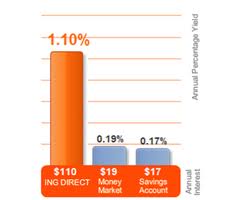
Yesterday, I got an advertisement in the mail from ING Direct Orange Savings Accounts. If you click the link you will see their lovely advertisement on just how much more money you can earn if you put your money with them than if you just drop it into your local bank or money market account.

The chart says it all (chart from right is from a previous period when interest rates were actually even higher than today). You can make so much more money with them. The orange bar is so much bigger than the other bars. But then read the fine print. Go with ING and you will earn $80 a year for every $10,000 you invest. 80? Sure, that is better than $10 you get at your bank for the same ten grand. But, will it really matter?

So, how do you make almost nothing seem like something? Build a great visual even if the differences are minimal.

1 Comment

Filed under Psychology

Ministry to Sex Offenders? post on www.biblical.edu blog site


I have another post on our Seminary’s faculty blog site today. You can read it here. In it I give a few very initial steps a church might take when considering starting a ministry to sex offenders.

Such a ministry is good, sorely needed, but should not be taken without concern for the entire church, including victims of abuse. as well as the family members of the offender. Any ministry we undertake should put spiritual protection–the very soul of our ministry targets–as a primary objective. Thus, helping an offender to limit access to vulnerable peoples would be seen as part of their spiritual care. As I have said on this site before, the grace of limits is a very good thing. When I accept boundaries, I am accepting God’s grace.

2 Comments

Filed under christian counseling, christian psychology, Christianity, church and culture, counseling, pastors and pastoring

What is an apology? Guest post at www.biblical.edu


I am a contributor to my seminary’s faculty blog and today one of my posts on apologies is up at www.biblical.edu. You can read it here.

Apologies are pretty simple things: ownership of responsibility without defense and willingness to make things right. Sadly, we have a hard time carrying out such a simple transaction because we invest in self-protection more than loving others.

For you, what do you most look for in an apology?

3 Comments

Filed under christian counseling, Christianity, conflicts

King to psychologists: Some maladjustment is necessary!


Dr. Martin Luther King at a press conference.

Image via Wikipedia

Recently, someone forwarded to me an email from Ken Pope (see his fabulous and informative website: www.kenpope.com) containing excerpts of Martin Luther King’s address to psychologists in September 1967. I pass on excerpts for your enrichment and encourage you to read the entire address available for download here.

Here’s King on the necessity of being maladjusted to some things:

On creative maladjustment

There are certain technical words in every academic discipline which soon become stereotypes and even clichés. Every academic discipline has its technical nomenclature. You who are in the field of psychology have given us a great word. It is the word maladjusted. This word is probably used more than any other word in psychology. It is a good word; certainly it is good that in dealing with what the word implies you are declaring that destructive maladjustment should be destroyed. You are saying that all must seek the well-adjusted life in order to avoid neurotic and schizophrenic personalities.

But on the other hand, I am sure that we will recognize that there are some things in our society, some things in our world, to which we should never be adjusted. There are some things concerning which we must always be maladjusted if we are to be people of good will. We must never adjust ourselves to racial discrimination and racial segregation. We must never adjust ourselves to religious bigotry. We must never adjust ourselves to economic conditions that take necessities from the many to give luxuries to the few. We must never adjust ourselves to the madness of militarism, and the self-defeating effects of physical violence.
Thus, it may well be that our world is in dire need of a new organization, The International Association for the Advancement of Creative Maladjustment. Men and women should be as maladjusted as the prophet Amos, who in the midst of the injustices of his day, could cry out in words that echo across the centuries, ‘Let justice roll down like waters and righteousness like a mighty stream’; or as maladjusted as Abraham Lincoln, who in the midst of his vacillations finally came to see that this nation could not survive half slave and half free; or as maladjusted as Thomas Jefferson, who in the midst of an age amazingly adjusted to slavery, could scratch across the pages of history, words lifted to cosmic proportions, ‘We hold these truths to be self evident, that all men are created equal. That they are endowed by their creator with certain inalienable rights. And that among these are life, liberty, and the pursuit of happiness.’ And through such creative maladjustment, we may be able to emerge from the bleak and desolate midnight of man’s inhumanity to man, into the bright and glittering daybreak of freedom and justice. (emphases mine)

Leave a comment

Filed under counseling, Great Quotes, Psychology, Race

The trick to tolerating that which you cannot change?


Some things can’t be changed. You just have to endure them. There are “little” endurances such as waiting for a line in the grocery store, a dentist to finish drilling your tooth, for a boring speech to end. Then there are much larger endurances to suffer through like living in unabating poverty or under a dictator.

Some of us are better at enduring things than are others. Ever wonder what their tricks they have?

In a word–some variant of dissociation.

If the unpleasantness is likely to be short we may choose to fantasize about a lovely place we’d rather be. We may focus our senses on some other stimuli (temperature, light, color, smell, etc.) in an effort to “quiet” the urge to run. If the unpleasantness is much longer and if we have little sense that we can bring about a change in our situation, then we may lose connection with our current surroundings and our self. While this adaptive feature allows us to survive unimaginable pain, a habituated dissociation will take on a life of its own and begin to change our sense of self and our sense of the world.

In short, we lose faith. We may even stop trying to change what can be changed.

I find this quote by Richard Grant (“Crazy River: Exploration and Folly in East Africa”) about his experience in an overcrowded bus in Tanzania most instructive of the need to dissociate and the long-term impact,

After ten minutes, my right foot was numb and throbbing, and I wanted desperately to shift its position, just by an inch or two, but an inch or two was impossible in the squeeze of other feet and bags, and there were people sittings on the bags, and others standing hunched over at right angles under the roof….The danger and discomfort endured by the passengers was of absolutely no concern to the driver and the assistant, and the passengers endured it with a calm, patient, well-mannered grace. This was normal, everyday life, and the only kind of bus journey they knew. There was an hour to go. I tried to will myself into a blank, passive, indifferent, fatalistic state of mind, which I had come to understand as a basic survival mechanism for the poorest people in this world, although not necessarily helpful for their future. (p. 45-6, emphasis mine)


3 Comments

Filed under Abuse, christian psychology, counseling, counseling science

How to evaluate a counseling model or intervention: Step four


Picking up on this series that was started last week, we come to the next-to-last step. Thus far I have suggested that whenever you are exploring the next best thing in counseling, you should

  • start with a healthy dose of suspicion about the motives and goals of the author. What are they trying to sell you?
  • Read with an open mind. Can you see what they observe about life?
  • Evaluate the author’s assumptions, worldview, etc. Be willing to be challenged!

Now we come to step four.

Step Four: Let yourself be critiqued

How might their observations and assumptions challenge your own? Sit with this a bit. Don’t worry that you will lose your faith. It never hurts to have our beliefs and values refined and challenged by our critics. Maybe some of your values are uncritically formed. How might these assumptions cause you to refine and renew your own? Can you eliminate some faulty logic?

Be willing to state some of the weaknesses within your own system of beliefs and assumptions. I wish every model builder would start with their own flaws. But, most of us are better at pointing out the speck in our brother’s eye than addressing the log in our own.

Finally, our next step will be to possibly adopt some portion of the model or intervention into our own repertoire.

Leave a comment

Filed under biblical counseling, christian counseling, christian psychology, Christianity, counseling, counseling science, counseling skills, Psychology

Health effects of traumatic stress on infants


In Rwanda we hear that children born after the genocide exhibit signs of trauma–even though they did not experience it firsthand. You could hypothesize a number of reasons for this:

  • Hearing of the stories of lost loved ones; being told that their neighbors were killers
  • Having peers in school stigmatize: “You are Hutu, you are a killer. You are Tutsi, you are a cockroach.”
  • Seeing pictures of genocide

Notice that all three have to do with the child’s internalization of trauma through their environment.

But what if their trauma began in utero and biologically altered their capacity to handle stress? Consider these words by Maggie Schauer (available to be seen in context here),

Exposure to significant stressors during sensitive developmental periods causes the brain to develop along a stress-responsive pathway. The brain and mind become organized in a way to facilitate survival in a world of deprivation and danger, enhancing an individual’s capacity to rapidly and dramatically shift into an intense, angry, aggressive, fearful, or avoiding state when threatened. This pathway is costly and non-adaptive in peaceful environments. Babies born with a deformed stress-regulating system (HPA-a) experience higher and faster arousal peaks, longer intervals of crying and irritability, and impaired affect regulation (Sondergaard et al., 2003). (p. 398, emphasis mine)¹

How might this information help us better understand how “the sins of the fathers” (or whoever is the abusive individuals or communities) extend beyond primary victims to those victim’s children? How might this help us train survivors to understand what might be happening in their children and support parenting strategies that will encourage healing. Might it also help survivors to feel less guilty for the struggles of their children? Survivors don’t ask to be abused and can’t help the impact on their children while in utero.

Now, not every child with a “deformed stress regulating system” is that way due to the mother’s stress. We just don’t know why one child has a good stress regulation system and why another does not. But we can say that those whose stress regulation seems broken (or different) likely need different parenting strategies and a different paradigm in understanding volition (will) when it comes to their outbursts.

 ¹ Schauer, M., & Schauer, E. (2010). Trauma-focused public mental-health interventions: A paradigm shift in humanitarian assistance and aid work. In E. Martz (ed.) Trauma Rehabilitation after War and Conflict (pp. 389-428). Springer

Leave a comment

Filed under counseling, counseling science, Psychology, Uncategorized

Read this: What’s wrong with giving a girl a push-up bra?


Friend and fellow counselor David Wiedis just sent me this Dailing News column link about his wife’s new self-published book. Having seen a mock-up of it, I can’t recommend it enough. It is clever, beautifully illustrated…and nails it on the slippery slope of playing to our sexualized culture when it comes to clothing for girls.  It will certainly make you think! Miho is also an acclaimed performance artist and does a show called, “Clean Sheets.” You can read about her work here.

Leave a comment

Filed under Christianity, church and culture, cultural apologetics