[Previously published April 2015 at http://www.biblical.edu. The faculty blog no longer exists there thus re-posting here]
We live in a world shaped by violence and trauma. This week that I write 147 Christian Kenyan university students were killed because of their faith. Such horrific forms of violence shock us. But they shouldn’t given that in our own country violence and trauma are everyday occurrences. While some of our local brothers and sisters face actual death, all of our communities are shaped by soul-crushing abuse and family violence. Take the most conservative numbers we have—1:6 males and 1:4 females have experienced sexual assault before age 18—and realize that a large portion of your friends and acquaintances have traumatic experiences.
In a congregation of 100, 20 of your fellow church members are walking around with invisible wounds of sexual violence on their bodies and souls. And that number says nothing about those walking around with other invisible wounds, such as caused by domestic violence, racial prejudice, sexism, bullying and the like. Were we to include these forms of interpersonal violence the number would likely reach 70!
As my friend Boz Tchividjian asks, what would the sermons and conversations look like if 20 of our mythical congregation of 100 had just lost a house in a fire or a child to premature death? Wouldn’t we be working to build a better understanding of God’s activity in the midst of brokenness rather than passing over pain as a mere hiccup of normal life?
Yet, we continue to imagine trauma as some sort of abnormal state.
Ruard Ganzevoort[1] tells us that, “When one looks at issues like these, we must conclude that our western societies are to no less degree defined by violence and trauma, even if everyday life is in many ways much more comfortable” (p. 13). Thus, Ganzevoort continues, we must “take trauma and violence not as the strange exceptions to an otherwise ‘nice’ world” (ibid, emphasis mine). He concludes that while we have a strong theology for sinners, we have a less articulated theology for victims.
What if we were to read the Bible in such a way to build a theology of trauma for victims? What would it look like? I would suggest that Diane Langberg’s maxim sets the stage quite nicely: the cross is where trauma and God meet. Jesus cries out due to the pain of abandonment by the Father. Since we do have a high priest who understands our trauma (Hebrews 4:15), we can read the entire canon from the frame of trauma—from the trauma of the first sin and death to the trauma of the cross to the trauma just prior to the coming new heavens and earth.
Key Themes in a Theology of Trauma
Reading the Bible through the lens of trauma highlights a few key themes beyond the foundation of a God who Himself knows trauma firsthand in the unjust torture and death of Jesus:
Anguish is the norm and leads most frequently to questions
When more than 40% of the Psalms are laments (and that doesn’t count the primary themes of the prophets!) we must recognize that anguish is most appropriate forms of communication to God and with each other. But we are not alone in the feelings of anguish. God expresses it as well. Notice God expresses his anguish over the idolatry of Israel (Eze 6:9) and Jesus expresses his when lamenting over Israel (Luke 13:34) and cries out in questions when abandoned by the Father (by quoting—fulfilling—Psalm 22).
Despised and rejected, a man of sorrows, acquainted with grief.
Peace happens…in context of chaos
Psalm 23 comes to the lips of many during times of trouble as it expresses peace and rest during times of intense trouble. Shadows of death yet comfort; enemies around yet feasts. Peace happens but rarely outside of chaos and distress. Consider Jeremiah 29:11, frequently quoted to those going through hardship to remind them that God has a plan. He does have one, but recall that the plan was to live in exile among those who see the Israelites as foreigners and second-class citizens!
The kingdom of God in the present does not promise protection of bodies
Try reading Psalm 121 aloud among those who have survived genocide or been raped repeatedly by soldiers. “The Lord will keep you from all harm.” Really? You lost 70 family members? You cannot maintain your bladder continence due to traumatic injury to your bladder? Where was your protection? Our theology of God’s care must take into consideration that He does not eliminate disaster on those he loves. Recall again the trauma wrought on those God chose to be his remnant. They were the ones ripped from families and enslaved by the Babylonians.
God and his people are in the business of trauma prevention, justice, and mercy responses
The kingdom of God is not for those who have pure beliefs. The kingdom of God is for the poor in Spirit, the persecuted, those who provide mercy and those who hunger for justice (Matthew 5). True or pure religion is practiced by those who care for the most vulnerable among us (James 1:27). Jesus himself is the fulfillment of healing as he claims Isaiah 61 as fulfilled in his personhood and mission (Luke 4:18-21). We his people are the hands and feet to carry out that binding up and release from oppression.
Recovery and renewal during and after trauma likely will not eliminate the consequences of violence until the final return of Jesus Christ
Despite our call to heal the broken and free those enslaved, we are given no promise that the consequences of violence are fully removed until the final judgment. Rarely do we expect lost limbs to grow back or traumatic brain injuries to be erased upon recovery from an accident. Yet sometimes we assume that traumatic reactions such as startle responses, flashbacks, or overwhelming panic should evaporate if the person has recovered. A robust theology of trauma recognizes we have no promise of recovery in this life. What we do have is theology of presence. God is with us and will strengthen us guiding us to serve him and participate in his mission to glory.
There is much more to say about a theology of trauma for victims. We can discuss things like theodicy, forgiveness, restorative justice, and reconciliation. But for now, let us be patient with those who are hurting as they represent the norm and not the exception. And may we build a missional theology of trauma, not only for victims, but also for all.
[1] Ganzeboort, R. Ruard (2008). Teaching that Matters: A Course on Trauma and Theology. Journal of Adult Theological Education, 5:1, 8-19.



 e of Christian circles. Bryan describes some of these approaches to forgiveness (do it because it is good for your health, do it to restore relationships, do it following a prescribed set of steps, etc.) and lays out a clearer definition of forgiveness and related concepts (justice, empathy, grace, repentance, and more). Without being overly methodical, Bryan examines the processes needed to move to active, other-centered forgiveness. However, along the way he spends a good deal of time talking about things such as the imprecatory Psalms (asking God for justice)–something not often found in literature encouraging us to forgive.
 courses at BTS. I’m really excited about Heather Drew’s course that explores therapeutic activities beyond talking about our struggles. Do check that out! Today, I’m posting about an upcoming trauma healing facilitator training (initial and advanced equipping) being held here in Philadelphia May 1-4, 2017. More on that in a minute.
 Mentoring with the American Bible Society’s Mission: Trauma Healing. I have been partnering with the Bible Society since 2010 as the Co-Chair of the Advisory Council for ABS trauma healing programs. In this new venture I hope to have a closer role in supporting best practices in their train-the-trainer model of addressing trauma around the world.
 the
the 


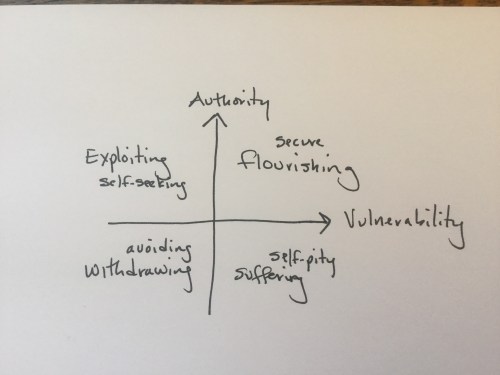 of power must be present at the same time if leadership is to be biblical or redemptive. In this model, leadership without vulnerability leads to exploitation. Leadership without authority or vulnerability leads to withdrawal. Leadership that avoids authority but remains vulnerable will lead to paralysis and self-pity. True leadership that reflects Christ’s authority and vulnerability looks like one who willingly goes to the cross.