Category Archives: Psychology

Your handy psychological fact…might be false: Why we believe what we believe and what it says about us


Ever heard of Stockholm Syndrome? The psychological phenomenon where hostages begin to identify with and feel positive feelings towards their captors, maybe even to the point in helping them escape? For many this is accepted, even if rare, fact. It supposedly why kidnapping victims don’t try to run away when they have the chance or why domestic abuse victims stay with their abusers.

But, what if the concept behind Stockholm Syndrome is only based on assumptions, rumors, falsehoods, and repeated unscientific “trainings” offered around the world by experts. THIS is the case. I highly recommend you listen to this December 2024 episode of Radiolab. It just might blow your mind. Even if you have no interest in the history of Stockholm Syndrome, the applications to how we treat victims and how we simplify psychological explanations can do harm to others.

The problem of face validity

As you listen to this episode you will hear how the name for the syndrome was created without

  • Interview or study of the hostages
  • Verifying the “facts” that were frequently repeated as undisputably true (e.g., that the hostage wanted to marry the kidnapper when he got out of prison)
  • Replication studies

Why the wholesale acceptance at the public and even governmental level? Because it seemed to explain the behaviors of hostages. It made sense. This is what we call face validity. Makes sense…and is a false understanding. To quote HL Mencken, “Explanations exist; they have existed for all time; there is always a well-known solution to every human problem—neat, plausible, and wrong.”[1] 

The problem is, we (the public) don’t know that they are wrong and so we promulgate simple yet wrong answers. Listen to the above episode and you will hear recordings of the police trainer who trained thousands of officers and departments on how to handle hostages who likely will develop the syndrome. Listen to how confident he speaks. So, we believe him, because how could we know any better?

But this confidence puts the focus on the wrong place and causes society to pathologize the wrong person.

This reminds me of the era of the late 80s and 90s where so many experts appeared talking about the reality of Satanic Ritual Abuse. Turns out many of these experts where self-proclaimed. But, the problem seemed real enough to be possible, so some accepted SRA as valid because it seemed to fit a probable reality. Sadly, this social angst created victims—not just those convinced to make false allegations but those whose lives were destroyed by those allegations.

While we could write about WHY some people present themselves as being experts when their theories and interventions are not really supported with empirical evidence, I want to consider why WE are prone to believe them. We believe them because we need simple answers to allay our own fears as to whether we are okay.  

Heuristics make life easier…and are close enough, until they are not

Heuristics are a method by which we ignore complex information that might overwhelm us in order to come to a reasonable and timely decision. For example, you look up 3 websites to discover the best diet to try and you decide to try the last one (recency effect) to avoid information overload. Or, you listen to an expert talk about a subject and you generally believe them because they are talking about some recent research.

Let’s talk about a common heuristic that probably you have used that makes sense and seems to explain things about personality—Myers-Brigs Type Indicator (MBTI). Surely you have taken this test and found you fit one of 16 variations of 4 letters. The assessment tool tells you which side of the 4 categories you fall. You can easily summarize your personality by saying you are an ENFP or INTJ or the like. This makes it easier for others to understand what you are like and might even explain why you approach the world the way you do.

Simple, right? But the MBTI lacks adequate reliability (getting the same answer every time) and validity. What It does do is communicate some things well, hence why we use it. But it lacks significant empirical backing and should not be used as a tool describing personality. Why do we accept it? Because it is easy. And we don’t mind so much that it is actually rather weak in describing personality variants.

No one is really being harmed with being labeled as INTP. But what if a heuristic points us in the wrong direction and creates additional harm to a victim?

Why the Stockholm Syndrome heuristic sends us down the wrong path

Back to the Radiolab episode. Listen to Grace Stuart talk about why she stayed with an abusive partner.

Grace: …people don’t realize how much of domestic abuse is about confusion….confusion about what was even happening….What if I overreacted and made something out of nothing…

Sarah (interviewer): Whether to judge her ex by his good days or his bad days.

Grace: Is he the good guy or is he the bad guy? Is he kind or is he cruel? … Am I the perpetrator? Am I the narcissist?… Let me just change this one thing about myself.

Grace was looking to make sense of what was happening. To ask the why question. And she wasn’t asking so much about her abusive partner but about herself. What is wrong with me?

This is where the Stockholm syndrome answer takes us. What is wrong with the hostage or the partner who seems to be tied to the abuser? It has the focus on the wrong person. In the interview between Grace and Sarah, Grace’s voice fades out when she is about to answer what helped her change her point of inquiry. As the sound fades in the interview she mentions a book that helped her, “Why Does He Do That? By Lundy Bancroft. This book has helped many women better frame the questions from the why about themselves to the why and the what about their abuser.

You see, we are focused on the wrong person when we try to answer the question about why someone might stay in a bad situation. What if we changed our question to, “what do abusers do to keep people trapped.”

All explanations will fail. All theories will fail. So now what? Ask more questions

Nearer to the end of the episode, another story about a young man who was in the “Sarah Lawrence” cult. Daniel states that after he was able to get out of the cult, it took him 6 years to be able to process what happened to him. He says that he had to come to terms that he would never have a satisfactory answer to the “why” question. And that he had to come to terms with the factors in why he stayed were complex and the tools he had to make decisions at that time were limited.

What is his solution? Keep asking curious questions about human behavior. “Be suspicious of any concept which doesn’t invite further curiosity.” “If it is a thought terminating answer…anything that ends our curiosity is bad.” So, he invites people to ask, “what helped you leave?” rather than “why didn’t you leave?”

Concluding thought

If you have read this far and listened to the podcast (if not, I remind you to not miss it!), take a moment to consider what easy explanations you might be using about yourself or others. Can you allow yourself to accept the answer, “Its complicated” to the why question. Now, try to move on to some different questions.

  • What can I do to make the moment better?
  • Who might I be able to enlist to help me understand my options?

And when someone offers you a simple (simplistic) solution (e.g., “just breathe” or “just leave” or “just eat better”), smile and look for those who can sit with complicated things and help you decide the next one move to make.  


[1] Prejudices, Second Series, p. 158.

1 Comment

Filed under Post-Traumatic Stress Disorder, Psychology

Did you forgive? Recovering faith from toxic theology, ep 2


Forgiveness is often misunderstood and misrepresented as a recipe to stop hurting after a betrayal. In this 2 minute podcast, I define forgiveness and bitterness since so often when we want to talk about our pain someone asks us if we are embittered and if we have forgiven the one who wounded us.

Thanks to those who gave me ideas about lengthening the podcast. I’m considering that but will trial out a few more of these shorter episodes first.

2 Comments

Filed under "phil monroe", Forgiveness, mental health, Psychology

Am I doing this trauma healing thing right? Part 2, Myths about healing that hinder recovery


In my previous post, I explored how chronic trauma responses lead many of us to think we are doing something wrong and are the reason why we are not getting better fast enough. We named some foundational principles for recovery, landmarks by which to navigate the journey of healing.

  1. Take care of your body.
  2. Look for stability in a triggering world.
  3. Begin (again and again) to tell the story of you.

These three steps are seemingly simple and yet they take every fiber of our being and the help from friends to keep fighting for healing day after day.

Unfortunately, there are some beliefs about healing—myths—that can hinder our recovery journey. As you read my shortlist of 4 misguided views about suffering and healing, consider what beliefs and ideas you have had about healing (or heard from others) that might create an extra barrier in your own journey.

Myth: Complete healing is possible and likely

There is a myth that healing from trauma means that I will no longer be bothered by things that used to trigger me. Healing means, in this belief, that memories will not be painful or show up at surprising times. If I continue to have triggers, these reactions are signs of failure to heal, to trust, to have faith in God.

Sadly, I see many who have found considerable healing after trauma to believe this because they have surprising triggers that knock them off their feet from time to time.

Consider this analogy, Your body has changed as much as if you were hit by a car. If you had been an elite athlete prior to the accident, you might need to accept you could no longer be an athlete as a result. It would not be a sign that you had failed to heal but that in healing, life is now different. When we believe that something is wrong with us since we bear scars (e.g., trauma triggers, bodies that are on higher alert, limitations to what we can now do) we add to our pain by accusing ourselves of not healing.

It doesn’t help when we see others who seem to have found more healing. Stories of “heroes” like Corrie Ten Boom or Malala Yousafzai seem to tell us that some people are truly healed. And since we know we are not, there must be something wrong with us. Truth? While post-traumatic growth is a real thing, there is ample evidence that these heroes still suffer with their invisible wounds. Growth does not eliminate injury.   

Myth: Healing should mean no longer in grief

Grief and growth will co-mingle, and one does not eliminate the other. Loss is loss. When we experience trauma, we also suffer loss. And loss means grief. These losses include safety, predictability, identity, voice, as well as other more physical and spiritual losses. We may lose family members, community, and capacities we once had (recall the elite athlete image above).

We don’t imagine that if you lost a close loved one that you should no longer feel something when reminders of their loss are present. Grief shows up like waves at the ocean. They may be big and knock us down. They may be small and less obvious to us. No matter the size, they are always present. And something will likely trigger a larger wave when we least expect it.

Myth: My faith should be able to be what it was

The story of you has changed as a result of trauma. It impacts every part of your story, including your faith and spiritual experiences. By every definition, you are now different because your story includes something that is difficult, if not impossible, to integrate into the way life was or is supposed to be.

Consider the Psalmist in the Bible. Psalm 42 and 43 tell us this fact in poetic form. The writer struggles to make sense of the loss of his capacity to lead the worship procession. He remembers how led the way to worship but now all he feels is isolation and the sting of those who mock him. He cannot find his way back to who he was and his efforts to press himself to trust God seem not to work. In the end, he is left with big questions for God.

If your trauma happened within your faith community, you may not be able to return or to worship in the same way. Even if you do return to your faith community, joy will likely be tinged with grief. Because you, like the psalmist, are trying to integrate a new disconcerting reality into your story. This new struggle is not a sign of failure to heal. It is a sign that things are now different. And remember, this struggle does not mean you do not have faith or trust God. The act of lament is just as faithful and worshipful as singing praise songs with a crowd. (To read more about lament, try this short essay.)

Myth: Suffering is God’s way of strengthening me

A common myth in Christian circles is that God has some master plan that includes suffering and without it, God could not prepare you for greatness or strengthen you. I see this myth at play when people minimize their suffering and try to whitewash it with phrases like, “but it is all for the glory of God.” Yes, God does get glory when his people seek him and honor him. And, suffering may indeed strengthen new parts of your being, in time. You may thank God for his presence in suffering and for his various ways of showing up in hard times. You may find hidden treasures in dark places (Is 45:3) and discover new strengths you did not know you had.

However, God’s heart for hurting people tells us that suffering is NOT his master plan. When suffering entered the world, God’s master plan was to pursue lost people (Gen 3:9, 21) and to care for them.

Suffering is suffering. Evil is evil. It is never good even if you find something good along the way to recovery. And no such positive outcome dismiss the suffering you have gone through. Our pain and our healing is not some balance sheet looking for a positive tally.

What are some of your beliefs that add to the pain and shame you are now experiencing? What can you release or begin to doubt? If you have a close friend who will listen and ask good questions, consider talking to them about some views on healing that might be holding you back.

A final thought about healing

Healing happens little-by-little. Of course we want it to happen now. You are not alone to long for more healing and less pain. There are things that can help and we will cover that in a future post in this series. I want to leave you with a garden analogy. In front of my office, there has been a lovely Japanese Maple tree. The leaves have been exquisite every fall. But this year, a big portion of it died and so had to be cut down. The spot there is now bare. I feel it’s absence every day. the building looks exposed now. Some small shrubs have been planted in the spot and lovely as they are, they cannot replace what was lost. And yet, when I stand there, I can see small growth and beauty of a different kind. The story of the building is certainly different. I see the stump and the growth that is happening.

You are a garden that had many beautiful things in it. Something happened to the garden of you and now the losses overwhelm any sense of goodness. You must now reconsider what the garden will be like going forward. Give yourself time to grieve what is no more and take time to notice what life is possible in you.

What’s next?

In part 3, we will explore another barrier we face on this journey of healing: the harmful actions of “helpers” and guides. We will look at some red flags you might see in your counselors, therapists, and spiritual guides.

Read more about healing on this site using the search bar. Try this video. Reconsider the language of healing. Would “integration” be a better way to describe recovery after trauma?

2 Comments

Filed under Post-Traumatic Stress Disorder, Psychology, trauma, Uncategorized

You are NOT alone webinar, 5.19.21


May is Mental Health Awareness month and so it is a good time to talk about how the church can be a place of safety for the millions of Americans who are facing emotional and mental health challenges, whether a result of COVID or other chronic conditions. Did you know, when individuals are part of supportive faith communities, they tend to recover more quickly than those who are isolated and alone?

Join me as I talk with Rev. Dr. Nicole Martin and Toni Collier about improving how we care well for wounded people. I’ll be unveiling some brand new, easy-to-use tools to help Christians bring healing and hope to their communities

Leave a comment

Filed under "phil monroe", Christianity, Psychology

Counselor failures: A short series


I recently passed my 29th year anniversary of mental health practice and 18th year as a psychologist. I’m not quite old but also have a few years under my belt. When I first began counseling as a counselor in my very early twenties I was fairly committed to proving my value. I wanted to diagnose problems and offer wise solutions. I’m embarrassed to say that I often thought I could do so in the first 15 minutes of a session. Sometimes I was right, but I can say for sure I hadn’t earned the right to speak. Needless to say, I wasn’t particularly helpful in those early sessions. Thankfully, I learned that if I was going to be helpful I needed to stop worrying about whether I sounded smart and had something valuable to say and instead spend my energy entirely on the work of listening and understanding the person in front of me.

Not listening to clients might be the first and most common failure counselors make. It can happen throughout a session or for just thirty seconds during a momentary lapse of concentration. While beginner counselors may struggle to listen well, seasoned therapists can lose their edge without even recognizing it.

Not listening can happen by means of trying to dictate goals. It can happen when we therapists talk about ourselves. It can happen when we misdiagnose a client. It can happen when we are bored, or irritated, or caught up in our own world of pain.

This little series is dedicated to therapist failures. We’d rather believe that our mistakes are really client resistance or family interference. But as we own our mistakes, we acknowledge that counseling is a human interaction that requires our willingness to evaluate our end of that interaction. While this series is written for mental health practitioners, I suspect clients will also benefit from this look inside, if for no other reason than to identify when they are not feeling heard.

Some related thoughts previously written

I’ve written a couple of blogs recently on related topics. The first is embedded in my last blog,

I’m going to skip over the large problem of counselors pressing for any change whatsoever. (Suffice it to say that pressing a client for forgiveness, confession, reconciliation, or any other action rarely works and more often causes harm. You cannot heal a trauma caused by misuse of power with more force–even if your goal is good.)

https://philipmonroe.com/2019/11/24/some-thoughts-on-when-restoration-hurts/

I will write more on the problem of choosing the wrong goals for counselees–or the problem of choosing goals in the first place. A few months ago I wrote about the problem of choosing reconciliation as a goal.

Some years ago, I wrote this list of common mistakes made by novice counselors.

Come back for the first post exploring the setting of goals in counseling and how not listening leads to the likelihood of failure.

1 Comment

Filed under biblical counseling, christian counseling, counseling, counseling skills, Psychology

Signs of over-hyped psychotherapy treatment?


Donald Meichenbaum and Scott Lilienfeld have recently published a short essay entitled: How to spot hype in the field of psychotherapy: A 19-item checklist.† This can be helpful for both counselors and future clients who are both hungry for finding “what works.”

Before giving their 19 warning signs they remind readers of two important factors:

  • General factors in therapy (alliance, therapist skill, client commitment) do account for significant portion of the positive effects of many therapies but this should not be taken to mean that any therapy will work fine. In fact there is evidence that some therapies are harmful.
  • It is helpful to have some self-doubt. Skepticism can be helpful, both in maintaining some humility and self-reflection of what we think works. The authors quote another who suggested to therapist that they should “love yourself as a person, doubt yourself as a therapist.” And to point to the challenge with this, they cite a study of 129 therapists where many therapists rated themselves as effective as 80% of all therapists while no one actually rated themselves as below average. Maybe these therapists live in Lake Wobegon?

Warning signs?

I will not repeat the actual language of their checklist but will give you a summary

  1. Language. How do they talk about the intervention? Revolutionary? Ground-breaking? Do they use psycho and neuro-babble? The authors point out that dropping words like neural networks, body memories, and the like do not substitute for scientific evidence.
  2. Illustrations. Does the “packaging” feel slick? Lots of scientific-looking images (brains, PET scans, etc.)?  Lots of explaining how something works but no evidence offered that it works (beyond anecdotes)?
  3. In-group focus. How much do they refer to gurus, name-drop recognized leader endorsements? Do they offer special certifications that only they offer and special in-group activities that you can only get if you pay for it? Do they slough off critics and criticisms for not being on the inside. You can’t critique us because you didn’t see what only the in-group people see. 
  4. Effectiveness. What evidence do they offer that it works? Anecdotes? Testimonies? Years of experience? Every treatment must start with anecdotes until it can get published research studies. But compare the language used to talk about effectiveness (and also lack of side effects) and the amount of published data. If the volume of data is limited, then the language should be as well. Also, are there any studies done by someone other than key authors and disciples?

These warning signs do not mean a treatment protocol will not work or is not a break-through. Certainly older well-accepted treatments may work less well than the new treatment. Just because the mainstream does not yet accept a new theory or intervention should not be a reason to reject it. But healthy skepticism is still warranted. Be wary of hype and over-promotion. Things that are said to work for everyone rarely do. Solutions to complex problems rarely can be found in a few quick steps or sessions.

Desperation pushes us to find solutions. I was challenged to find a solution to a friend’s mental health concerns. In exploring options we came across an intervention that held our interest. But upon further investigation we discovered it would cost $3,000 up front and take 30 sessions before knowing if it would be effective. A further review found many claims of huge successes and when we asked the practitioner about when it doesn’t work the answers given were clearly defensive. In addition, we could find no one at established university programs offering training and research provided could only be characterized as superficial despite the intervention being around for a nearly 20 years. Bottom line: we went looking for something else. The intervention might work but we didn’t want to risk the time it would take to find out if it would work.

†Meichenbaum, D. & Lilienfeld, S.O. (2018). How to spot hype in the field of psychotherapy: A 19-item checklist. Professional Psychology: Research and Practice, 49, 22-30.


5 Comments

Filed under counseling science, Psychology

New book for those who wonder about the value of diagnoses and medications in biblical counseling


What kind of messages about mental health diagnoses and medications do you receive in your community? What do you hear about these in the church? Silence? Warm embrace? Implicit or explicit rejection?

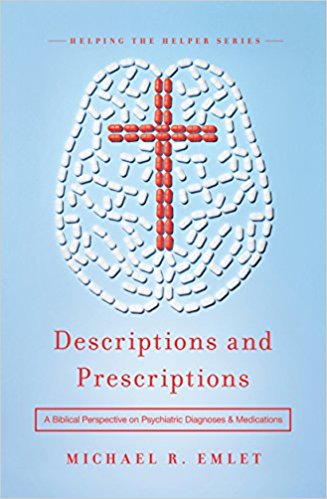
Mike Emlet, a former family practice physician and now counselor, has written a small book to introduce readers to a nuanced and biblical take on the value of diagnoses and medications. Descriptions and Prescriptions: A Biblical Perspective on Psychiatric Diagnoses & Medications (New Growth Press, 2017) comprises 22 short chapters exploring the pros and cons of both arenas for those who are “too cold” or “too warm” towards the use of mental health diagnoses and medications.

In the first section Mike explores some of the weaknesses of the current DSM (psychiatric diagnostic system). Those who are “too cold” and who think the system is fraught with problems may find themselves saying “yes, exactly.” But rather than just stop there, he begins to articulate implications for ministry responses—how to go deep to understand the person behind the diagnosis. There is much the pastor or counselor can learn.

One key point is made here and in later chapters: we live in bodies and Scripture takes this seriously. So learn about the symptoms a person experiences.

So, you might think this book is negative on the value of diagnoses. It is not. Chapter 9 begins to describe the potential value of diagnoses, especially to those who tend to see mental health problems ONLY as spiritual and ONLY or usually involving just the will. If there is one thing the reader should get from this chapter is that humility is in order. If you don’t put much stock in diagnoses you likely don’t put much stock in published research exploring symptom clusters. As an example, Mike briefly discusses the multivariate experiences of those with obsessions and compulsions. This little window into the problem of OCD should remind us that we must work hard to understand the many subtle forms of obsessional thinking and consider how best to describe and care for the person suffering with them.

On the final page of chapter 9, Mike takes on one crucial criticism—that since you can’t see structural differences in the brain that implicate a particular diagnosis then the diagnosis isn’t real. From his point of view, this is a simplistic understanding of biology and diagnoses.

51kk83nh4bl-_sx325_bo1204203200_

The second section explores the challenges and benefits of psychiatric medications. Mike gives a very brief overview of the categories of medications and how they work (what we know and what we don’t know). He summarizes the research as indicating a modest positive effect, though also showing that other means are quite effective (placebo and counseling). Such results show us that there are a range of helpful responses. While it is true that medications for anxiety and depression aren’t cures and aren’t without their side effects, it is important to remember that the individual in front of you may in fact benefit immensely. Thus it is good to remember that we don’t offer advice to others based on population statistics. Rather wisdom is in order for this particular person.


In probably the best part of the book, Mike walks the reader through a wisdom approach to the use of medications—walking the tightrope as he suggests. Too much suffering and too little suffering can be hazardous to our spiritual health. We can make idols out of medications or out of not taking them. Medications aren’t good or bad on their own. It is how we approach them that matters.

He makes this statement nearing the end of the book,

“I hope you have seen that there is not a clear-cut “right” or “wrong” answer. There is no universal “rule” that we can apply to all people at all times. There is no simple algorithm. Rather, the use of these medications is a wisdom issue, to be addressed individually with those we counsel. There will always be a mix of pros and cons, costs and benefits to carefully consider.”  (p. 87)

This answer may frustrate those who want a clear-cut “this is right/wrong” response. However, counselors are not umpires calling what is “fair” or “foul.” Instead we are walking with and helping others look for relief (what can I do to make the moment better?) and look for acceptance (what is God up to in my life?).  Sometimes relief means medications, other times it means examining thoughts, habits, perceptions, etc. Sometimes acceptance means pursuing other goals beyond symptom relief, other times it means understanding accepting that God has, in his providence, allowed them to have a body that needs external supports.

Book Recommendation: Great first text for those who either over-estimate the value of mental health diagnoses or medications or those who minimize their value. Author leans to a conservative approach and probably spends more time speaking to those who might over-value medications. Yet, he also repeatedly affirms that biblical counseling must take seriously the fact that humans are embodied souls and that diagnoses and medications have value, albeit limited value. Great text to start the conversation and lead to deeper study about our responses to suffering, especially for beginning pastoral counselors and lay helpers.

1 Comment

Filed under Psychiatric Medications, Psychology, Uncategorized

Single session debriefing sessions? Helpful or harmful? 


I write this from Uganda having just completed a Community of Practice conference hosted by the Ugandan Bible Society. This community of practice is for bible-based trauma healing facilitators and local mental and public health experts. I presented on an update to PTSD causes, effects, and treatment. We looked at the value of Scripture engagement around the topics of trauma, loss, and recovery as well as how it fits into the larger picture of trauma counseling. 

Much of what we clinicians know and do for treatment for PTSD symptoms is based on partial research but a significant dose of “clinical judgment.” What is that? Well, it is treatment models that may have some empirical support but mostly formed over long-held assumptions in the field. One of those assumptions is that we may be able to prevent PTSD if we provide group or individual debriefing sessions soon after a traumatic experience. These debriefing sessions have been offered for decades to first responders, humanitarians, and missionaries after exposure to traumatic and tragic events. In recent years we have seen some evidence that some may not be helped but these sessions. In fact, some may even be harmed. 

The evidence of possible harm is not new. Yet, debriefing is still offered indiscriminately. We find it hard to let go what seems to work. Today I was able to read a 2006 study published in the British Journal of Psychiatry (citation below). This bit of research compared emotional debriefing, educational only debriefing, and no treatment. This study of Dutch civilians who had experienced a single episode of trauma within the last two weeks found that all three groups (emotion oriented debriefing, education only, and no treatment) saw a decrease of symptoms at 2 and 6 weeks post intervention. There was no benefit from either form of debriefing found in this study. 

In addition to no benefit, those individuals with high arounsal trauma symptoms who completed emotional debriefing showed higher rates of PTSD symptoms than the those with higher arousal who did nothing or only the educational oriented debriefing intervention. So, some forms of debriefing may actually worsen symptoms. Why? The authors surmise, 

In previous studies it has been established that high degrees of arousal in the immediate aftermath of a traumatic event are associated with an increased risk for the development of PTSD, measured both by self-report (Carlier et al, 1997; Schell et al, 2004) and physiologically by means of heart rate response (Shalev et al, 1998; Bryant et al, 2000; Zatzick et al, 2005). Encouraging highly aroused trauma survivors to express their feeling and emotions concerning the trauma might activate the sympathetic nervous system to such a degree that successful encoding of the traumatic memory is disrupted. Moreover, during an emotional debriefing session negative appraisal of one’s sense of mastery may be promoted (Weisaeth, 2000). This is assumed to keep the hyperreactive individual in a state of high arousal which may cause symptoms of PTSD to escalate rather than resolve (McCleery & Harvey, 2004). 

So, what should we do with this information? Nothing? No. But what we do should not harm, especially when we know some may be harmed. I suggest a few possible outcomes:

  1. Education about PTSD and trauma should continue. This study does not reveal harm for this intervention and given the relatively low trauma symptoms in this study (and the possibility some may have already been aware of what trauma is), education is likely to be helpful. Education is not only about trauma but also about good coping skills and activities. It does not focus on the events of the trauma experienced.
  2. Bible-based trauma healing begins not with a person’s story but looks at culture and common reactions. It normalizes pain and suffering and connects people to God and others. We do not yet have great empirical evidence (it is being collected) that such an intervention is helpful or harmful. But it appears that giving people permission to ask questions of their faith and to see that God encourages lament may still be helpful. 
  3. We need assessment of the growing movement and art oriented responses to trauma. What do these non-talk therapies add to the prevention or intervention strategies? 
  4. Debriefing or talking about a trauma that has just happened should focus less on replaying the details and more on current cognitive and affective impact with focus on resilience and boosting existing capacities. Brief assessment of arousal symptoms may well be warranted by those who promote processing trauma stories. This may be why NET, CPT and DBT oriented PE have lower drop-out rates than classic PE (prolonged exposure) therapy. 

Citation: Emotional or educational debriefing after psychological trauma (Randomised controlled trial) by MARIT SIJBRANDIJ, MIRANDA OLFF, JOHANNES B. REITSMA, INGRID V. E. CARLIER and BERTHOLD P. R. GERSONS. In BRITISH JOURNAL OF PSYCHIATRY (2006), 189, 150-155. doi: 10.1192/bjp.bp.105.021121

Leave a comment

Filed under mental health, Post-Traumatic Stress Disorder, Psychology

Is it trauma or is it intensity/identity loss?


The current definition of PTSD requires an exposure to an intensely distressing event or events (either witnessed or told about in great detail) resulting in a pattern of intrusive re-experiencing, attempts to avoid such experiences and an ongoing negative cognitive/mood pattern. Such a diagnosis might be made after domestic and sexual violence, accidents, natural disasters, war, betrayal traumas, and even after hearing repeated stories of traumatic experiences to others (called secondary trauma).

Someone experiencing PTSD after life-threatening events might feel disconnected from family/friends, find it difficult to sleep, experience repeated nightmares, have difficulty not thinking about events during and after the traumatic experience, choose unhealthy coping patterns like alcohol abuse, or place themselves in situations where they re-enact parts of their trauma story.

But not everyone who has intrusive thoughts about a challenging situation, feels disconnected from their community (and previous self), drinks too much, or impulsively jumps back into danger have PTSD. Some of these same behaviors and experiences also show up in those who have left dangerous and all-consuming experiences and now do not know how to re-engage in regular life.

Consider these words of Dr. Steven Hatch, who spent time in Ebola clinics in Liberia at the height of the 2014 pandemic crisis in West Africa. He describes his experience after returning to his job at the University of Massachusetts.

To match the outside weather, my mood willingly turned dark. I withdrew from people, wandered about in a daze, and avoided public gatherings. When I did venture out, I carried myself in a completely different manner than I had before in my life.


The simple explanation was that I had post-traumatic stress disorder, and a few people, including some whose job it is to make such diagnoses, thought this to be true. (p. 239, Inferno)

He goes on to dispute his experience fighting Ebola as trauma. While difficult, he did not think it rose to the level of trauma experienced in war or even other more overwhelming Ebola clinics.

I could, however, recall the event [death of a toddler] in my mind without being emotionally overwhelmed, but also just as importantly I was able to still experience emotions about it, feeling appropriately somber. I just didn’t feel traumatized. (p 240)

So, what was his problem?

What I did share with many other volunteers was a sense that I didn’t belong in the States, for the work in West Africa was far from over. I desperately wanted to return, and almost within days of coming home I was trying to figure out how I could get back to an ETU [crisis Ebola center]. What I missed was the profound sense of purpose that such work had provided, and I slowly realized why people talked of “missing the war,” a phrase that always seemed discordant to my ears. You miss being in the midst of senseless butchery? Great. But I belatedly realized it was that purposefulness, the sense that you were doing something that was deeply and truly meaningful, that drove people back to such unstable situations. (p. 240-41)

There you have it. The seeming loss of crystal clarity or purpose in life can be very painful. When you are in an intense helping situation as Dr. Hatch was, every movement leads towards life or death. At the end of a day, you can count who lived and who died. No ambiguity. In addition, you are doing it with a team of people all committed to the same thing. You share the same vision, goal, and daily experience. You do not have to explain anything. And in these intense situations, you can have the kinds of intimacy not often experienced even in your immediate family. Also subtract mundane activities (grocery shopping, cleaning, taking care of children, etc.) that may not need to be done.

This is a recipe for distress upon return.

Return to regular life where you are expected to do these seemingly inconsequential activities AND where you have no one around to save AND no one who was present with your toughest experience…and you have a recipe for trouble. You may find it difficult to find joy in light of intrusive thoughts of recent emotionally intense experiences. You may long for a return to that sense of purpose and value. Because others do not understand and aren’t part of your “tribe” you may withdraw or find other ways to numb the pain.

Loss of identity and intensity may mimic trauma symptoms. They may be significant to need treatment. Military ending tours of duty, missionaries returning from field, humanitarians returning from doing crisis work, church planters leaving high stakes urban church plants, and trauma healing trainers returning from intense experiences may be at risk.

What can be done to prevent this distress?

  1. Probably nothing will take care of the problem. One could not go do intense work. Or one could become a crisis junkie. Neither are good options.
  2. But developing re-acclimation plans can help. Yes, training done before entering the intense experience will set the stage for healthy returns but post-tour of duty re-entry work is more important. The Army has develop protocols for re-entry by beginning the process even before leaving the “theatre.” Creating space for coming off the “high” giving time to process and following-up in the early days back can help. Involving family in the re-entry planning and building activities that can elevate family intimacy upon return will help immensely.
  3. Encouraging time and space to lament and process in group settings. This is where a therapist can help. Group process helps to put words to experiences and acknowledges impact on identity. This can also help re-connect with meaningful activities and experiences at home. One has to re-learn that meaning is not solely connected to intensity.

I have some very small personal experience with this. I’ve had intense experiences in international settings. When I have returned, I have sometimes found it hard to be at home when my head was still overseas. Being able to share with Kim and others helped. Practicing lament helped. Learning to be mindful of the present also helped me remember what has meaning and value in everyday life.

3 Comments

Filed under Post-Traumatic Stress Disorder, Psychology, trauma, Uncategorized

Reading the bible through the lens of trauma?


What if you read the bible through the lens of trauma? Some passages are quite obvious–catastrophes are all throughout the bible. But are these stories of trauma in the bible merely keeping a record of pain or attempts to deal with the trauma, to put the world back proper perspective after chaos?

Consider this 2015 video by Rev. Dr. Robert Schreiter entitled: Trauma in The Biblical Record. He gives some background about this newer way to read the bible through this lens and then ends with 3 examples. I’ve just ordered this book on the subject, but those wanting to jump ahead may wish to know about it as well.

Leave a comment

Filed under Abuse, American Bible Society, counseling, Doctrine/Theology, Post-Traumatic Stress Disorder, Psychology, ptsd, trauma