A few days ago I wrote this for our seminary’s blog regarding how counseling supports the global mission of the church. If you are interested in international counseling work…you need to read this blog and follow the link I promote.
Category Archives: counseling science
DRC/Rwanda Trip: October 14, 2011
Day 4:
A breakfast of coffee, fruit and egg and we’re off visiting rape victims and those who help them today. First stop is the DOCS hospital (Doctors on Call for Service) run by a gynecologist, Dr. Ahuka Ona Longombe. This hospital specializes in obstetrics and in fistula surgery for rape victims. Dr. Ahuka if a larger than life, forceful personality. The ABS has done some partnering to provide the hospital with some
better equipment. After touring the facility, he took us to a room to show us his PowerPoint presentation on the causes of sexual violence, the impact on women and the work they do to repair. It was a difficult slide show (with a few pictures!). If you think of rape as forced intercourse only, think again!
He showed us current stats (42,225 cases of reported sexual violence as of 2 years ago). He pointed out how these stats are very likely LOW due to stigma, violence, and the complexities of multiple reporting agencies. Victims during the reporting period are 21% little girls, 56% young women, and 23% old women.
Only 25% get treatment within the desired 3 days.
While they do HIV/STD testing and treatment, medical, surgical, nursing, spiritual, and legal care, Dr. Ahuka repeatedly begged for help for the psychological damage. As a team we discussed whether it would be possible to send two high level interns (even post grads) for 6 months to focus on training nursing and doctor staff as well as lay people from local churches who might reach out and care for the spiritual needs of these terribly traumatized women. Interns would have to be able to speak French.
Leaving the hospital we traveled some very bumpy roads to Sister Alvera’s home. Now, all roads are bumpy in Goma. But these roads were the bumpiest. I kept expecting to lose teeth or an axle. Sister Alvera, a nun who runs an orphanage and home for raped women, was not home but they were expecting us. We came for the express purpose of talking to two women who have been treated by Dr. Ahuka for fistulas and who were willing to tell their trauma story. We were most interested to hear how they are learning to cope. The first young woman, C, had bright eyes and passion all about her. We met in her small abode, something akin to a shed in this country. She told of her rape and her treatments. Through the translator we heard how she experiences both joy and deep pain (she has been rejected by her family because of the rape). She described her struggle with dissociation as, “getting lost in my mind.” Sleeping, talking to the local pastor and being prayed for were helpful interventions. Near the end of our time with C we heard her lament that she could not find her attacker in order to forgive him. The pressure to do so seemed to eat at her. She felt she could not rest until she forgave him. Diane had the presence to respond that while she wasn’t able to find him, God could see her heart and the forgiveness in it. This seemed very meaningful to C.
The 2nd woman, X, had been raped and given birth to a child. The child had been rejected but lived in the compound. Sitting with X was her new little baby who played with nearby fingers and nursed when fussy. This woman was far more triggered during our conversations. Her eyes were missing light. She did not look present. However, she described a caring husband and pastor who helped her cope with her trauma experiences.
The rain, which had been pounding down for our interviews let up just as we were getting ready to run to our vehicles to leave. A view of several green cauldrons came into view through the puffy clouds passing by. From the Sister’s place we traveled to the local bible society office. We got to see the bibles we would be giving out the next day as well as opportunity to meet the staff. I can attest to two things about the bible society. They keep amazing records on all the widows and children they serve (food, stuffs, etc.) and they do not spend their money on expensive property. Back in 2002, their offices were destroyed by the lava eruption and now they rent rather humble space. If you give the bible society, you can expect your money to go to people and services, not bricks and mortar!
We ended the day back that the hotel with a enjoyable dinner meeting with World Relief country director, Charles Franzen, and two of his staff. Our dinner was outside under a thatch canopy and just above the loud lapping waves of Kivu. I can only describe him as a character–in the best sense of the word. He speaks Swahili but not French and has lived for many years in East Africa. We had wide-ranging conversations about Africa, Baltimore (his home town), baseball (his dislike for Dustin Pedroia of the Red Sox) and football (soccer). And of course the work of trauma recovery was a central topic this evening.

DRC/Rwanda Trip: October 13, 2011
Up by 5:30am, a nice breakfast (omelet, Nescafe, fresh avocado half, and bread with Nutella), and then a trip to the airport to catch another MAF flight hop south to Beni (3 hour stop) and then on to Goma in the afternoon.
The flight to Beni from Bunia lasts about 35 minutes and travels a over verdant landscapes criss-crossed with reddish dirt paths. Wish we could stop here and there to check out some of the remote places. We see frequent fires being used to burn vegetation to prepare the land for farming. We arrived on time to Beni, a tiny dirt-tracked airport. I do not believe the small building space we walked through had electricity. Surprisingly, the road outside the airport was paved. In fact, it was the best paved road I saw in all of the DRC. We hear that the Chinese built it. What is the pay off for them I wonder.
Our quick car trip takes us to UCBC, a bilingual christian university in the town. We met with a number of young teachers and staff along with Daniel Masumbuko Kasereka, the chaplain and an administrator. The school was running some intensive English language classes in preparation of the start of a new term. Here too we hear about the trauma in students and the negative impact on their learning. We also learn about their attempts to bring some trauma recovery to the community by hosting some seminars using the trauma/reconciliation materials of Rhiannon Lloyd. We hear of sex trafficking and abduction of women by militias. Our time is short but we do have some good conversation with them. Nice to meet Baraka Kasali, the son of the rector and someone who clearly was raised in the US but using his talents in this small area. Also, met an American, Bethany Earickson who teaches English here.
Our time is short so we say our goodbyes (after using the pit toilets), pile back in the car and head back to the MAF plane awaiting our trip to Goma. We arrive at Goma around 1:00pm. Sadly, it was raining and so we did not get a view of the massive volcano just outside Goma. Instead we dodged clouds, flew over high peaks and Lake Albert, and then flew jus
t above the tree tops to avoid turbulence.
First sights at the airport are rusting UN aircraft, lookouts, someone who demands money for landing, and customs officials who laboriously re-enter all of our visa information. Our passports disappear and then reappear. Not sure what they do with them.The trip to the hotel is our first glimpse of this chaotic city. All streets are rutted with potholes and unpaved. Piles of lava chunks litter the streets. Besides potholes and lava, you see boys going in every direction pushing the congolese “bike” as they transport goods hither and yon?
We arrive at Hotel Linda by 2pm. Hotel Linda sits on the edge (literally) of Lake Kivu. It is a beautiful view and beautiful sound (waves). This will be our home base for the next several days. Kingfishers are sitting on flowers outside my room. I find that the hotel has a public computer and free (slow) internet so I quick pop off an email to my family to let them know we have arrived. We have time to rest and talk about what we have so far seen and heard and how we might develop a trauma curriculum for training the faculties of various schools. For dinner, I choose Capitaine fish (chunks not fillet) cooked in spices and a banana leaf. Excellent.
Tomorrow begins an intense time of listening to trauma workers and trauma victims.
Filed under AACC, counseling, counseling science, Uncategorized
Christian counseling theory and the bible: A dangerous mix?
Maybe Christian counselors shouldn’t use the bible when they promote their counseling theory. Maybe they should just articulate their theory and leave the bible verses out. Sound radical? An overreaction? Guilty as charged. But…consider with me that some of our most popular Christian models may be built on rather flimsy biblical data.
Some (simplistic) background thoughts
All Christian counselors recognize that the bible plays a unique role in counseling theory. Otherwise, they would just be “counselors.” But not all use the bible in the same way. Some view the bible as the primary (even sole) guide or resource for understanding human nature and recovery from every sort of relational and/or emotional struggle. These counselors would likely cite 2 Tim 3:15-16 as evidence that Scripture is powerful and primary in our fight against sin and suffering. Others view the bible as a helpful foundation designed to remind us who God is, who we are, and a resource for comfort, encouragement, and rebuke. But, these counselors might also look to other resources as well–psychological research, physiology, medicine, sociology, etc. They would not dismiss the value of the bible but would argue that the bible doesn’t intend to be the answer guide for all the questions we might have. Thus, sources of human knowledge are important to the work of good Christian counseling. Now within this second camp, counselors vary widely as to how important either Scripture or human sources of knowledge function in their given practice. Some seem to emphasize (or neglect) one source more than the other.
The problem…
No matter where a counselor falls on the above continuum, it is far too easy to use the bible to baptize a particular viewpoint or theory. From my most recent christian counseling conference, I heard a plenary speaker say something like this (not a quote but pretty near exact):
Men need respect. It is their airhose. Women need love. It is their airhose.
Along with this statement, the speaker bolstered their points with personal stories and biblical passages indicating the women should be loved and men treated as having authority (submitted to). Here the speaker used bible passages to indicate that men are designed to operate optimally when respected and women designed to operate optimally with love.
Is this true? It could be. I certainly think that this SEEMS to be true for most men and women. But, and this is the BIG BUT…does Scripture indeed teach this. Does Paul teach us that these are our basic needs in order to function well?
Close but way off
Notice that love and respect cannot be our “airhose.” Habakkuk 3:16f would suggest that when everything has been taken away, it is possible to have joy in all things. Notice that Ephesians 5 is about what each are commanded to do…not about what each of us needs to receive. Christ is our “airhose” and nothing else. This speaker would have been better served just teaching us about observations made about what actions tend to make for better marriages than to indicate that the Scriptures teach us we have these two needs.
So, the next time you pick up a cool book by a christian counselor. Check out how they use the bible. As a support for a good theory (e.g., this verse teaches us…)? Or, as a source for understanding the problem of evil and the nature of our God who leads, guides, and saves us?
If you are interested in this topic, let me give you a couple of resources.
- October 2011 print issue of Christianity Today covers the general misuse of the bible. It is not just counselors who do this. They list the example of a book with anti-aging techniques supposedly gleaned from the bible.
- 2 chapters in Care for the Soul:Exploring the Intersection of Psychology & Theology (IVP, 2001). Chapters 12 and 13 both cover the issue of hermeneutics. Richard Schultz addresses how counselors misuse wisdom literature and chapter 13 (myself and my colleague Bryan Maier) give more general recommendations for good hermeneutic work.
Healing Trauma in International Settings: AACC Seminar
Today, Carol King and myself will be presenting this PowerPoint show for our 1 hour breakout at this year’s AACC World Conference. Feel free to check out what we talk about by following the link.
Filed under AACC, counseling, counseling science, counseling skills, Uncategorized
Supervisors: FREE Ethics CE at Biblical, 11/5/11
If you supervise counselors, would be willing to consider supervising a Biblical Seminary MA Counseling student for a practicum or internship, then we have an offer for you. On Saturday, November 5th, 2011, we will be holding our annual fieldwork expo. It is a time when supervisors come and meet first and second year MA students over lunch. Students get to find out about potential sites and supervisors get a quick feel for the students and may even be able to identify ones that would make good interns.
During the 3 hours, we offer a one hour CE (NBCC approved) for all supervisors, an ethics update. The CE and certificate are free of charge! Check out Expo Flyer for all the details.
Coming does not mean you have to take a student as an intern (though you should be open to it) nor that you will automatically receive an intern. But, by coming you do get a CE for your efforts and students get a chance to see those doing the work they one day hope to do.
If you are coming be sure to follow the directions on the flyer and register. Last minute walk-ins may not get to eat!
Sneak preview: Healing Trauma in International Settings (AACC seminar)
Just completed preparing my breakout seminar for this year’s AACC World Conference at the beautiful but outlandishly expansive Opryland Hotel in Nashville (Sept 28-Oct 2). This time around I presenting with my colleague Carol King on “Healing Trauma in International Settings: Best Practices.” Carol has had some experience in Rwanda and Goma, DRC and will be with our group in October when we do trauma recovery training in Kigali. Come back to the blog on the 30th and you can see and download the slideshow we will do.
What will we be talking about? 3 main points:
- Listen…don’t assume you already know trauma or treatment practices
- Train…don’t do the interventions yourself (train local leaders)
- Utilize…don’t reinvent the wheel (use existing models)
Now obviously we will be fleshing those points out. Our goal is to help prepare interested counselors to develop short and long-range intervention strategies that utilize the cultural and human resources of the people they will serve. The only way to do this well is to have a listening and collaborative/support role approach. To that end I will talk about hoe to build an effective area case map. We end by reviewing a few models for trauma recovery (both Christian and secular).
Check back on the 30th for the full set of slides.
Good Read: Is addiction a disease of the brain?
Over on the NPR website Alva Noe (Philosopher, UC Berkeley) writes an interesting opinion blog (aren’t they all?) about why we shouldn’t call addiction a disease of the brain. As you will see from the hundreds of comments, he surely riled a bunch of people up. Some of the comments are quite clear, others just humorous. But I commend his blog for you to read. It makes you think about how some of our language regarding addiction unhelpfully narrows down the problem, thereby making it more difficult to pinpoint all that needs to change when fighting addiction.
Is addiction a disease of the brain? Following his logic, no. Is it a disease that involves the brain? Yes. We must recognize that we are not mere machines and as a result mental illness and addiction both must be viewed from socio-cultural-biological-relational-experiential-spitual-will perspective. A lot goes into creating an addiction. We ought not single out neural structures and activity as if that says all we need to know.
However, on the flip side, to suggest the that addiction isn’t a disease or a biological problem may also send the wrong message. In fact, addicts rarely can “just say no.” By the time they seek help their bodies are working against whatever little will power they have left.
So, addiction is a disease of the person. It may not qualify as a disease that we can identify on a specific cell, but the addicted person is no longer functioning properly and thus their entire person is diseased.
Filed under counseling, counseling science
Getting confirmation on global trauma recovery plans
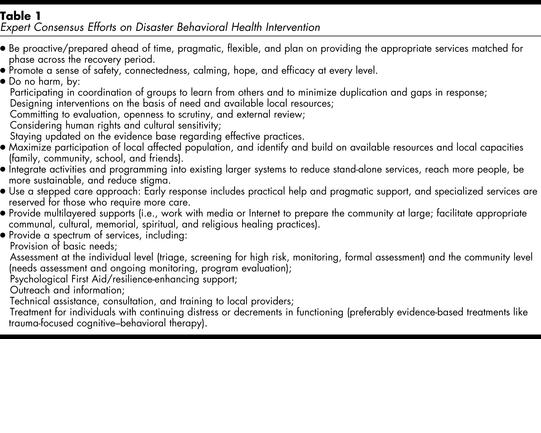
Since January I have been trying to articulate the best practices in doing trauma recovery or trauma healing work in international settings. The foundation of this approach to trauma recovery is, (a) Listen first to the needs, resources, and concerns of a community(b) identify local leaders who can be trained to be the primary trauma recovery workers (rather than outsiders being the primary clinicians), (c) tailoring interventions to the needs of the community, and (c) above all…do no harm by over-promising, under-delivering, etc.
Today, I opened up my most recent American Psychologist (66:6, September 2011) and found my thinking confirmed in Watson, Brymer, and Bonanno’s Postdisaster Psychological Intervention since 9/11 (see citation at the bottom of the page). On page 485 they list what experts consider an appropriate steps to take in postdisaster behavioral health interventions. Now, most of you don’t probably get excited about research articles like this but I can tell you I did. Here’s the chart (click to see a larger image)
It is nice to find confirmation for something I was thinking but hadn’t read elsewhere.
From: Watson, P. J., Brymer, M. J., & Bonanno, G. A. (2011). Postdisaster psychological intervention since 9/11. American Psychologist, 66(6), 482-494. doi:10.1037/a0024806
Filed under Abuse, counseling science, Post-Traumatic Stress Disorder, Psychology, trauma, Uncategorized
Trauma Recovery Work in the DRC and Rwanda
It is official. Diane Langberg and I have our tickets for our upcoming trip to the Congo (DRC) and Rwanda where we will be interacting with trauma victims, pastors (who are also trauma victims), Bible Society and World Vision workers, and probably medical and education officials as well.
We leave on October 10 and arrive in Uganda on the 11th. We will be traveling into the DRC in the northeast quadrant (picture tiny plane!) near Bunia and also to Goma, on the shores of Lake Kivu and under the shadow of a large and active volcano. There we will be observing the work of the American Bible Society and She’s My Sister as well as meeting with rape and trauma survivors.
On the 17th, Lord willing, we’ll drive from Goma into Rwanda to Kigali. There we will be joined by colleague Carol King (Langberg & Associates therapist) and Josh Straub of the AACC and our Rwandan compatriots Josephine (WV) and Baraka (IJM) and will lead a three-day training seminar re: trauma recovery resources and best practices. The plan is to return home via Kenyatta airport and Brussels on the 22nd.
Prepping for the trip includes everything from shots to planning who does what training segments. Those of you inclined to do so, pray for the logistics there as World Vision Rwanda puts the final touches on the location of training and invitees. A lot of work must happen for this to go smoothly. Also, there is an effort to raise funds for this (Project Tuza) at the AACC World Conference in Nashville the last week of September. Pray that attendees will catch a vision and support us as they can.
Anyone wishing to donate can here.