Category Archives: christian counseling

Psychopharmacology for counselors? Take a class at Biblical!


This summer, Jim Owens, PsyD will be offering a one weekend class (Aug 23-24) entitled, Essential Psychopharmacology for Counselors. Jim is a board member here at Biblical and has extensive training in psychopharmacology. In fact, he is board certified by the Prescribing Psychologist Registry. He will review traditional and alternative medicines commonly used today as well as best practices for engaging prescribers. In his course description he says,

The ever-growing use of medications, both traditional and complementary, to treat mental health problems, has both helped and harmed many people. Approximately 80% of all psychoactive medicines are prescribed or recommended by non-specialists, who frequently have little time, training or experience to accurately diagnose the person’s condition. Therefore, trained counselors and psychotherapists are in a crucial position to aid their clients in getting appropriate treatment. This involves knowing some basics regarding which available talk therapies as well as medications are most likely to be helpful for those struggling with certain problems. It is also important to know how to interact with your clients’ physician(s) and other health care providers.

Get CEs!

The course is 1 graduate credit (includes some pre and post course work) OR, 9 CE hours for counselors. Biblical is an approved provider of CES for counselors by NBCC. To read more on costs and other CE approved courses this summer, click here.

Leave a comment

Filed under Biblical Seminary, christian counseling, christian psychology, counseling, counseling science, counseling skills, Psychiatric Medications, Psychology


[A version of this post was first published here on February 24, 2009. Given the content of my previous post, I decided to place it back at the top by republishing today]

Now for the matters you wrote about: ‘It is good for a man not to have sexual relations with a woman.’ But since sexual immorality is occurring, each man should have sexual relations with his own wife, and each woman with her own husband. The husband should fulfill his marital duty to his wife, and likewise the wife to her husband. The wife does not have authority over her own body but yields it to her husband. In the same way, the husband does not have authority over his own body but yields it to his wife. 1 Cor. 7: 1-4

In the past year I have had several conversations with men about these verses. In every situation one spouse (not always the woman) had refused to engage in certain sexual practices with their spouse. These they found unappealing or disconcerting for a variety of reasons (e.g., a husband did not wish to use sex aids, a wife did not wish to receive oral sex, a spouse found a position brought back memories of abuse, or either found themselves undesirous of any sexual activity).

And so the frustrated spouse remembered these verses and wished to use them to compel their spouse or at least remind them of the duty to provide sex.

So, whose desires trump if the gist of the passage suggests that neither has full ownership of their own body nor has the right to demand in the bedroom? 

Sadly, I have listened to  men argue that women must submit to their husband’s sexual requests. She should fulfill her marital duty, should abstain only for prayer, and that her body is her husband’s. They appeal to this text and to Ephesians 5 which commands women to submit to their husbands.

Here is what is missing in that argument:

1. The husband is commanded to sacrifice everything to love his wife. That would include his desires.

2. This passage clearly states that the wife has control over her husband’s body and thus gets veto power over how he wants to use it in bed.

Some other things from the text that get neglected:

1. The Corinthian church wanted Paul’s opinion about sex and marriage. Paul does not affirm their position. In fact, he says that given the problem of immorality, couples should not unnecessarily tempt each other.

2. Sex is not the highest good in life or in marriage. It would be better to not marry and no, not everything is beneficial. Thus our desires cannot be a god to us.
2. The mutuality of sex is obvious. No one gets trump. The goal of the passages is to encourage each other to look out for problems of temptation.
3. And yet, these aren’t commands but advice (v. 6).

Now consider these application Q & As:

1. Should a spouse comply to a request for sex if they aren’t interested?

Interested is a key word here. Some spouses may wish to engage in sexual activity even as they know their own level of desire isn’t nearly as high as the requesting spouse. But the one who wishes to please their spouse ought not feel compelled or asked to do something they find distasteful or compromising. Couples that can talk through sexual desire differences in a manner where both the asker and the assenter feel heard and supported should not face much difficulty here. It is only when either the asker feels rejected or the assenter feels forced/guilty does differences in sexual desire create trouble.

2. Should one ever use these verses to urge their mate to engage in certain sexual behaviors?

There is a big difference between asking and urging (aka compelling). Lauren Winner says that God oriented sex is unitive and sacramental. It is about giving rather than getting and/or performance. It is hard to imagine how a person would use these verses  in a manner that wouldn’t violate the law of sacrificial love. Recall that these texts are not providing “rights” for either party. The entire Christian life is a “dying to self” experience.  

3. Are there situations that might cause a couple to abstain from sex other than for prayer?

Absolutely. The text doesn’t cover every situation. Health factors obviously limit sexual activity. These may include non-genital disease, STDs, and even past or present traumas. Generally speaking, married individuals enjoy sex. So, if one is resistant to sex or to certain sex practices, it probably won’t take much time to uncover problems in the relationship or other illnesses. Note here that this 1 Corinthian text focuses on the problem of sexual immorality. Paul gives several pieces of advice (give yourself to ministry, avoid marriage, get married, watch out for each other, etc.) but nowhere does he command any of these activities. His goal is to help the church avoid the sins of idolatry and adultery. When we take the text and look for a passage to defend our “must-haves”, we miss out on the larger context and purpose and fall into the very sin Paul is exhorting us to avoid–idoloatry.

4 Comments

March 8, 2013 · 5:07 am

Better objectives than reconciliation?


When you experience a broken relationship, do you long for the day when what is broken is made new? I do, even when I know that the chances of restoration and reconciliation are slight.

However, I’ve written a post over at our faculty blog suggesting that as good a goal as reconciliation is, it makes for a poor objective for us. Wonder why I think little of reconciliation as an objective? Click the link to find out and to consider some alternate objectives.

Leave a comment

Filed under Abuse, biblical counseling, Biblical Reflection, christian counseling, Christianity, conflicts, Relationships

Mistakes we make when responding to minor false accusations


Picture this. You are a manager. One of your subordinates, John, accuses you of playing favorites–giving more opportunities for development and promotion to one person and intentionally ignoring the one making the accusation. You absolutely believe the accusation is baseless due to a misunderstanding of workflow and skill sets.

What would be your usual response? Explain? Pull the, “I’m the authority here, I do what I think is right” card? Silence and an eye roll? I imagine most of us choose the explain option. If feels right that we should clarify the misunderstanding.

Why is explaining wrong?

Let me clarify. Explaining isn’t necessarily a sin (though it could be). Surprisingly it rarely helps the situation when offered first. Why is this?

  1. Pointing out the facts as you see them almost always sounds like a defense
  2. Defenses (AKA explanations) rarely address the root concern of the other leaving them feeling unheard

A better way

Contrary to our natural tendency to defend against an attack, the best strategy is to validate the concerns of the other. If the employee is concerned they are getting passed over (and you can imagine they have been feeling this for a long while when they finally speak it to you), your explanation of the facts does NOTHING to address their concerns. A loving, Spirit-empowered response will take to heart their fears. “John, I bet you’ve been feeling this for some time. It is important to me that I hear and understand what you are feeling. I do not want you having the impression that you are not valued. I would be happy to explain why Lisa got the new position and how I see your future here. Can we set a time to talk about this tomorrow?”

One of the reasons we don’t validate others first is that we fear our own view of the facts will be swallowed up in the opinions of others. In addition we fear that validation will be heard as agreement. Be wary of these feelings. In fact, when you give the accuser the chance to state their concerns/case first (and do so in a way that they feel heard), your own views are much more likely to be heard.

Now, if only I could employ this technique with better success (on my part) with my teenaged boys! If you don’t know already, such a simple technique of validation requires a massive dose of humility and self-sacrificial love. You cannot do this in your own strength!

6 Comments

Filed under christian counseling, conflicts, Family, Relationships, Uncategorized

A Danger in Christian Counseling Theory?


The faculty blog at Biblical Seminary (where I teach) has published an edited version of an older post here on this site. If you like cheeky titles, try this on for size:

Christian Counseling Theory and the Bible: A Dangerous Mix?

Leave a comment

Filed under biblical counseling, christian counseling, christian psychology, Christianity, counseling, Psychology

The Christian Counselor’s Greatest Temptation?


Ask any beginning counselor and they will tell you that the one thing they most want to know is, “What do I say? What do I do?”

No one gets into the world of Christian counseling just to see messes. No, we take up the work because we want to see people recover life and health. But with the desire to see others get well, we also face the large temptation to push people into places of health. We want to tell people what to do

  • For those we find disagreeable or resistant: We want to tell them the full extent of their problems (rip the bandages off and make them see!)
  • For those we have compassion: We want to tell them it will be all right
  • For those we see are stuck: We want to tell them specific steps to wellness
  • For those we find to be much like us: We want to tell them they are doing just fine

Telling, exhorting, (or less nice words: cajoling, forcing, pushing) is a great temptation for every counselor. We want to impart our wisdom. We want to feel good by solving other people’s problems. We want others to experience our successes or our love for the Bible.

What does Jesus know and do?§

Do you find it odd that Jesus asks the blind man, “What do you want me to do for you?” Do you think Jesus didn’t know what he wanted? Or what about Jesus’ question, “Who touched me?” after the woman touched the hem of his garment. Did he not already know? We see that Jesus frequently uses the form of question in order to draw out the heart and mind of the person seeking help.

Do you want to be well? Where are your accusers? Where is your husband? Whose image is on this coin? When you went into the desert, what did you go to see? Where is your faith?

While we I don’t intend to argue that Jesus’ question asking somehow makes a rule for us, I do intend to argue that questions are more likely to lead to the client’s active engagement of a topic than telling them the conclusion. When we listen to others tell us values, facts, ideas, it is easy to slip into a passive acceptance or passive neutral stance. But when asked a question, we who answer more frequently engage the question.

§These biblical passages were discussed by Rev. Rick Tyson in our annual worship service at our counseling practice.

2 Comments

Filed under christian counseling, christian psychology, counseling, counseling skills, Uncategorized

Do psychological explanations of behavior absolve wrongoers?


If I describe the psychological characteristics of a violent person (e.g., has autism, a brain tumor, or a history of child sexual abuse), does that tend to be heard as absolution for crimes committed? In turn, does that make you skeptical about the value of psychology?

My latest edition of the American Psychologist (2012, v. 67:9) has a brief comment/discussion about the phenomenon of public skepticism of the field of psychology. The comments refer to a previous article published by the same journal earlier in the year. That essay reviewed common reasons for skepticism and how the field should counter them.

I’m not going to discuss the initial article nor whether or not the rebuttals are helpful. What I want to point out is one comment by Newman, Bakina, and Tang. They provide an anecdotal experience of suspicion after making public statements to a newspaper following criminal behavior. They noted that a person wrote a letter to the editor stating, “These remarks consist of convoluted thinking that absolves all participants of any personal responsibility for what happened.” In response, here’s what Newman et. al have to say,

This anecdotal experience reflects a more general finding. Laypeople are suspicious of accounts of human wrongdoing that feature situational/contextual factors (as typical of social-psychological explanations), and they prefer dispositional ones. Clearly, the letter writer would have been much happier if the psychologist’s comments had focused on how cowardly and immoral the [criminals] were. (p. 805, emphasis mine)

Do you agree? Do we prefer characterological reasons for behavior rather than descriptive/contextual discussions? Do we think that discussions of context or mindset absolves others from responsibility for wrong behavior? Having taught physiology to counseling students, I can say that some students find discussions of brain abnormalities (an example of one contextual matter) as tantamount to saying that the person must not be responsible for their actions.

How do we do a better job in being highly descriptive of human behavior without denying moral responsibilities? (i.e., that I cannot help certain matters but yet I am still responsible for what I do)


1 Comment

Filed under christian counseling, christian psychology, Psychology

Diane Langberg on Lessons for Counselors


Back in November, Diane Langberg presented 10 things that counseling students might not normally hear about during their academic training. Click here for the video.

Leave a comment

Filed under Biblical Seminary, christian counseling, christian psychology, Christianity, Psychology, teaching counseling

Abuse in the Church DVD now available


This summer I taught a class, along with Boz Tchividjian, about the problem and response of abuse within the church. Our four main plenaries were filmed and are now available on a 2 DVD set distributed by Vision Video. You can purchase the DVDs here at 20% off the price that will be listed on Amazon (and if you use the above link Biblical Seminary makes a few more pennies!). We Abuse in the Churchcover topics such as

  • how to recognize common characteristics of predators
  • prevention strategies beyond background checks
  • why we fail to act on abuse allegations and what to do about it
  • ministry responses to victims and offenders

The class was well-received by students and church leaders alike. It could be a great tool to get conversations going among lay and ordained church leaders as well as counselors who may be helping a church ensure top-notch abuse prevention measures as well as strategies for responding in a Godly way to abuse allegations–a way that ensures that the least of these are protected in the church.

Leave a comment

Filed under Abuse, biblical counseling, christian counseling, Christianity, Christianity: Leaders and Leadership, pastors and pastoring, trauma

Trauma and Trafficking DVDs on Amazon


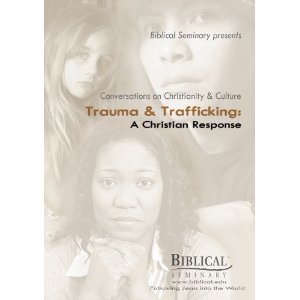
Nearly 2 years ago (March 2011), Biblical Seminary put on a conference about the problem of sexual trauma and trafficking. Our speakers included Dr. Diane Langberg (a noted psychologist), Bethany Hoang (IJM), Robert Morrison (a grassroots organizer), and Pearl Kim (now ADA for 2 Philadelphia counties). The sessions covered domestic and international sex trTrauma and Traffickingafficking, abuse and violence against women worldwide, the problem of sexual abuse in christian organizations, and how to mobilize community action without expending energy on non-profit status.

It was a powerful conference…and you can own it for a mere $19.99. Here’s the link to Amazon. Or, you can find it here at Vision Video (along with MP4 options as well) for 20% off.

This DVD set (3 DVDs) are an excellent starting point if you or your church group want to think more deeply about the biblical call to justice in the area of trafficking, trauma, and violence against women, whether “out there” or in the church.

Look for information on purchasing our most recent DVD series, Abuse in the Church, in the next week.


Leave a comment

Filed under Abuse, biblical counseling, Biblical Reflection, christian counseling, Christianity, Christianity: Leaders and Leadership, Diane Langberg, Post-Traumatic Stress Disorder, trauma