Category Archives: biblical counseling

AACC 2013: Narcissistic Leaders and Systems


Today, AACC’s World Conference begins at the Opryland Hotel in Nashville. This morning, Dr. Diane Langberg and myself will be running a pre-conference workshop entitled: Narcissistic Leaders and Organizations: Assessment and Intervention. I will start us off with a meditation from 1 Kings 1 (ideas I first heard from a sermon by Phil Ryken last year). We will review current explanations of narcissism as well as an emerging model that may be helpful for those who are trying to move beyond seeing narcissists as only arrogant and exploitive.

Can a system be narcissistic?

Yes. Here are some of the features.

  1. Leader exudes god-like status and does not share power; surrounded by yea-sayers, unwilling to tolerate disagreement, accept mentoring and willing to scapegoat others when failures arise
  2. Constituents gain self-esteem/identity from the organization and love of the system is the highest priority; insider status provides immeasurable value
  3. There is an approved way of thinking, one must take sides for/against; constituents justify dictatorial behaviors of leaders
  4. No toleration for admiration of competitors
  5. Inability to assess own weaknesses

But, here is a most interesting fact: most collective narcissistic systems are NOT filled with individual narcissists! There is something  “in the water” that brings non-narcissists together to develop these 4 features (as written about by Golec de Zavala and colleagues in 104:6 of the the Journal of Personality and Social Psychology):

  1. Inflated belief and emotional investment in group superiority
  2. Required continuous external validation and vigilance against all threats of loss of status
  3. Perception that intergroup criticism is a threat and exaggerated sensitivity to any form of criticism
  4. Intergroup violence can restore positive group image (violence may be verbal as well as physical

Why teach counselors about narcissistic systems?

Counselors often interact with church and parachurch systems by consulting with the system, counseling leaders, or advocating for an individual client. It is good to be able to (a) recognize some of the unhealthy egocentric patterns (blind spots) leaders and systems develop, and (b) offer help to individuals and systems that do not get the counselor sucked into the system or unnecessarily alienate the system. I have had the opportunity to work with a significant number of churches and have learned that there are ways to help and ways that I can get in the way, especially if I begin to attack a long held belief system. For example, if parachurch organization A has had a string of CEO/Board conflicts, then I as a counselor may have to navigate some long cherished beliefs about the system when asked to consult on their next hire.

Leave a comment

Filed under "phil monroe", AACC, biblical counseling, christian psychology, counseling, counseling skills, personality

Why counseling? To be fixed or found?


Chuck DeGroat and Johnny LaLonde have written a post that some might find helpful when considering therapy or counseling (I use these words interchangeably). At some point in our lives, we all feel like life is getting out of control. We need help. We begin to wonder if there isn’t someone out there who can help us. But, even as we think these thoughts, we may also think, “what is the point? How can therapy fix this problem?”

Well, to give a partial answer, check out this first post over at Q Ideas. The authors argue that we should all be in therapy. However, they suggest that the purpose of such counseling is not so much to fix our problems but to understand ourselves, to admit our weaknesses, to be “found” or known. Now, these may sound like things that only wealthy people have the time to do. And yet, I would argue that in our isolated, individualized society, the normal communal means of being understood, supported, known, etc. are not often present in our lives.

Three paragraphs in this first post jump out for attention:

Don’t I go to therapy to get fixed? Believe it or not, I don’t advocate therapy because it fixes people. Now, while some forms of therapy help people get past difficulties that stifle them (e.g. panic attacks, major depression, bipolar symptoms), Christians should recognize there is always a deeper and more transformative purpose to counsel and care.

This was the ancient art called curam animarum—the care of souls. And the wisest therapists will foster this process. Now, the vast majority of clinicians practicing today have been trained in fix-it strategies—cognitive and behavioral solution-based processes which are aimed at quick, painless fixes. This is what sells. This is what insurance tends to pay for. But there is a profound difference here—fix-it strategies try to remove pain while deep soul care attempts to learn from it. Sometimes in the process we are afforded the mercy of pain relief. But it is not the goal. And so I counsel people to search carefully, to interview therapists, to ask many good questions.

And then this reflection:

But at the same time, I’m not convinced Christian therapists do this as well as secular therapists at times. Let me explain. Many settle for what Dietrich Bonhoeffer called “cheap grace,” a quick fix approach which stands in stark contrast to the “costly grace” of searching and knowing ourselves, through exploring our stories and examining our motives. This kind of care is, indeed, much more rare. Christian counseling which is reduced to mere Bible memorization, or repentance or a behavioral regimen misses the point.

Fixed and found?

I imagine that the authors would agree that both are possible. Therapy can lead to being fixed and found, to find relief and care for the soul. Therapies that ignore the need for immediate mercy and relief are of little value. I once talked to someone who had just completed a decade of psychoanalysis (3 sessions per week!). His therapist, a well-known analyst had just released him as having completed analysis. My new friend was looking for a therapist to deal with his longstanding panic disorder. I have also seen Christian counselors who have so emphasized discipleship that they paid little attention to easy helps for their addict clients. On the flip side, simple behavior change (now that is an oxymoron!) may provide some relief but miss insight into self and what God is up to in the world. In seeking only relief, we miss out on deepening our relationships with God and others. A superficial life lived may hurt lest, but is it worth living? 

Note at the bottom of the post there is a link to another post about how to choose a counselor. If you are looking for one, consider one who can have difficult conversations with you, one who does not over-simplify the problem, one who cares about your growing relationship with Christ, one who can provide ideas to bring immediate relief, and best of all, one who listens more than talks.

1 Comment

Filed under biblical counseling, christian counseling, christian psychology, counseling, counseling skills, Psychology

How one church has taken up the task of addressing sexual abuse


As a christian psychologist, I work with disasters of the church. No one comes to me to tell me how their abuse was handled in a fabulous way. I get to hear all the mistakes. So, it can be tempting for me to believe that no church handles sexual abuse or abuse allegations in a healing manner.

But that would not be true. Many churches do a phenomenal job addressing this problem. Below is a link to a site illustrating how one church handled the topic. This church put a lot of time into crafting an event with aftercare, resources, and prevention plans. Check out this link to see what pastor and counselor Brad Hambrick’s church did: the sermon, video of the after service care, additional resources including other media and policy on dealing with child abuse allegations.

1 Comment

Filed under Abuse, biblical counseling, christian counseling, christian psychology, counseling

5 Minute Antidote to Anxiety repost


Over at the Biblical faculty blog, I have a post previously posted here. You can read it here. The trick to this antidote? It starts every 5 minutes.

Leave a comment

Filed under biblical counseling, christian counseling, christian psychology, counseling

The origin of the biblical counseling analogy: the bumped cup


Amy Carmichael with children

Amy Carmichael with children (Photo credit: Wikipedia)

I have heard several biblical counselors use the following story to teach about the true source of our sinful anger.

If you are holding a cup and I bump your arm and so the contents spill out on the floor, what caused the spill? You might be inclined to blame me. It wouldn’t have spilled except that you bumped me. But, really, the only reason why it spilled is that you had contents in your cup. If the contents weren’t in the cup, it wouldn’t spill no matter how hard I bumped into you. When we get sinfully angry, it is easy to blame the other as the cause. In reality, the true source of sinful anger is the one who is expressing it. The one who bumps is not the cause, only the situation that uncovers what was already there

This little analogy finds its basis in the book of James (3:9f)

With the tongue we praise our Lord and Father, and with it we curse human beings, who have been made in God’s likeness. Out of the same mouth come praise and cursing. My brothers and sisters, this should not be. Can both fresh water and salt water flow from the same spring? My brothers and sisters, can a fig tree bear olives, or a grapevine bear figs? Neither can a salt spring produce fresh water

Origins of the cup story?

But, where did this cup story find its origin? In all of the times I heard this little story, I never heard it attributed to someone. As a result, I assumed it originated with someone in the biblical counseling movement.

While I still do not know the FIRST time it was used, I can tell you that it appears in Amy Carmighael’s little book, IF, published first in the 1930s. I have an undated copy of the book (published by CLC). Page 37 says this,

If a sudden jar can cause me to speak an impatient, unloving word, then I know nothing of Calvary love.*

*For a cup brimful of sweet water cannot spill even one drop of bitter water however suddenly jolted.

Is this the origin? Anyone know if someone before the 1930s used this example?

4 Comments

Filed under anger, biblical counseling


[A version of this post was first published here on February 24, 2009. Given the content of my previous post, I decided to place it back at the top by republishing today]

Now for the matters you wrote about: ‘It is good for a man not to have sexual relations with a woman.’ But since sexual immorality is occurring, each man should have sexual relations with his own wife, and each woman with her own husband. The husband should fulfill his marital duty to his wife, and likewise the wife to her husband. The wife does not have authority over her own body but yields it to her husband. In the same way, the husband does not have authority over his own body but yields it to his wife. 1 Cor. 7: 1-4

In the past year I have had several conversations with men about these verses. In every situation one spouse (not always the woman) had refused to engage in certain sexual practices with their spouse. These they found unappealing or disconcerting for a variety of reasons (e.g., a husband did not wish to use sex aids, a wife did not wish to receive oral sex, a spouse found a position brought back memories of abuse, or either found themselves undesirous of any sexual activity).

And so the frustrated spouse remembered these verses and wished to use them to compel their spouse or at least remind them of the duty to provide sex.

So, whose desires trump if the gist of the passage suggests that neither has full ownership of their own body nor has the right to demand in the bedroom? 

Sadly, I have listened to  men argue that women must submit to their husband’s sexual requests. She should fulfill her marital duty, should abstain only for prayer, and that her body is her husband’s. They appeal to this text and to Ephesians 5 which commands women to submit to their husbands.

Here is what is missing in that argument:

1. The husband is commanded to sacrifice everything to love his wife. That would include his desires.

2. This passage clearly states that the wife has control over her husband’s body and thus gets veto power over how he wants to use it in bed.

Some other things from the text that get neglected:

1. The Corinthian church wanted Paul’s opinion about sex and marriage. Paul does not affirm their position. In fact, he says that given the problem of immorality, couples should not unnecessarily tempt each other.

2. Sex is not the highest good in life or in marriage. It would be better to not marry and no, not everything is beneficial. Thus our desires cannot be a god to us.
2. The mutuality of sex is obvious. No one gets trump. The goal of the passages is to encourage each other to look out for problems of temptation.
3. And yet, these aren’t commands but advice (v. 6).

Now consider these application Q & As:

1. Should a spouse comply to a request for sex if they aren’t interested?

Interested is a key word here. Some spouses may wish to engage in sexual activity even as they know their own level of desire isn’t nearly as high as the requesting spouse. But the one who wishes to please their spouse ought not feel compelled or asked to do something they find distasteful or compromising. Couples that can talk through sexual desire differences in a manner where both the asker and the assenter feel heard and supported should not face much difficulty here. It is only when either the asker feels rejected or the assenter feels forced/guilty does differences in sexual desire create trouble.

2. Should one ever use these verses to urge their mate to engage in certain sexual behaviors?

There is a big difference between asking and urging (aka compelling). Lauren Winner says that God oriented sex is unitive and sacramental. It is about giving rather than getting and/or performance. It is hard to imagine how a person would use these verses  in a manner that wouldn’t violate the law of sacrificial love. Recall that these texts are not providing “rights” for either party. The entire Christian life is a “dying to self” experience.  

3. Are there situations that might cause a couple to abstain from sex other than for prayer?

Absolutely. The text doesn’t cover every situation. Health factors obviously limit sexual activity. These may include non-genital disease, STDs, and even past or present traumas. Generally speaking, married individuals enjoy sex. So, if one is resistant to sex or to certain sex practices, it probably won’t take much time to uncover problems in the relationship or other illnesses. Note here that this 1 Corinthian text focuses on the problem of sexual immorality. Paul gives several pieces of advice (give yourself to ministry, avoid marriage, get married, watch out for each other, etc.) but nowhere does he command any of these activities. His goal is to help the church avoid the sins of idolatry and adultery. When we take the text and look for a passage to defend our “must-haves”, we miss out on the larger context and purpose and fall into the very sin Paul is exhorting us to avoid–idoloatry.

4 Comments

March 8, 2013 · 5:07 am

Better objectives than reconciliation?


When you experience a broken relationship, do you long for the day when what is broken is made new? I do, even when I know that the chances of restoration and reconciliation are slight.

However, I’ve written a post over at our faculty blog suggesting that as good a goal as reconciliation is, it makes for a poor objective for us. Wonder why I think little of reconciliation as an objective? Click the link to find out and to consider some alternate objectives.

Leave a comment

Filed under Abuse, biblical counseling, Biblical Reflection, christian counseling, Christianity, conflicts, Relationships

A Danger in Christian Counseling Theory?


The faculty blog at Biblical Seminary (where I teach) has published an edited version of an older post here on this site. If you like cheeky titles, try this on for size:

Christian Counseling Theory and the Bible: A Dangerous Mix?

Leave a comment

Filed under biblical counseling, christian counseling, christian psychology, Christianity, counseling, Psychology

Abuse in the Church DVD now available


This summer I taught a class, along with Boz Tchividjian, about the problem and response of abuse within the church. Our four main plenaries were filmed and are now available on a 2 DVD set distributed by Vision Video. You can purchase the DVDs here at 20% off the price that will be listed on Amazon (and if you use the above link Biblical Seminary makes a few more pennies!). We Abuse in the Churchcover topics such as

  • how to recognize common characteristics of predators
  • prevention strategies beyond background checks
  • why we fail to act on abuse allegations and what to do about it
  • ministry responses to victims and offenders

The class was well-received by students and church leaders alike. It could be a great tool to get conversations going among lay and ordained church leaders as well as counselors who may be helping a church ensure top-notch abuse prevention measures as well as strategies for responding in a Godly way to abuse allegations–a way that ensures that the least of these are protected in the church.

Leave a comment

Filed under Abuse, biblical counseling, christian counseling, Christianity, Christianity: Leaders and Leadership, pastors and pastoring, trauma

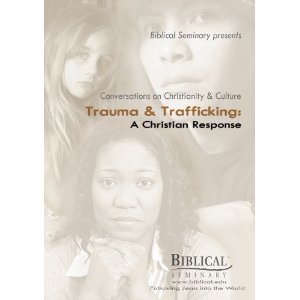
Trauma and Trafficking DVDs on Amazon


Nearly 2 years ago (March 2011), Biblical Seminary put on a conference about the problem of sexual trauma and trafficking. Our speakers included Dr. Diane Langberg (a noted psychologist), Bethany Hoang (IJM), Robert Morrison (a grassroots organizer), and Pearl Kim (now ADA for 2 Philadelphia counties). The sessions covered domestic and international sex trTrauma and Traffickingafficking, abuse and violence against women worldwide, the problem of sexual abuse in christian organizations, and how to mobilize community action without expending energy on non-profit status.

It was a powerful conference…and you can own it for a mere $19.99. Here’s the link to Amazon. Or, you can find it here at Vision Video (along with MP4 options as well) for 20% off.

This DVD set (3 DVDs) are an excellent starting point if you or your church group want to think more deeply about the biblical call to justice in the area of trafficking, trauma, and violence against women, whether “out there” or in the church.

Look for information on purchasing our most recent DVD series, Abuse in the Church, in the next week.


Leave a comment

Filed under Abuse, biblical counseling, Biblical Reflection, christian counseling, Christianity, Christianity: Leaders and Leadership, Diane Langberg, Post-Traumatic Stress Disorder, trauma