Tag Archives: Posttraumatic stress disorder

The biological roots of PTSD…and resilience


Brain structures involved in dealing with fear...

Brain structures involved in dealing with fear and stress. (Photo credit: Wikipedia)

A good friend of mine pointed me to a recent Nature essay that describes the biological markers for PTSD and resilience–and provides some of the answer of why some seem to recover fairly quickly while others continue to struggle. Here’s a couple key quotes:

“Functional magnetic resonance imaging (fMRI), which tracks blood flow in the brain, has revealed that when people who have PTSD are reminded of the trauma, they tend to have an underactive prefrontal cortex and an overactive amygdala, another limbic brain region, which processes fear and emotion…”

“People who experience trauma but do not develop PTSD, on the other hand, show more activity in the prefrontal cortex.”

Of course, we need to understand that we are complex beings with complex histories and current social connections. We don’t only look at neural activity but with increasing understanding, we learn how experiences such as childhood trauma, poor social support influence brain activity.

Some worry that the discussion of biological features of PTSD will lead only to increasing chemical interventions (meds, surgeries, etc.). I do not believe this to be the case given that we are also learning about the ways that current relationships and psychotherapies are altering brain activity.

4 Comments

Filed under counseling, counseling science, Post-Traumatic Stress Disorder, Psychiatric Medications, Psychology

Why is some trauma complex? A helpful distinction from Judith Herman


Counselors talk about trauma as if all traumas lead to traumatic reactions. They do not. Some people have significant distress from what might be considered slight traumatic experiences (surely an oxymoron!) while others appear not have any negative or ongoing reactions to very large distressing events.

There’s another problem. We sometimes talk as if all traumatic reactions are the same. This is also not the case. While the symptoms of posttraumatic stress disorder (PTSD) are well-known to many (i.e., intrusive re-experiencing of trauma experiences, emotional numbing and other attempts of avoiding memories or triggers, and hypervigilance), you can find counseling students and practitioners who are less aware of a cousin of PTSD: Complex Trauma.

Defining Complex Trauma

I’m reading Treating complex Traumatic Stress Disorders: An Evidence-Based Guide, edited by Christine Courtois and Julian Ford (Guilford Press, 2009). This is an excellent text if you are interested in exploring the symptoms, neurobiology, and treatment protocols for complex trauma. In the foreword, Judith Herman helps the reader clarify the main difference between regular and complex trauma

These days, when I teach about complex PTSD, I always begin with the social ecology of prolonged and repeated interpersonal trauma. There are two main points to grasp here. The first is that such trauma is always embedded in a social structure that permits the abuse and exploitation of a subordinate group… The second point is that such trauma is always relational. It takes place when the victim is in a state of captivity, under the control and domination of the perpetrator. (xiv, emphases mine).

For trauma to become complex one needs to experience the trauma at the hands of those who are most perceived to control a social unit (family, community, etc.). It needs to be repeated and woven into the fabric of distorted relationships. You can see that prolonged abuses experienced as a child prior to development of an understanding of the world and of the self would have more devastating impact than an unfortunate and distressing event that happens as an adult. If I experience a horrific accident and an unexpected attack by a stranger, I would not, usually, begin to feel unsafe amongst friends and family. I would likely continue to trust them even as I might not trust the larger community. However, if I experience repeated abuse by a teacher, a parent, a relative, a church leader as a young child, I do not have the prior experiences of safety to rely on and thus, I am likely to experience all of the symptoms of PTSD and then some more.

What More Symptoms?

Courtois and Ford give a cursory description of complex trauma on the first page of the book,

…involving traumatic stressors that (1) are repetitive or prolonged; (2) involve direct harm and/or neglect and abandonment by caregivers or ostensibly responsible adults; (3) occur at developmentally vulnerable times in the victim’s life, such as early childhood; and (4) have great potential to compromise severely a child’s development.

Adding to the typical symptoms of PTSD, complex trauma victims also struggle to regulate emotions, impulses, somatic experiences, consciousness, and evidence significant distortions in views of the self and others leading to difficulty forming trust relationships and finding meaning in life and faith.

Those interested in learning more about the current thinking on complex trauma conceptualization and treatment may find this book useful. Others may wish to check out the latest articles at www.traumacenter.org, one of the leading centers in the country focused on the problem of trauma.

14 Comments

Filed under Abuse, counseling, counseling science, counseling skills, Post-Traumatic Stress Disorder, Psychology, Uncategorized

3 important goals for trauma recovery


In the last week we have been discussing the best words used to describe the process of trauma recovery (see related post below). While words are important and carry much meaning, it may be more helpful to consider what recovery goals are in order for trauma victims. While we know recovery road can be long and arduous, it helps to know when we make progress and a general sense of the direction we are headed. In the days before GPS, if you went on a long car trip you probably consulted a map on several occasions in order to make sure you were headed in the right direction. So also, when you are working to get better after a traumatic experience, you want some sense you are still working on good goals. This need is especially great if the traumatic symptoms are complex and the treatment not brief (think war, genocide, child sexual abuse, etc.)

What three goals?

Esad Boskailo, as noted on p. 94 in his memoir (written and reported by Julie Lieblich) works toward these three goals that in turn support the ultimate goal: thriving (notice that the goal is not being free of symptoms, free of triggers, or back to life as if the trauma did not happen).

  • Acknowledge losses
  • Foster resiliency (i.e., build the capacity to use current coping resources)
  • Find meaning in life again

I think these do function well as helpful signposts or intermediate goals in the process of recovery from traumatic experiences. Now, I don’t believe these goals are necessarily in sequence. For some clients, they stumble on something that gives new meaning to life and thus are better able to acknowledge losses. Others get to work on building better coping mechanisms (e.g., a vet puts away items that cause him or her to dissociate, an adult victim of CSA stops cutting and develops acceptance strategies, etc.) and then can acknowledge losses.

So, in the murky water of therapy (and it surely is murky!), the trauma victim can find some comfort in activities pointing to these intermediate goals. Each day they reject self-condemnation for not being who they used to be before the trauma, they are moving toward thriving. Each day they embrace available coping resources (e.g., a friend who will call or pray), they are moving toward thriving. Each day they find one meaningful experience, they are moving toward thriving.

the how we meet these goals is, of course, the 64,000 dollar question…and not something we can set in stone. I will write on some general activities that are common in most treatment modalities in the coming days.

2 Comments

Filed under christian counseling, counseling, counseling science, counseling skills, Psychology

In Counseling, Who is the Teacher?


Most counselors and therapists get into the field of counseling because they want to help people. This is a good thing! Imagine if they only wanted to make money or to be the center of attention. But, underneath the goal of wanting to help people lurks an insidious goal:

being seen as wise.

Being seen as wise (notice the difference between being wise and being seen as wise) tempts us to become the teacher, the teller, the obnoxious sage.  Teaching, telling, training are all activities that may happen in counseling, but only when necessary. Truth be told, we counselors resort to teaching and telling because it gives us a job to do and makes us feel good. This is especially true when we work with the most severely traumatized people. Here someone is hurting in front of us. We can see that they are stuck. Who wouldn’t want to pull them out of the mud? Now, there may well be important teaching moments–gently instructing someone on the symptoms of trauma and/or the physiology of trauma. This might be important for the client who believes that the symptoms are really signs they are sinning and that they can just choose to stop being triggered.

In Counseling, Who is the Teacher?

“The patient is the ultimate teacher about trauma, and a good therapist is a good listener.” (Boskailo, p. 81)

While the counselor has much to offer in regard to teaching, training, and goal setting, we must remember that the client is the one teaching us about their trauma experiences and how much they can deal with at a given time. For example, Boskailo reminds us (see above link for book) that while telling the trauma story is an important part of the healing process, the “how” of telling (and the “how much”) is something each client will need to teach us. One client may need to tell and re-tell the same story each week. Another may be better helped by drawing. Still another may tell once and never again.

We counselors are the student in these kinds of matters. It is our job to listen well and learn well!

5 Comments

Filed under biblical counseling, christian counseling, christian psychology, counseling, counseling science, counseling skills, Psychology

Military trauma: an opportunity for the church?


There were several military (Army) personnel on our flight to Charlotte yesterday. They announced over the loudspeaker that these men were returning home from a tour of duty in Afghanistan. The cabin filled with applause and many passengers personally thanked them for their service to the country. A couple of people in first class gave up their seats so some could ride in style on their journey home. Most of us felt warm and fuzzy. Certainly this is a better “welcome home” than Vietnam veterans received.

But beneath the good feelings are many trauma wounds that most of us cannot see. As the information trickles out about the rampage killing of Afghanis, we come to find out that the alleged shooter was on his 4th tour of duty and had suffered injury in 2 of the previous tours, including a traumatic brain injury. On top of that he may have been having some marital problems (4 tours could do that to nearly any marriage!).

While nearly all military vets do not go on shooting rampages, we do see that suicide rates have markedly increased, especially among females and reservists in active duty. One newspaper reported that an US vet kills him/herself every 80 minutes–but Iraqi vets do so every 36 minutes. Startling!

One barrier to getting help for symptoms of PTSD is that veterans are less likely to talk to civilians about their struggles. If you haven’t had to kill, it feels like you can’t understand what it is like to live with guilt, memory, of killing. This is understandable–even though civilians willing to listen can be of great help. Thus, it makes sense for every church with active military (or recently discharged) to find someone with street cred to take up the cause of talking to vets as well as their families. Most likely, someone on the front lines comes home significantly changed. If married, you can imagine how that would stress a family. This “chaplain” to vet families could be that person who is able to hear the struggles, point to God’s handiwork, and point to local services when needed.

PTSD is a destructive disease of the whole person. But, it can be treated, managed, and coped with. There are a couple of newer forms of treatment (Prolonged Exposure) that hold much promise. Let us not let these men and women continue to suffer silently. A first class seat can be a wonderful present but an ongoing presence and pursuit once home will have more lasting results.

12 Comments

Filed under Post-Traumatic Stress Disorder, Uncategorized

Health effects of traumatic stress on infants


In Rwanda we hear that children born after the genocide exhibit signs of trauma–even though they did not experience it firsthand. You could hypothesize a number of reasons for this:

  • Hearing of the stories of lost loved ones; being told that their neighbors were killers
  • Having peers in school stigmatize: “You are Hutu, you are a killer. You are Tutsi, you are a cockroach.”
  • Seeing pictures of genocide

Notice that all three have to do with the child’s internalization of trauma through their environment.

But what if their trauma began in utero and biologically altered their capacity to handle stress? Consider these words by Maggie Schauer (available to be seen in context here),

Exposure to significant stressors during sensitive developmental periods causes the brain to develop along a stress-responsive pathway. The brain and mind become organized in a way to facilitate survival in a world of deprivation and danger, enhancing an individual’s capacity to rapidly and dramatically shift into an intense, angry, aggressive, fearful, or avoiding state when threatened. This pathway is costly and non-adaptive in peaceful environments. Babies born with a deformed stress-regulating system (HPA-a) experience higher and faster arousal peaks, longer intervals of crying and irritability, and impaired affect regulation (Sondergaard et al., 2003). (p. 398, emphasis mine)¹

How might this information help us better understand how “the sins of the fathers” (or whoever is the abusive individuals or communities) extend beyond primary victims to those victim’s children? How might this help us train survivors to understand what might be happening in their children and support parenting strategies that will encourage healing. Might it also help survivors to feel less guilty for the struggles of their children? Survivors don’t ask to be abused and can’t help the impact on their children while in utero.

Now, not every child with a “deformed stress regulating system” is that way due to the mother’s stress. We just don’t know why one child has a good stress regulation system and why another does not. But we can say that those whose stress regulation seems broken (or different) likely need different parenting strategies and a different paradigm in understanding volition (will) when it comes to their outbursts.

 ¹ Schauer, M., & Schauer, E. (2010). Trauma-focused public mental-health interventions: A paradigm shift in humanitarian assistance and aid work. In E. Martz (ed.) Trauma Rehabilitation after War and Conflict (pp. 389-428). Springer

Leave a comment

Filed under counseling, counseling science, Psychology, Uncategorized

Getting confirmation on global trauma recovery plans


Since January I have been trying to articulate the best practices in doing trauma recovery or trauma healing work in international settings. The foundation of this approach to trauma recovery is, (a) Listen first to the needs, resources, and concerns of a community(b) identify local leaders who can be trained to be the primary trauma recovery workers (rather than outsiders being the primary clinicians), (c) tailoring interventions to the needs of  the community, and (c) above all…do no harm by over-promising, under-delivering, etc.

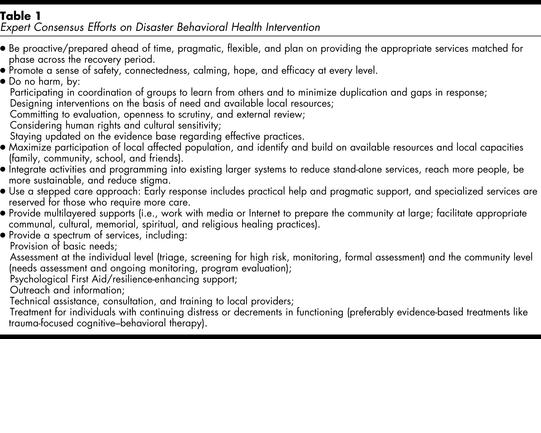
Today, I opened up my most recent American Psychologist (66:6, September 2011) and found my thinking confirmed in Watson, Brymer, and Bonanno’s Postdisaster Psychological Intervention since 9/11 (see citation at the bottom of the page). On page 485 they list what experts consider an appropriate steps to take in postdisaster behavioral health interventions. Now, most of you don’t probably get excited about research articles like this but I can tell you I did. Here’s the chart (click to see a larger image)

It is nice to find confirmation for something I was thinking but hadn’t read elsewhere.

From: Watson, P. J., Brymer, M. J., & Bonanno, G. A. (2011). Postdisaster psychological intervention since 9/11. American Psychologist, 66(6), 482-494. doi:10.1037/a0024806

1 Comment

Filed under Abuse, counseling science, Post-Traumatic Stress Disorder, Psychology, trauma, Uncategorized

When someone you love suffers from PTSD?


Has anyone read this book? The full title is: When Someone You Love Suffers from Posttraumatic Stress: What to Expect and What you Can Do  (By Claudia Zayfert and Jason DeViva (Guilford Press).

If so, any thoughts on it? I do not yet have it in my possession. One of the areas I found wanting re: PTSD is a good book for spouses of survivors of sexual abuse. There was a book that I would use but is no longer in print. Some do read “Stop Walking on Eggshells”, a book about living with Borderline Personality Disorder. While there are relational behaviors commonly seen in people with either complex PTSD or BPD, the two problems are different and sadly, those with complex trauma reactions get stigmatized with the BPD label.

So, if anyone has seen this and wants to lend their comments, I would welcome them here.

4 Comments

Filed under Abuse, Post-Traumatic Stress Disorder, Psychology, ptsd, Uncategorized

Safe churches for sufferers of PTSD?


A friend recently asked me about the characteristics of the kind of church someone with PTSD should seek out in looking for a safe place to heal. I’d like to ask that of my readers. What special characteristics might someone look for as a good church family when they suffer from hidden damage? If YOU were looking for a church and wanted to find a safe, compassionate, sensitive church, what would you look for? What characteristics would tell you that the church was what you wanted?

Preaching and teaching? Interpersonal characteristics? Resources? Characteristics of leadership?

36 Comments

Filed under Abuse, pastors and pastoring, Post-Traumatic Stress Disorder, Psychology

Listening to trauma


Those interested in trauma recovery work in international settings where rape is used as a tool of war will find this article on CNN to be of interest. WARNING: Not for those who are easily triggered by trauma stories!

Here’s a couple of reasons to read the article.

1. Why do this work?

They believe that listening is acknowledgement — and that acknowledgment is a kind of apology. Listening, they say, is the least the world owes.

2. Impact of this work?

You will experience secondary trauma. Don’t think you won’t.

3. How to do this work?

Start with an open question: Tell me about your experience. Look them in the eye. Don’t look at your notepad. If they say, “No, I don’t want to talk,” then leave. If they say, “Yes,” and tell you horrible things, wipe the emotion from your face. Get over being surprised they would tell a stranger, you, such intimate violations.

Know they are telling you because they need to tell someone, for whatever reason. And bearing that in mind, make no promises. Different victims want different things — revenge, financial compensation, asylum, prosecution of their attackers. Tell them that you can only listen, and do only that.

Leave a comment

Filed under Abuse, Post-Traumatic Stress Disorder, Rape