Stopping seasonal high anxieties: Some strategies and a better goal


For most people, anxiety is a looped internal conversation. It just keeps starting over even when we don’t want to listen to it anymore.

The Christmas season we’re in can make anyone quite anxious. (Don’t think so, watch this fun video to remind you why.) Those of us naturally anxious and ruminative find the added responsibilities, family stresses, and disappointments just adding fuel to the fire. You try to take a moment to rest but all you can do is think about what is yet to be done or what you tried to do but failed. You pray but before you finish you are back to your worries. You distract yourself but the looped fears keep running in the background.

What helps you decrease your anxieties and repetitive worries? Can you really suppress them? Or should you have another goal in mind than just trying to shut them down? Are there any practical strategies that work?

Practical Strategies?

Daniel Wegner gave a short award address on this topic at the 2011 APA convention (now found in v. 66:8 of the American Psychologist, pp 671-680). In the address he tells us what we already know. It is hard to suppress thoughts in a direct manner (e.g., I won’t think about how much work I have to do). So, Wegner focuses on indirect strategies. Here is a sample of strategies with empirical support:

  • focused distraction
    • pre-planned alternative topic to think about when the rumination starts. Benefit? Avoids mind wandering which will more quickly return to the anxiety. Example: Every time I think about the conflict at work I will focus on a comforting favorite verse or an upcoming happy occasion.
  • Stress and load avoidance
    • Overall reduction of stress helps reduce unwanted/anxious thoughts. Focused distraction helps only to a point. Overwork which may provide some distraction will increase anxious thoughts over time.
  • Thought postponement
    • Choosing to postpone anxiety to a set time can work to reduce the amount of rumination experienced.  Example: I’ll spend time worrying about my visiting in-laws at 4:30 pm.
  • Acceptance
    • Instead of fighting and arguing with fears some find it helpful to observe fears without taking action. There is some evidence that those who accept the occurrence of unwanted thoughts have less distress than those who fight the thoughts.

Wegner goes on to mention other strategies (i.e., planned exposure, mindfulness, focused breathing, self-affirmation, hypnosis, and journaling) for reducing unwanted thoughts.

 A Different Goal?

What if the goal isn’t to remove or end unwanted thoughts and anxieties but to cope with them and not to be dragged along by them? Does this sound like failure to trust God? Failure to be at peace? if the goal is to trust God in the midst of uncertainty and anxiety, what would that look like? How would you know that you were doing well? To do this we would need to give up on the goal of having an absence of anxiety and to reimagine peace as something one can have in the midst of angst. After all, we are not seeking to be absent from this world but to live in the world that is full of chaos and uncertainty.

Here are two goals you might consider:

  • Being okay with things not done to perfection and with the disappointment of others who have come to expect perfection from you
  • Experiencing anxious thoughts as normal and yet savoring moments of rest when they present themselves
  • Using one strategy for anxiety reduction each day

So, how do you measure your seasonal high anxieties and what goal do you seek to reach during this Christmas season?

4 Comments

Filed under Anxiety, Psychology, Uncategorized

Does sympathy require action?


Can you experience true sympathy towards another but do nothing in response? When you watch people suffering the effects of famine, hear of genocide, see a homeless person begging for money, can you feel sympathy but not do something about the problem?

Consider these opening words of Octavius Winslow, 19th century preacher (in the US and London) in his The Sympathy of Christ with Man: Its Teaching and its Consolation New York: Robert Carter & Brothers, pp iii-iv.

Much that passes for sympathy, and is really so, as commonly understood, is deficient in this one essential element, and needs to be remodeled. There is poetry and there is beauty in real sympathy; but there is more- there is action. True sympathy may exist impotent to aid, we concede, and its silent expression may not, in some instances, be the less grateful and soothing; but the noblest and most powerful form of sympathy is not merely the responsive tear, the echoed sigh, the answering look- it is the embodiment of the sentiment in actual help.

In this book he takes up the action oriented sympathies of Christ. We have a high priest who sympathizes with our state AND acts to do something about it.

Does true sympathy lead to action?

I believe so. Now, I want to be clear that it does not always lead to removing the suffering. It does not always mean immediate and direct help. There are times where the help is indirect. Consider the Scriptures in that the Lord hears the cries of the Israelites enslaved in Egypt and rescues them…some 400 years later. We can’t say that his action was deficient.

Our sympathies may lead to,

  • speaking the truth in love
  • comfort
  • pursuing justice
  • educating others who can do something
  • praying
  • not rescuing someone too quickly from their own tragic choices
  • inviting another to get some help

So, if you feel sympathy and helpless about doing something of value. Think again. What action does the Lord enable you to do “at such a time as this”?

3 Comments

Filed under Christianity, Insight, Psychology, Uncategorized

Characteristics of a competent counselor?


I’ve published another blog post on the Seminary’s faculty blog site. This time, I’ve written a bit on 7 characteristics of a competent counselor. Readers here may remember there was a famous book  by Jay Adams by the title, “Competent to  Counsel”. I’m not trying to compete with that title but rather to focus on the character of the counselor. Too often we worry about the beliefs of the counselor. While beliefs, assumptions, models are very important, they are secondary to the character of the counselor. Having the right model but unable to be kind is a counseling fail. Frankly, choose the kind and humble counselor over the “right” thinking counselor if you have to make the choice between the two. The humble counselor is more likely to keep out of the way of the Spirit’s work in your life.

What are the seven characteristics I look for in my students and that I hope I exude in increasing measure? Read on here.

3 Comments

Filed under christian counseling, christian psychology, counseling, counseling science, counseling skills

New post on creation v. fall approach to relationships


I apologize for the absence here of late. Somehow, my “free time” has been eaten up, this despite my having not taught a class since October 25. Little meetings and assignments add up to a boatload of work! I’m looking forward to getting back into the classroom just so I can have a regular schedule. However, I have a new post up on the Biblical Faculty blog site on the impact of our “glasses” on our relationships. What do you look for most? The good (creation) or the bad (fall) in those around you?

1 Comment

Filed under christian counseling, Christianity, counseling, Relationships

Bookend sins?


Human moral frailty is never singular. Meaning, we don’t sin with just one sin. Every moral failing includes at least 3 parts: deception, action, cover-up. Think of deception and cover-up as bookends and the specific behaviors as the books in the middle. And just as it is hard to keep books on a shelf without bookends, it is hard to do what we know is wrong without deception of self and cover-ups.

What are your versions of bookends that give you “permission” to hate, to excuse, to overlook your faults?

Knocking down the bookends goes a long way to defeating outward sins like abuse as well as inward sins like festering bitterness.

1 Comment

Filed under christian counseling, christian psychology, Christianity, Uncategorized

Meeting with someone who harmed you: What do you need to know?


Harm. Abuse. Accident. There are any number of ways that one human or an institution can harm another. Some “harm” is intended, others unintended. Some completely accidental, others planned and still others the result of unthinking and self-focused neglect.

How you feel about the harm likely has something to do with your assessment of the motives and intent behind the harmful behavior. Now, imagine for a minute that you were about to meet with someone who harmed you in a significant way. Do you know what their motives were at the time of the harm? Do you know how they think about it now? Further, do you know what you think about concepts such as forgiveness and reconciliation? Repentance?

It is my experience that we sometimes rush individuals to meet and reconcile with someone who has harmed them before gathering some important data. Before you meet with someone who has harmed you, consider the following questions in order to clarify what you think and believe:

1. Of the person who harmed me:

  • the intention behind their harmful behavior and their intention behind this meeting (if they requested it)
    • Did they intend to hurt me?
    • Do they want to apologize? Do they want to blame me?
  • their understanding of harm they caused and their current feelings now
    • Do they really believe they caused me harm?
    • Are they remorseful?
    • Have they made changes in their life so this won’t happen again?
  • their current relationship desires and expectations
    • Are they looking for me to forgive them? To forget? To take ownership of a portion of the problem?
    • Do they expect me to act as if it never happened?
    • Do they want me to release them from the consequences?
    • Do they want an ongoing relationship? Do I have the freedom to choose?

2.Of myself

  • Am I ready to speak the truth in love?
    • Am I tempted to sugarcoat the truth? Rage?
    • Am I tempted to offer forgiveness too quickly, too slowly?
  • Do I see the offender as no different from myself, in need of mercy?
  • Do I know what outcome I desire?
  • Am I willing to give a fair hearing rather than prejudge?
  • Do I know the difference between justice and revenge?
  • Do I know the differences between reconciliation, restitution, restoration, and repentance?
  • Do I know what forgiveness looks and feels like (and what it does not look and feel like)?
  • Do I want to forgive even if the person asking for forgiveness doesn’t seem to get how badly they hurt me?

3. Of the system

  • What are the human system consequences of meeting/not meeting. Similarly, what are the consequences of reconciling/not reconciling, forgiving/not forgiving?
  • What are the system pressures/expectations on me?
  • What promises does God provide in the kingdom system? What protections? What comforts?
  • What expectations does God place on Believers? Does the command to forgive mean to forget or live as if it never happened?

It is important to be prayerful as we answer these questions. The intensity of the meeting and the swirling emotions will make it hard for us to evaluate ourselves, the offender, and the system. The more preparation, the better shot we will for being at peace with our responses to a difficult situation.


6 Comments

Filed under Abuse, biblical counseling, Christianity

What to do with Psalm 89?


Check out this blog entry from my colleague, Steve Taylor. Steve helps us consider what to make of the “unrebutted” charges against God found in Psalm 89. If you ever struggle with feeling that God has not kept his promises or struggled with what to do with OT passages that seem to charge God with failure to keep his promises…read this:

Jesus Redeems a Psalm: What a Difference “Christotelicity” Makes!.

1 Comment

Filed under biblical counseling, Biblical Reflection, Biblical Seminary, Doctrine/Theology, suffering

Pray for the Congo (DRC) this week


DRC, orthographic projection.

Image via Wikipedia

Today, November 28, 2011, Congolese have been voting in presidential and parliament elections. For those of you who followed my DRC/Rwanda trip posts, I encourage you to lift up this country, its leaders, and the people. As you likely know, the country has a weak central government, an assortment of militias roaming the north and east, wrecking havoc in the form of rape where ever they go. It is a lovely country, resource rich (minerals) and yet one of the poorest places in the world.

Pray for no violence. Pray for leaders with integrity. Pray for the church to be the church. Pray for nonprofit ministries like the Bible Society in the Congo. Pray for a united will among all the peoples to stand against rape.

Read this short news item in the WSJ on the elections.

Leave a comment

Filed under News and politics

DRC/Rwanda Trip: Final Days


October 21-22, 2011, Kigali, Rwanda

Friday morning and we are up by 6 am. Have to pack this morning because we have to be out of our rooms. As soon as we finish the conference we must say our goodbyes and get to the airport. We have breakfast with Robert Briggs of the American Bible Society. He’s on his way to a United Bible Society meeting in Kenya. Our conference begins with Diane

Planning the next steps

Langberg and Carol King covering the topics of lament and grief. After their presentations, the participants practiced writing their own laments. We made time for sharing them with others. We concluded this section with a choral reading of Scriptural laments. This choral reading was compiled by Lynn MacDougall and quite moving for all. We had enough time before lunch for me to teach a bit on vicarious trauma.

After lunch, I did a short teaching on peer supervision. It is important for these caregivers to support each other and so I taught on how to do case consultations and to write-up case study/questions. After finishing this teaching, Baraka led the participants in a “What next” brainstorm. Their main recommendation was to form an association of counselor/caregivers–Rwandan Association of Christian Counseling as a place to get further support, training and to share resources. They wanted a website that would allow them to connect via social media. As they explored their current needs, many said that the number one need is ongoing mentoring. Others talked of finding ways to get paid for their work in counseling. Many spoke of the need for skills and training in dealing with drug and alcohol issues, sexuality, gender-based violence, depression, and anxiety. They asked for trainings 2 times per year. The group decided to appoint a few of the attendees to a committee to see these recommendations to completion.

We concluded our time by asking them to tell us what parts they liked the most. They liked the small group activities. They wanted these to go longer. They liked the role plays and want more. They would like PowerPoint slides (we didn’t do these but handed out outlines) and for speakers to speak slower English. We promised to send them a PDF of our talks and outlines for them to have in electronic form.

Our final activity was to hand out the certificates for real. I got the pleasure of doing this and getting a hug and a picture from each attendee. We said our goodbyes, made a quick change of clothes and headed off to the car to take us to the airport. Just as we were about to get in the car, we were given handkerchiefs each with notes and signatures from the attendees. A sweet parting gift!

Friday night at 7 pm, we boarded our plane (Brussels Air) to start the trip back home. The flight was full and our seats were all over the plane so no debriefing for us. For the next 10 hours (including a stop in Nairobi), I was jammed into a middle seat without leg room (front role of cattle class). Arriving in Brussels by 6 am, we managed to get coffee, chat a bit with each other, and buy some Belgian chocolates for the family. After a total of 28 hours of travel, we arrived back in Philadelphia, PA. 42 hours of no sleep (all day Friday and the night and then most of Saturday) but I arrived home wired and ready to tell my family about what I had seen. Funny, as I tried to tell them about my trip, I found I was having a hard time making sense of everything. I’m not sure it was just because I was tired but more because I had too many thoughts and feelings and was without words to express it all.

As I post this, I am now 1 month from the end of this trip. It is still hard to be concise about the trip. We learned much, saw much, and have ideas about how we can have an impact on future counseling training in Rwanda and the DRC. Clearly, we need to do more live vignettes for the counselor trainees. And we can impact the area by offering materials to existing schools.

I am blessed to have been able to do this work. Probably more blessed than the recipients! I couldn’t have asked for a more successful trip, better travel connections (well, unless someone has a teleporter lying around), or better travel companions. Can’t wait til the next time.

4 Comments

Filed under christian counseling, Christianity, counseling, counseling skills, Uncategorized

DRC/Rwanda Trip: Day 10


October 20, 2011, Kigali, Rwanda

The second day of our conference with NGO caregivers. Today Bishop Nathan Gasatura joined us from Butare. It is always a pleasure to meet with the Bishop. We had a good lunch meeting with him where we discussed future possibilities of counseling/trauma training in his city. I learned why the national university is not in the capitol but 3 hours south in Butare. When Rwanda and Burundi were one country,

The Bishop grooves to some Gospel

the capitol was Butare and thus it made sense to have the national university there. Oh, and another reason it is good to see the Bishop is that he can really dance.

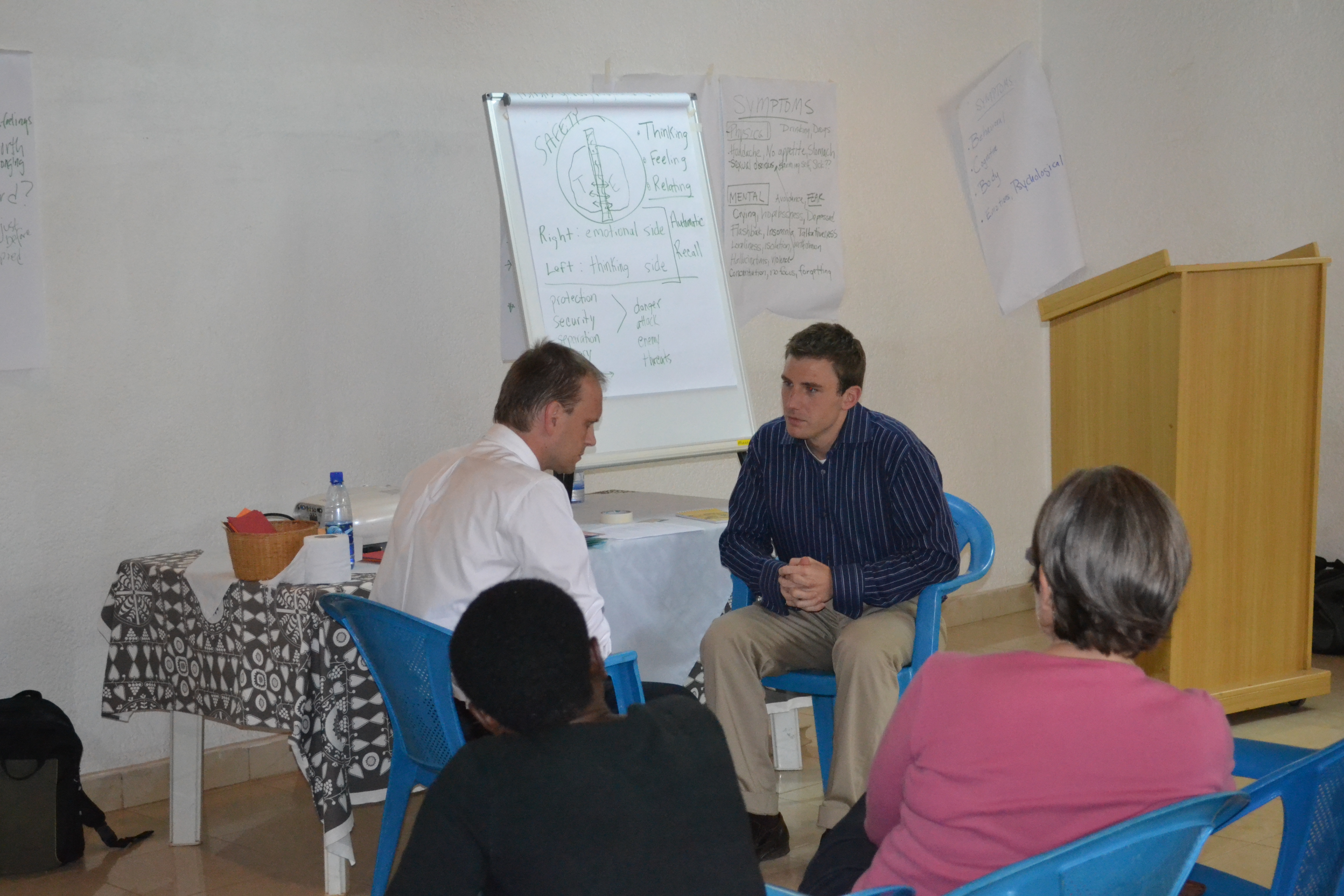
Carol King and I started this morning’s session with a short counseling vignette. I counseled Carol in order to illustrate the skills of bad listening and then good listening, stabilization, and grounding during dissociation. We then talked with them about ways to get another person’s story in bits (rather than all at once) and with their lead (rather than having the counselor pull it out of them). The role play was something that few had ever seen and we had lively discussion afterward, including why I didn’t push Carol (she played a hesitant, fearful counselee) and the issue of exploring emotion. At the end of the conference we learned our role plays were some of the most important parts of the conference.

Later, Josh presented some material on trauma, attachment, and the impact on the brain. To make this presentation practical, we did another role play where I was the counselee and Josh the counselor. We illustrated (in a rather speeded up illustration) portions of the levels of repair: telling the story, re-framing the story (in a wider truth), re-writing the story

Josh counseling Phil

, and re-connection with others. We concluded this time by having them practice counseling each other with a focus on drawing out emotions in the story. We had another great discussion about culture and emotion as well as the cultural differences between the US and Africa (counseling as listening vs. counseling as advising and solving problems).

The evening concluded with a party and hors d’oeuvres. It was an amazing celebration where many of the women wore traditional attire. We danced (I tried), sang scripture songs, heard silly riddles, and cultural stories. Then, we concluded with a ceremony of giving out the certificates. Normally, we would do this on Friday night at the conclusion of the conference but many wanted to receive their certificate in their traditional dress and we were leaving immediately after the conference ended on Friday so we determined to do this tonight. It was a time full of celebration and joy and a wonderful reminder of one antidote to trauma–communal celebration.

2 Comments

Filed under christian psychology, counseling, counseling skills, Rwanda, Uncategorized