Pray for the Congo (DRC) this week


DRC, orthographic projection.

Image via Wikipedia

Today, November 28, 2011, Congolese have been voting in presidential and parliament elections. For those of you who followed my DRC/Rwanda trip posts, I encourage you to lift up this country, its leaders, and the people. As you likely know, the country has a weak central government, an assortment of militias roaming the north and east, wrecking havoc in the form of rape where ever they go. It is a lovely country, resource rich (minerals) and yet one of the poorest places in the world.

Pray for no violence. Pray for leaders with integrity. Pray for the church to be the church. Pray for nonprofit ministries like the Bible Society in the Congo. Pray for a united will among all the peoples to stand against rape.

Read this short news item in the WSJ on the elections.

Leave a comment

Filed under News and politics

DRC/Rwanda Trip: Final Days


October 21-22, 2011, Kigali, Rwanda

Friday morning and we are up by 6 am. Have to pack this morning because we have to be out of our rooms. As soon as we finish the conference we must say our goodbyes and get to the airport. We have breakfast with Robert Briggs of the American Bible Society. He’s on his way to a United Bible Society meeting in Kenya. Our conference begins with Diane

Planning the next steps

Langberg and Carol King covering the topics of lament and grief. After their presentations, the participants practiced writing their own laments. We made time for sharing them with others. We concluded this section with a choral reading of Scriptural laments. This choral reading was compiled by Lynn MacDougall and quite moving for all. We had enough time before lunch for me to teach a bit on vicarious trauma.

After lunch, I did a short teaching on peer supervision. It is important for these caregivers to support each other and so I taught on how to do case consultations and to write-up case study/questions. After finishing this teaching, Baraka led the participants in a “What next” brainstorm. Their main recommendation was to form an association of counselor/caregivers–Rwandan Association of Christian Counseling as a place to get further support, training and to share resources. They wanted a website that would allow them to connect via social media. As they explored their current needs, many said that the number one need is ongoing mentoring. Others talked of finding ways to get paid for their work in counseling. Many spoke of the need for skills and training in dealing with drug and alcohol issues, sexuality, gender-based violence, depression, and anxiety. They asked for trainings 2 times per year. The group decided to appoint a few of the attendees to a committee to see these recommendations to completion.

We concluded our time by asking them to tell us what parts they liked the most. They liked the small group activities. They wanted these to go longer. They liked the role plays and want more. They would like PowerPoint slides (we didn’t do these but handed out outlines) and for speakers to speak slower English. We promised to send them a PDF of our talks and outlines for them to have in electronic form.

Our final activity was to hand out the certificates for real. I got the pleasure of doing this and getting a hug and a picture from each attendee. We said our goodbyes, made a quick change of clothes and headed off to the car to take us to the airport. Just as we were about to get in the car, we were given handkerchiefs each with notes and signatures from the attendees. A sweet parting gift!

Friday night at 7 pm, we boarded our plane (Brussels Air) to start the trip back home. The flight was full and our seats were all over the plane so no debriefing for us. For the next 10 hours (including a stop in Nairobi), I was jammed into a middle seat without leg room (front role of cattle class). Arriving in Brussels by 6 am, we managed to get coffee, chat a bit with each other, and buy some Belgian chocolates for the family. After a total of 28 hours of travel, we arrived back in Philadelphia, PA. 42 hours of no sleep (all day Friday and the night and then most of Saturday) but I arrived home wired and ready to tell my family about what I had seen. Funny, as I tried to tell them about my trip, I found I was having a hard time making sense of everything. I’m not sure it was just because I was tired but more because I had too many thoughts and feelings and was without words to express it all.

As I post this, I am now 1 month from the end of this trip. It is still hard to be concise about the trip. We learned much, saw much, and have ideas about how we can have an impact on future counseling training in Rwanda and the DRC. Clearly, we need to do more live vignettes for the counselor trainees. And we can impact the area by offering materials to existing schools.

I am blessed to have been able to do this work. Probably more blessed than the recipients! I couldn’t have asked for a more successful trip, better travel connections (well, unless someone has a teleporter lying around), or better travel companions. Can’t wait til the next time.

4 Comments

Filed under christian counseling, Christianity, counseling, counseling skills, Uncategorized

DRC/Rwanda Trip: Day 10


October 20, 2011, Kigali, Rwanda

The second day of our conference with NGO caregivers. Today Bishop Nathan Gasatura joined us from Butare. It is always a pleasure to meet with the Bishop. We had a good lunch meeting with him where we discussed future possibilities of counseling/trauma training in his city. I learned why the national university is not in the capitol but 3 hours south in Butare. When Rwanda and Burundi were one country,

The Bishop grooves to some Gospel

the capitol was Butare and thus it made sense to have the national university there. Oh, and another reason it is good to see the Bishop is that he can really dance.

Carol King and I started this morning’s session with a short counseling vignette. I counseled Carol in order to illustrate the skills of bad listening and then good listening, stabilization, and grounding during dissociation. We then talked with them about ways to get another person’s story in bits (rather than all at once) and with their lead (rather than having the counselor pull it out of them). The role play was something that few had ever seen and we had lively discussion afterward, including why I didn’t push Carol (she played a hesitant, fearful counselee) and the issue of exploring emotion. At the end of the conference we learned our role plays were some of the most important parts of the conference.

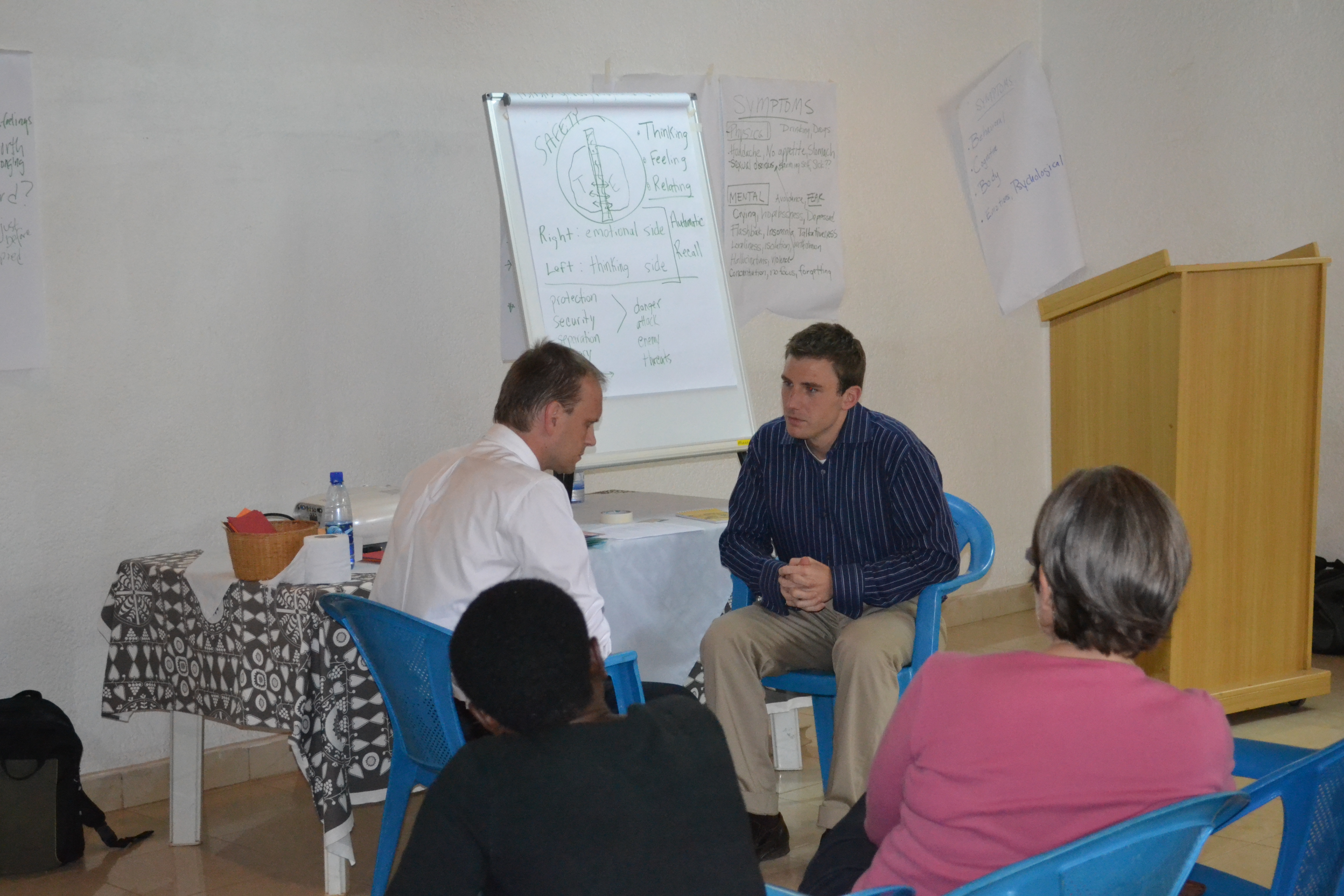
Later, Josh presented some material on trauma, attachment, and the impact on the brain. To make this presentation practical, we did another role play where I was the counselee and Josh the counselor. We illustrated (in a rather speeded up illustration) portions of the levels of repair: telling the story, re-framing the story (in a wider truth), re-writing the story

Josh counseling Phil

, and re-connection with others. We concluded this time by having them practice counseling each other with a focus on drawing out emotions in the story. We had another great discussion about culture and emotion as well as the cultural differences between the US and Africa (counseling as listening vs. counseling as advising and solving problems).

The evening concluded with a party and hors d’oeuvres. It was an amazing celebration where many of the women wore traditional attire. We danced (I tried), sang scripture songs, heard silly riddles, and cultural stories. Then, we concluded with a ceremony of giving out the certificates. Normally, we would do this on Friday night at the conclusion of the conference but many wanted to receive their certificate in their traditional dress and we were leaving immediately after the conference ended on Friday so we determined to do this tonight. It was a time full of celebration and joy and a wonderful reminder of one antidote to trauma–communal celebration.

2 Comments

Filed under christian psychology, counseling, counseling skills, Rwanda, Uncategorized

DRC/Rwanda Trip: Day 9


October 19, 2011, Kigali, Rwanda

Finally! Our conference begins. 19 separate group represented here for a total of 42 caregivers. Baraka Unwingeneye (IJM and lay counselor trainer) opened the conference with small and large group discussions on the causes, symptoms, and definition of trauma. The participants were active in discussions. The energy is high! Baraka concluded her section by reminding us all that everyone can be traumatized, even the strong in body and faith. Diane then spoke for 50 minutes or so on the nature of traumatic memory and an overview of the first two phases of intervention. Her voice was a bit weak as she came down with a cold but she delivered it well just the same. Her outline provided a useful reminder of treatment necessity: talking…tears…time. She concluded with some discussion of how having healing relationships, a purpose, and faith all play significant roles in the recovery process.

We ended the morning with a handkerchief project where participants created a depiction of their grief/suffering and then shared it with others. We knew this was going to be powerful and that it would take time. However, we were somewhat surprised at just how powerful it was and how much the participants valued telling others (in dyads and groups) a portion of their trauma story. Several told us that even though they had been counseling others since the genocide in 1994, they had never told anyone their own trauma story.

Our afternoon continued with small and large group activities/discussions and concluded with a question and answer session. The group is hungry for information and we do not have to do much to encourage conversation, discussion, and engagement. Our late afternoon and evening is spent resting, planning for tomorrow’s work and enjoying each other’s company. The food continues to be outstanding at Solace. The only complaint I have is how early the roosters and birds start calling. 4 am is way too early for this. Just outside my window is something sounding like a bird having swallowed a bugle. I later discover it is the gray crowned crane. Here’s a short video I shot from my balcony where I got it to “sing.”  (photos by Joshua Straub)

Leave a comment

Filed under AACC, counseling, counseling skills, Post-Traumatic Stress Disorder, Rwanda, trauma

DRC/Rwanda Trip: Day 8


Tuesday, October 18, 2011, Kigali

Today is our first relaxed day of the trip. We begin the day by having devotions with the staff at IJM. Josh led them in some thoughts from the book of James on themes of justice and justified. The Apostle Paul illustrates the payment (transaction) for justification found in the cross. James points us to the evidence (receipt) of our justification found in our works that prove we have been justified. There is no faith without works.

After devotions, we went to a very American looking cafe to have coffee and to go

Good coffee good colleagues

over the conference plans with IJM employee and counselor Baraka Unwingeneye. She and Josephine Munyeli (WorldVision) are our co-laborers and without them we would not be able to do this work. Our planning helps us nail down tomorrow’s conference efforts. We know we have good ideas for days 2 and 3 but we must be flexible and alter what we want to do for what can be done well.

Walked back to Solace for lunch and then out for a stroll of nearby streets with Carol. Just prior to dinner we received a visit from Rev. Nathan Ndyamiyemenshi at ALARM. He took us to see their retreat property on a lovely hill on the edge of Kigali. A beautiful spot for anyone who would want to take a group to Rwanda. One of the buildings had a plaque stating that it was a donation from Calvary Church of Souderton!

On the return to Solace, we stopped off to by Rwandan coffee beans to bring home. Speaking of home, I am getting homesick. While it is good to have a restful day, I am ready to get on with our conference and go home. Good that we start tomorrow.

2 Comments

Filed under counseling, Rwanda, trauma

Truth or Lie? Sandusky interview answers and the questions they raise


Did you catch the Bob Costas/Sandusky telephone interview last night as it aired on NBC? I did not but heard a rebroadcast on the radio this morning. If you didn’t hear it and you want to read it, follow this link.

Now, before I begin some exegetical questions, let me say that I am not a forensic psychologist and I don’t play one on TV. I have had graduate coursework on the topic, attended trainings, been supervised in juvenile and adult forensic cases by experts and benefited from the works of Anna Salter.

I also believe that how people answer may sometimes reveal clues to the truth. In other words, people can tell more truth than they intend as they try to lie. I am not saying that I know where Sandusky is lying. I do not. And TV shows that illustrate that “experts” can uncover lies in 30 minutes or less are fun but not particularly factual.

Disclaimers aside…check out some of these interesting exegetical problems (from the website above):

BOB COSTAS: Mr. Sandusky, there’s a 40-count indictment. The grand jury report contains specific detail. There are multiple accusers, multiple eyewitnesses to various aspects of the abuse. A reasonable person says where there’s this much smoke, there must be plenty of fire. What do you say?

JERRY SANDUSKY: I say that I am innocent of those charges.

BOB COSTAS: Innocent? Completely innocent and falsely accused in every aspect?

JERRY SANDUSKY: Well I could say that, you know, I have done some of those things. I have horsed around with kids. I have showered after workouts.  I have hugged them and I have touched their leg.  Without intent of sexual contact. But — so if you look at it that way – there are things that wouldn’t — you know, would be accurate.       

“I could say that”? “So if you could look at it that way…”? These suggest that there are some creative ways to look at the facts and that Sandusky is trying to view them from some of these creative ways. Wouldn’t you expect that he would be very straight forward on what did happen. For him, there should be no two ways to view something.

Here’s the next pause I had:

BOB COSTAS: What about Mike McQueary, the grad assistant who in 2002 walked into the shower where he says in specific detail that you were forcibly raping a boy who appeared to be 10 or 11 years old? That his hands were up against the shower wall and he heard rhythmic slap, slap, slapping sounds and he described that as a rape?

JERRY SANDUSKY: I would say that that’s false.

Maybe I’m being picky but, “I would say,” sounds like he is shaping a response. Either it is true or it is false. Wouldn’t you want to shout, THAT IS A COMPLETE LIE, if someone made this false allegation about you? He seems to be saying more than just a denial of McQueary’s allegation. It sure sounds that he is shaping his own reality.

Later he is asked by Costas if he feels guilty for what is happening to all at Penn State. In fact, Costas asks him, he says he doesn’t know what Costas is asking. Costas clarifies with this:

BOB COSTAS: Do you feel guilty? Do you feel as if it’s your fault?

JERRY SANDUSKY: Guilty?

Does he still not get the question? Answering questions with questions is one way that some deflect. It takes a 3rd attempt before he can answer with a “no.”

Later there is this exchange with the same style, using a question to answer a question:

BOB COSTAS: Are you sexually attracted to young boys, to underage boys?

JERRY SANDUSKY: Am I sexually attracted to underage boys?

BOB COSTAS: Yes.

JERRY SANDUSKY: Sexually attracted, you know, I enjoy young people. I love to be around them. But no I’m not sexually attracted to young boys.

Again. Why would one even waffle here for a second. Did he not understand the question that he needed to repeat it? If he is not sexually attracted to boys then he can answer an emphatic NO. Other forms of attraction (filial, ministerial empathy) wouldn’t even come to mind as you deny the allegation.

One of the ways that people lie is that they spend far too much time parsing questions in order to answer truthfully one portion and to ignore another portion so they can comfort themselves with the feeling they are telling the truth.

Now, to be fair to Sandusky. I do not know if his answers reveal that he is lying or that he is just tense and having a hard time with the questions. All I do know is that he answers in a manner similar to those who are known to be lying. Repeat the question; “I would say”; “If you look at it that way”

Bottom line. When we lie, sometimes we tell on ourselves.

1 Comment

Filed under Abuse, self-deception

DRC/Rwanda Trip: Day 7


October 17, 2011

Monday morning dawns bright and beautiful. By 9 am we are traveling the one mile to the border with Rwanda. At the border we have DRC officials stamp our passports with exit stamps and walk the thirty yards or so to the Rwandan border guard stations. There, they look in our bags for contraband and plastic bags (banned from the country). Once through the border, we board a private bus and begin the 3 hour trip to Kigali, the capital of Rwanda. The drive is beautiful. Immediately, you notice that the roads are paved, smooth, and the properties neat and tidy. We climb steeply among verdant hills covered with terraced gardens. Low hanging clouds sweep by and leave a misty residue. We see waterfalls as we climb higher. As I look at the beauty I keep imagining what it must have been like for nearly 2 million Rwandans fleeing to Goma to escape the violence back in 1994 and then again in 1996 when many were repatriated under pressure.

As always, Rwanda travel gives you many vistas as we make switchback turns. Around lunchtime we stop in Musanze area to eat at the Ishema Anglican hotel. This area is near where tourists come to plunk down $500 to go see silverback gorillas in the wild. This picture is off their website and is pretty much like the view we had in the restaurant, looking into a quiet interior garden. No windows or doors marking the room from the garden. Beautiful.

We traveled the rest of the way to the capitol without problems, said goodbye to the other members of the DRC trip (Bagu, Harriet, Margaret, and John), and moved on to Solace Ministries, a guesthouse and conference center in Kigali and our home for the next 5 days. As we traversed the city, familiar sights of places came into view. However, changes are quite obvious too. Several locations that held shanty towns in 2009 were green spaces now. I wonder what has become of those who lived there in abject poverty.

Entering the main building of Solace, we were greeted by our Rwanda trip partners, Josh Straub (AACC) and Carol King (Langberg & Associates colleague). They had arrived the previous Saturday and were in a meeting with some other trauma recovery counselors. We sat down and commenced 3 hours of meetings without hardly a breath. Later, our friends told us we looked rather haggard. I guess the DRC will do that to you. I remember having a hard time putting my thoughts together for Bishop Alexis in talking about possible next steps in our counselor training efforts. We ended the evening with a wonderful, 3 course meal. The cook at Solace provided incredible meals for us. We never ate better. Simple, delicate foods with an African touch. If you ever want to stay somewhere in Rwanda, I highly recommend Solace.

Leave a comment

Filed under Uncategorized

Another reason why we don’t report abuse


In the wake of the Penn State scandal I wrote this post about some of the reasons we fail to report abuse. My wife reminded me of one more that I think we have to consider. Beyond our denial, beyond our fear of begin exposed, beyond our desire to protect beloved institutions, beyond our gullibility when winsome abusers confess to little crimes in order to assuage our concerns…there is another reason: guilt.

What guilt, you ask? The guilt in being “the cause” of destroying someone’s career. We know that founded sexual abuse will (should) end someone’s people-helping career. In this regard, sexual abuse is a capital crime. A person might not hang for it but if they now are a convicted sex offender, they probably won’t be able to find employment as a pastor, teacher, counselor, etc.

Notice I put the cause in the previous paragraph in quotes. If we are in the position of reporting a sex offense, we have done nothing to destroy that person’s career. If the offense has been committed, the offender has destroyed their own career and family.

And yet, when we report someone we know, we feel guilty. We may feel as if we are the cause of their loss of their reputation and career. We worry about what will become of their family. How will they ever be able to support their loved ones? What will become of their children? Sometimes the guilt is enough to cause us to waffle. Maybe we can just move them along to a new venue. Maybe starting over will help them put this awful chapter behind them. Maybe they have repented and won’t do it again. Maybe they will make better choices and avoid prior temptations.

In addition, many of us have heard of those who were falsely accused. We have seen or heard of the devastating impact of a lie. And we wonder, what if we are wrong? What if there is another explanation?

So we hesitate. And once we let some time pass, we rarely activate to do the right thing.

4 Comments

Filed under Abuse

Counseling as Global Mission of the Church


A few days ago I wrote this for our seminary’s blog regarding how counseling supports the global mission of the church. If you are interested in international counseling work…you need to read this blog and follow the link I promote.

Counseling as Global Mission of the Church.

Leave a comment

Filed under christian counseling, christian psychology, Christianity, counseling science, counseling skills, Cultural Anthropology, ethics, Uncategorized

Failures to act: Why we don’t always blow the whistle on abuse


Outrage. Befuddlement. Demands for the heads of leaders who probably knew something but didn’t appear to act. Righteous indignation against those who merely met legal obligations to report abuse but failed moral obligations to stop abuse.

Right now, in most of the country but especially in Philadelphia, you cannot turn on the television or listen to the radio without encountering such comments about the Sandusky/Penn State sexual abuse scandal. In my county, democrats control the county leadership for the first time in 140 years but no one seems to give that much time because of the outrage about this case. What people are talking about is, (a) why didn’t those who knew something was amiss do more to investigate abuse, and (b) what should happen to those people who failed to stop the abuse.

What would you have done?

If you are like me, you imagine that you would have acted to stop the abuse. You would have grabbed the boy out of the shower. You would have screamed bloody murder until someone took notice. You feel righteous indignation that no one seems to have had the moral fortitude to deal with this issue head on.

And you would be right to feel this way. But while we are holding leaders accountable for their failure to act and to protect (as well we should!) let us take a moment and address some of the reasons why we might not be quite as action oriented as we imagine ourselves. By doing so, we may make it more likely that we will respond correctly should we face the unfortunate situation of reporting someone we know to the authorities.

Here are some of the reasons we fail to intervene when intervention is needed:

Self protection

Worry about personal consequences can hinder our taking action. Thinking about how we will be treated, viewed, responded to can cause us to pause and not act. What if I get fired? What if this abusive person targets me? What if someone were to make an allegation about me? I wouldn’t like that so I don’t want to stir up trouble for this person.

Have you ever wondered why so many drivers flee the scene of a pedestrian/car accident–even when they were not at fault? We want to avoid facing the possibility that we might have done something wrong.

System protection

We sometimes worry about how the organization will be treated or viewed if abuse comes to light. Far too frequently individuals have covered up the sins of church leaders for fear of ruining the reputation of the congregation. This reason is also seen in the next two reasons. We don’t want people to turn away from God so we cover up what happened.

Groupthink

We’d like to think that with a larger group of individuals, sensibility will prevail. But my experience with institutions dealing with a sensitive issue suggests that once a group is deciding how to respond to abuse, it devolves into who has the loudest voice in what should be done next. Unfortunately, the loudest voice may be about liability (vs. morality) or outer reputation (vs. protection of victims). Also, groups often fail to address pertinent issues and alternative responses due to groupthink. Some of the reasons why this is the case can be found in Wikipedia’s definition.  One other thing about groups. We have ample evidence that individuals in a group setting are less likely to intervene when they witness violence happening to someone else. We’re more likely to act if we witness this when alone. Why is this? We may feel less responsibility when others are around.

Denial

We like to keep the good people good and the bad people bad. When those who are considered good do bad things, we can fall prey to denial. It is not possible. I know him. He couldn’t possibly do that. Thus, we deny what we have seen and that leads to the next reason.

Self doubt

Have you ever witnessed something troubling but then wondered if you really saw what you thought you saw? Maybe you catch a glimpse of an adult smacking a child in a parking lot as you drive by. Do you stop and confront? Well, maybe you didn’t really see that. Maybe there is some other explanation that might make this acceptable. When the abuse is done by someone we respect, it is easy to think we must have misconstrued it. And once we hesitate, it is that much harder to activate to do the right thing.

Winsomeness of the abusive person

It is important to remember that the most dangerous abuser is the person who is inter-personally winsome. The reason why a person can have access to others and can get away with abuse is often due to their capacity to put others at ease. Most abuse is not done by those who are revolting to others just because they don’t get opportunity. I know of individuals who were caught in acts of child abuse, questioned by authorities, and so winsome that the investigation was dropped before completed. They provide plausible even highly believable explanations that help the questioner feel at ease. They appear to be open and concerned. They are so good they convince most that such abuse could never happen by their hand. It takes a very expert examiner to catch them in the subtle lies they tell to themselves and to others. Check out Anna Salter’s book on predators if you want to see what she has learned from decades of interviewing known, convicted sex offenders.

It is easy for us to sit in the chair of judgment when we hear of cover-ups and failures to act. These failures to protect children do need to be judged and we ought not shrink back from administering restorative justice for abuse and for the inaction of others. However, let us remember that the work of being light in the midst of darkness has many enemies. Our own weaknesses plus the pressures of our community and the manipulative actions of offenders conspire to make inaction the easier choice.

May we take the high road as we encounter abuse in any form.

11 Comments

Filed under Abuse, Christianity, church and culture, Cognitive biases, Cultural Anthropology, deception