Category Archives: counseling skills

Summer counseling courses announced!


Biblical is offering 2 fantastic summer counseling courses for your consideration.  In both classes, you will walk away with practical tools! Both classes are hybrid (meaning you have both online and in person portions) and can be taken for 1 or 2 credits or for continuing education. Click the attached PDF  for more details: BIB-0112-BFINAL. The classes are:

One Session Coaching: Action Focused Change

Taught by Pam Smith, VP for Student Advancement and Coach

When? July 6-7 at Biblical Seminary: Who should take the course? Counselors and church leaders.

Abuse in the Church: Biblical, Legal, & Counseling Perspectives

Taught by my self and Boz Tchividjian (Liberty Law School, founder of GRACE, and a former child abuse prosecutor)

When? July 20-21 (at BranchCreek Church, Harleysville, PA) Who should take this course? Anyone who wants to see the church a safer place. Breakout sessions will focus on counselors and also church leaders.

Both courses are expected to fill up fast given their practical focus. Sign up ASAP by contacting either,

Leave a comment

Filed under Abuse, biblical counseling, Biblical Seminary, christian counseling, christian psychology, Christianity, counseling, counseling science, counseling skills, pastors and pastoring, Psychology, Uncategorized

The Journal of Biblical Counseling is Back!


Those of you familiar with the wider field of Biblical Counseling and of the leading role played by the Christian Counseling and Educational Foundation may be interested to know that they have re-launched their popular journal after being on hiatus since 2007. the Journal of Biblical Counseling (v. 26) is available for FREE here on their website. You can download individuals articles or the entire issue for free, OR…you can order a print version for a fee if you would rather touch the pages.

I would especially point readers to Mike Emlet’s helpful essay on psychoactive medications, Julie Lowe’s essay on counseling children, or any of the book reviews. All well worth your time!

It may not be free for long so take advantage of this resource.

4 Comments

Filed under CCEF, christian counseling, counseling, counseling skills

Translating EFT into Christian Psychology? Publication notice


My friend and colleague Mike McFee (Eastern University) and I recently had an article published in the latest edition of the Journal of Psychology & Christianity (v. 30, pp 317-328). In it we tried to tackle how someone from a Christian Psychology perspective might interact with Emotion-Focused Therapy, a popular treatment protocol.

Here’s how we started our paper,

Emotion-Focused Therapy (EFT) is a rapidly growing treatment system offering empirically based treatment for couples and families. As with many current secular theories of psychology, EFT is embedded in humanistic assumptions which propose a few challenges to the Christian practitioner…. Using the methodology of Eric Johnson…this essay explores the practices of translating EFT into a Christian Psychology.

Next we identify a problem for counselors. We say that being christian and thinking christianly is supposed to influence all that we do. But, the truth is much of what goes on in Christian counseling doesn’t look that much different from counseling from markedly different ideologies. Both are compassionate and use similar techniques. The problem isn’t always bad integration but that we haven’t defined well the various levels of translation between two languages (i.e., humanistic founded EFT and Christian psychology).

The rest of the essay explores the two languages and 3 kinds of translation possibilities depending on the context and need, rather than is a one-size-fits-all approach. We conclude with a case example and actual dialog to show one kind of translation work.

What are the 3 kinds of translation? You’ll have to read if you want to know? There has to be SOME mystery, right?

7 Comments

Filed under christian counseling, christian psychology, Christianity, counseling, counseling science, counseling skills, Psychology, Uncategorized

Financial questions about becoming a Christian psychologist


Recently, I received a  blog comment to an post I wrote a year ago about the decision process for those thinking about pursuing doctoral programs in psychology. You can read that old post here. In response, Emily asked,

I’m really wondering what you’re thoughts are on places like Rosemead and Fuller. They appear to be wonderful institutions but I have heard that students come out with $100,000+ worth of debt. Is that really worth it, or would it be just as well to get two separate degrees – one in psychology and one in theology. Doing my own research, I’ve discovered that to get a PsyD at Rosemead would cost me over $200,000 for 5 years. That includes tuition, miscellaneous fees, books, and the cost of housing in SoCal. I just can’t decide whether it’s worth it or not and I would love to know the thoughts of a Christian Psychologist on this.

Emily’s question is very important. Much of the time, we answer questions about doctoral training by discussing career goals, philosophy of education, and theological training. However, it is a huge oversight to ignore the high cost of a doctorate in clinical psychology. So, I want to respond to the issue of economics by raising a few questions for the person considering doctoral education.

What is your desired career outcome? Is it necessary to have a doctorate?

Wait, this doesn’t sound like an economics question, right? Well, if you are thinking about taking on a sizable debt then you ought to consider whether or not you absolutely need to do it. If you want to be a professor in a University, then you’d better be looking for a PhD (probably over a PsyD which tends to cost more). If you want to counsel people, you might not need a PhD or PsyD. You might be fine with a Masters’ degree and really good supervision by a doctoral level psychologist. If you really want the extra years of training and the possiblity of supervising others, then maybe the doctorate is right for you. If you don’t know if you need a doctorate for what you want to do, then find out first before you take on the debt load.

Can I find a cheaper PhD/PsyD program?

Some of the Christian programs tend to be longer and therefore more costly. The reason is that these programs believe (rightly so) that theological training is essential. While I am a proponent of an integrated (theological and psychological training), you may be able to find cheaper theological training and mentoring in another format while completing a secular (and shorter) degree program in clinical psychology. It is possible that a seminary degree or certificate in theological or biblical studies will provide you want you need. Or, you may be able to befriend a well-trained pastor or counselor who will mentor you for free or for a meal and and coffee. The question you need to evaluate is whether you want theological competency or a degree to show up on your vita? Do you need to get the official “blessing” of a degree to get a job?  Are you prepared to complete a secular based psychology degree and confident that your value system will remain intact? If not, you could undertake some graduate training in theology first and then complete your doctoral training elsewhere.

What is the likelihood you can pay off your school debt quickly?

Will you be able to secure a job that pays well enough to pay off your debt, pay your living expenses and/or purchase a house at the same time? Are you wanting to be a missionary psychologist with a 200K debt? Do you know what the going salary is for individuals working in the field you want to enter? You should check out www.apa.org for some very helpful data (search their site for “salary” and check out the information) such as this link or this one on the current debt load and salaries of the field.  Some psychology grads have been able to land jobs that enable them to pay off federal loans in an abbreviated fashion in return for their years of service in an underserved population.

One way that students reduce their debt is by (a) marrying someone rich (just kidding…though I was married to someone able to command a great salary), (b) working full-time while going to school full-time, (c) reducing expenses by living in a communal setting, or (d) getting work study for tuition reduction. Options A and D may be limited. Option B is possible but may drive you insane as you do it.

Finally, do you have family/friends who want to give to your educational needs?

I know of a student who held a dinner for important friends/family/church members in the church basement. After the meal, he made a presentation to all about his educational dreams and desire for training. He asked them to give…and they did. I imagine there might be some creative ways for people to give and get a tax credit for it. If what you want to do is important and will fill a void…someone might be willing to help fund you. Friends? Family? Church? Employer?

I was blessed by being able to get through a 5 year (4 years of coursework and 1 year postdoc year) program with no debt at all. We lived very frugally. My wife had a great job. We received some inheritance. I worked a couple of different part-time jobs. Somehow, we survived for a year of postdoc life with a newborn (adopted even! Thank goodness for adoption tax credits) on about 11,000 dollars of salary. The Lord provided. The degree was absolutely essential for what I wanted to do.

If you are thinking about this kind of major decision. Pray. Ask for those you trust to offer their advice and to pray with you for an open door.

6 Comments

Filed under christian counseling, christian psychology, Christianity, counseling, counseling skills, Psychology, Uncategorized

How to evaluate a counseling model or intervention: Step four


Picking up on this series that was started last week, we come to the next-to-last step. Thus far I have suggested that whenever you are exploring the next best thing in counseling, you should

  • start with a healthy dose of suspicion about the motives and goals of the author. What are they trying to sell you?
  • Read with an open mind. Can you see what they observe about life?
  • Evaluate the author’s assumptions, worldview, etc. Be willing to be challenged!

Now we come to step four.

Step Four: Let yourself be critiqued

How might their observations and assumptions challenge your own? Sit with this a bit. Don’t worry that you will lose your faith. It never hurts to have our beliefs and values refined and challenged by our critics. Maybe some of your values are uncritically formed. How might these assumptions cause you to refine and renew your own? Can you eliminate some faulty logic?

Be willing to state some of the weaknesses within your own system of beliefs and assumptions. I wish every model builder would start with their own flaws. But, most of us are better at pointing out the speck in our brother’s eye than addressing the log in our own.

Finally, our next step will be to possibly adopt some portion of the model or intervention into our own repertoire.

Leave a comment

Filed under biblical counseling, christian counseling, christian psychology, Christianity, counseling, counseling science, counseling skills, Psychology

How to evaluate a counseling model or technique: Step three


In my two previous posts I suggested that the best way to evaluate “the next best thing” in counseling models or techniques is to start with a healthy dose of suspicion and then to read with an open mind as you try to enter their world and see what they see. Now, moving on to step three, I recommend that you take a look under the hood.

Step Three: Evaluate Assumptions

Whether you are considering adopting a whole model of counseling or merely a technique, you want to step back a bit and assess what assumptions and presuppositions color the author’s view of the world. If you adopt any portion of the model, you will be likely to adopt some portion of their assumptions. In evaluating assumptions, I find it best to ask yourself a few questions,

1. What presuppositiong, worldview, beliefs, etc. bleed through on their pages? Do they focus most on nature? Nurture? Individualist? Communitarian?

2. What ideas and values seem to be most prominent for this author, especially about human nature, health, healing, struggle, etc.

For some authors (especially model builders) assumptions are handed to you on a platter. When Carl Rogers said that he believed that humans had a drive to find health and wholeness, he made his assumptions quite well known. However, during the 80s and 90s, many psychologists stopped trying to build models. They hid behind “eclectic” and focused on “what works.” Well, “what works” (aka utilitarianism) is an assumption that we ought to be aware of. Many current authors have returned to try to build a better explanatory model for human flourishing. For example, Mark McMinn has penned an integrative psychotherapy model (reviewed here in past years) attempting to bring together cognitive and affective and spiritual models. Despite the return to model building, most popular trade book authors rarely discuss their own assumptions.

Still sound fuzzy? Just what are we looking for and what do we do with it once we find it? Consider these made up examples.

Author one: “…her problem? Her love tank was empty, had a huge hole in it from the way she was treated by her father.” Assumptions? You can see a little Maslow’s hierarchy of needs and a statement that present problems are the result of victimization from the past. This will surely impact the author’s ideas for treatment.

Author two: “…her problem? She struggles to connect her whole brain when processing emotions. Neural networks need to be developed and used to cool down her hypothalamus. she…” You can see here that the focus is on neural networks, possibly brain chemistry issues, and an overactive hypothalamus. You might not hear anything about will, choice, right thinking or experiencing. This client is a product of her brain. This will surely impact the author’s ideas for treatment.

Now, a word of caution. Just because we discover assumptions that we don’t agree with, it doesn’t mean we have to chuck the model or technique. Rather, we are merely trying to understand some of the straggler assumptions that might cling to the parts we buy into. I used to start all of my model evaluations with this step. However, I found that I was more likely to wholesale reject their observations if they were wrong in their assumptions. But everyone sees—even if poorly. And observations can be very helpful—even if fixated on one small aspect of life.

In our next step we will seek to let their assumptions challenge, correct, or refine our own (rather than just believing what we have always believed is airtight correct).

Leave a comment

Filed under christian counseling, christian psychology, counseling, counseling skills, Psychology

Characteristics of a competent counselor?


I’ve published another blog post on the Seminary’s faculty blog site. This time, I’ve written a bit on 7 characteristics of a competent counselor. Readers here may remember there was a famous book  by Jay Adams by the title, “Competent to  Counsel”. I’m not trying to compete with that title but rather to focus on the character of the counselor. Too often we worry about the beliefs of the counselor. While beliefs, assumptions, models are very important, they are secondary to the character of the counselor. Having the right model but unable to be kind is a counseling fail. Frankly, choose the kind and humble counselor over the “right” thinking counselor if you have to make the choice between the two. The humble counselor is more likely to keep out of the way of the Spirit’s work in your life.

What are the seven characteristics I look for in my students and that I hope I exude in increasing measure? Read on here.

3 Comments

Filed under christian counseling, christian psychology, counseling, counseling science, counseling skills

DRC/Rwanda Trip: Final Days


October 21-22, 2011, Kigali, Rwanda

Friday morning and we are up by 6 am. Have to pack this morning because we have to be out of our rooms. As soon as we finish the conference we must say our goodbyes and get to the airport. We have breakfast with Robert Briggs of the American Bible Society. He’s on his way to a United Bible Society meeting in Kenya. Our conference begins with Diane

Planning the next steps

Langberg and Carol King covering the topics of lament and grief. After their presentations, the participants practiced writing their own laments. We made time for sharing them with others. We concluded this section with a choral reading of Scriptural laments. This choral reading was compiled by Lynn MacDougall and quite moving for all. We had enough time before lunch for me to teach a bit on vicarious trauma.

After lunch, I did a short teaching on peer supervision. It is important for these caregivers to support each other and so I taught on how to do case consultations and to write-up case study/questions. After finishing this teaching, Baraka led the participants in a “What next” brainstorm. Their main recommendation was to form an association of counselor/caregivers–Rwandan Association of Christian Counseling as a place to get further support, training and to share resources. They wanted a website that would allow them to connect via social media. As they explored their current needs, many said that the number one need is ongoing mentoring. Others talked of finding ways to get paid for their work in counseling. Many spoke of the need for skills and training in dealing with drug and alcohol issues, sexuality, gender-based violence, depression, and anxiety. They asked for trainings 2 times per year. The group decided to appoint a few of the attendees to a committee to see these recommendations to completion.

We concluded our time by asking them to tell us what parts they liked the most. They liked the small group activities. They wanted these to go longer. They liked the role plays and want more. They would like PowerPoint slides (we didn’t do these but handed out outlines) and for speakers to speak slower English. We promised to send them a PDF of our talks and outlines for them to have in electronic form.

Our final activity was to hand out the certificates for real. I got the pleasure of doing this and getting a hug and a picture from each attendee. We said our goodbyes, made a quick change of clothes and headed off to the car to take us to the airport. Just as we were about to get in the car, we were given handkerchiefs each with notes and signatures from the attendees. A sweet parting gift!

Friday night at 7 pm, we boarded our plane (Brussels Air) to start the trip back home. The flight was full and our seats were all over the plane so no debriefing for us. For the next 10 hours (including a stop in Nairobi), I was jammed into a middle seat without leg room (front role of cattle class). Arriving in Brussels by 6 am, we managed to get coffee, chat a bit with each other, and buy some Belgian chocolates for the family. After a total of 28 hours of travel, we arrived back in Philadelphia, PA. 42 hours of no sleep (all day Friday and the night and then most of Saturday) but I arrived home wired and ready to tell my family about what I had seen. Funny, as I tried to tell them about my trip, I found I was having a hard time making sense of everything. I’m not sure it was just because I was tired but more because I had too many thoughts and feelings and was without words to express it all.

As I post this, I am now 1 month from the end of this trip. It is still hard to be concise about the trip. We learned much, saw much, and have ideas about how we can have an impact on future counseling training in Rwanda and the DRC. Clearly, we need to do more live vignettes for the counselor trainees. And we can impact the area by offering materials to existing schools.

I am blessed to have been able to do this work. Probably more blessed than the recipients! I couldn’t have asked for a more successful trip, better travel connections (well, unless someone has a teleporter lying around), or better travel companions. Can’t wait til the next time.

4 Comments

Filed under christian counseling, Christianity, counseling, counseling skills, Uncategorized

DRC/Rwanda Trip: Day 10


October 20, 2011, Kigali, Rwanda

The second day of our conference with NGO caregivers. Today Bishop Nathan Gasatura joined us from Butare. It is always a pleasure to meet with the Bishop. We had a good lunch meeting with him where we discussed future possibilities of counseling/trauma training in his city. I learned why the national university is not in the capitol but 3 hours south in Butare. When Rwanda and Burundi were one country,

The Bishop grooves to some Gospel

the capitol was Butare and thus it made sense to have the national university there. Oh, and another reason it is good to see the Bishop is that he can really dance.

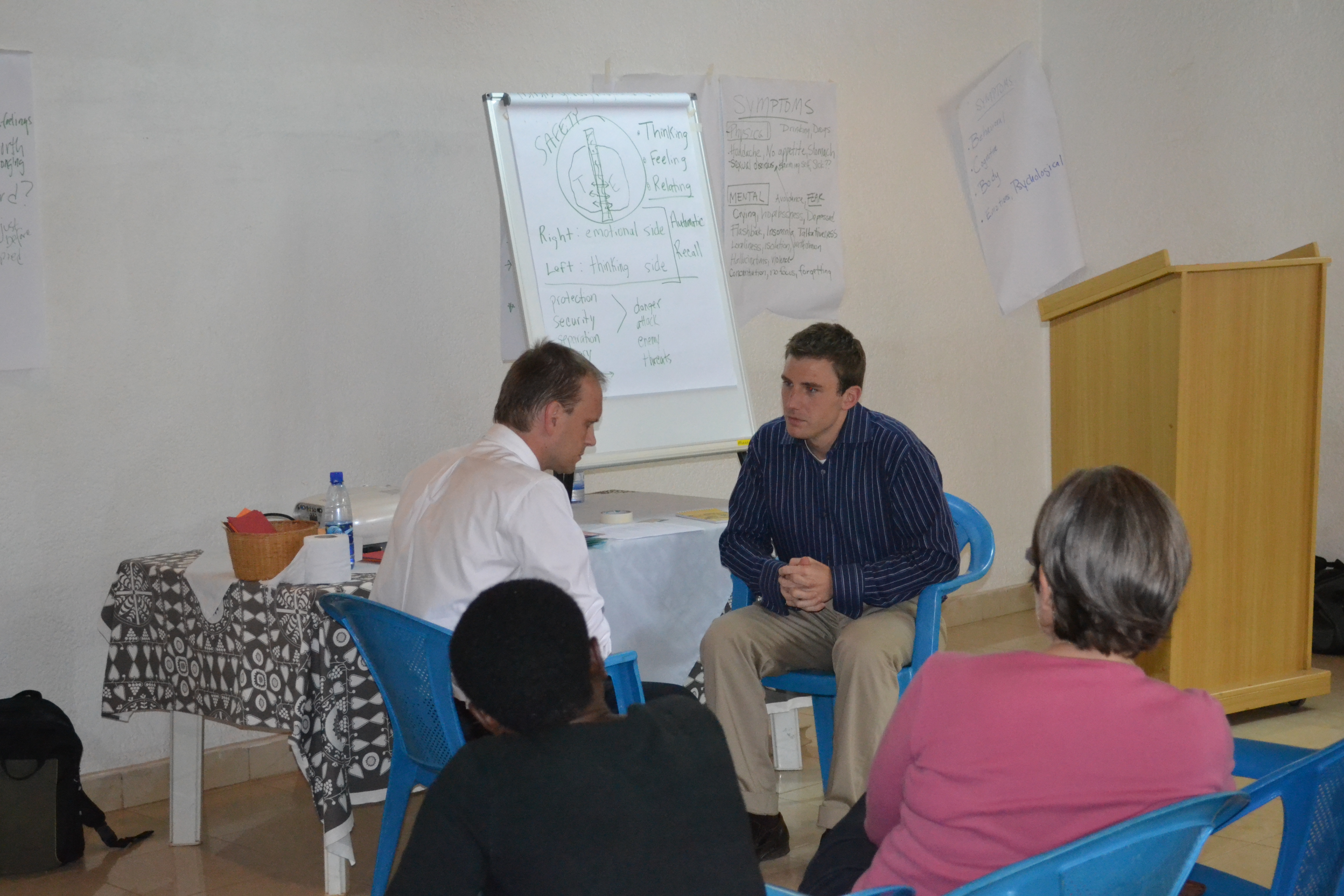
Carol King and I started this morning’s session with a short counseling vignette. I counseled Carol in order to illustrate the skills of bad listening and then good listening, stabilization, and grounding during dissociation. We then talked with them about ways to get another person’s story in bits (rather than all at once) and with their lead (rather than having the counselor pull it out of them). The role play was something that few had ever seen and we had lively discussion afterward, including why I didn’t push Carol (she played a hesitant, fearful counselee) and the issue of exploring emotion. At the end of the conference we learned our role plays were some of the most important parts of the conference.

Later, Josh presented some material on trauma, attachment, and the impact on the brain. To make this presentation practical, we did another role play where I was the counselee and Josh the counselor. We illustrated (in a rather speeded up illustration) portions of the levels of repair: telling the story, re-framing the story (in a wider truth), re-writing the story

Josh counseling Phil

, and re-connection with others. We concluded this time by having them practice counseling each other with a focus on drawing out emotions in the story. We had another great discussion about culture and emotion as well as the cultural differences between the US and Africa (counseling as listening vs. counseling as advising and solving problems).

The evening concluded with a party and hors d’oeuvres. It was an amazing celebration where many of the women wore traditional attire. We danced (I tried), sang scripture songs, heard silly riddles, and cultural stories. Then, we concluded with a ceremony of giving out the certificates. Normally, we would do this on Friday night at the conclusion of the conference but many wanted to receive their certificate in their traditional dress and we were leaving immediately after the conference ended on Friday so we determined to do this tonight. It was a time full of celebration and joy and a wonderful reminder of one antidote to trauma–communal celebration.

2 Comments

Filed under christian psychology, counseling, counseling skills, Rwanda, Uncategorized

DRC/Rwanda Trip: Day 9


October 19, 2011, Kigali, Rwanda

Finally! Our conference begins. 19 separate group represented here for a total of 42 caregivers. Baraka Unwingeneye (IJM and lay counselor trainer) opened the conference with small and large group discussions on the causes, symptoms, and definition of trauma. The participants were active in discussions. The energy is high! Baraka concluded her section by reminding us all that everyone can be traumatized, even the strong in body and faith. Diane then spoke for 50 minutes or so on the nature of traumatic memory and an overview of the first two phases of intervention. Her voice was a bit weak as she came down with a cold but she delivered it well just the same. Her outline provided a useful reminder of treatment necessity: talking…tears…time. She concluded with some discussion of how having healing relationships, a purpose, and faith all play significant roles in the recovery process.

We ended the morning with a handkerchief project where participants created a depiction of their grief/suffering and then shared it with others. We knew this was going to be powerful and that it would take time. However, we were somewhat surprised at just how powerful it was and how much the participants valued telling others (in dyads and groups) a portion of their trauma story. Several told us that even though they had been counseling others since the genocide in 1994, they had never told anyone their own trauma story.

Our afternoon continued with small and large group activities/discussions and concluded with a question and answer session. The group is hungry for information and we do not have to do much to encourage conversation, discussion, and engagement. Our late afternoon and evening is spent resting, planning for tomorrow’s work and enjoying each other’s company. The food continues to be outstanding at Solace. The only complaint I have is how early the roosters and birds start calling. 4 am is way too early for this. Just outside my window is something sounding like a bird having swallowed a bugle. I later discover it is the gray crowned crane. Here’s a short video I shot from my balcony where I got it to “sing.”  (photos by Joshua Straub)

Leave a comment

Filed under AACC, counseling, counseling skills, Post-Traumatic Stress Disorder, Rwanda, trauma