Category Archives: Abuse

Failures to act: Why we don’t always blow the whistle on abuse


Outrage. Befuddlement. Demands for the heads of leaders who probably knew something but didn’t appear to act. Righteous indignation against those who merely met legal obligations to report abuse but failed moral obligations to stop abuse.

Right now, in most of the country but especially in Philadelphia, you cannot turn on the television or listen to the radio without encountering such comments about the Sandusky/Penn State sexual abuse scandal. In my county, democrats control the county leadership for the first time in 140 years but no one seems to give that much time because of the outrage about this case. What people are talking about is, (a) why didn’t those who knew something was amiss do more to investigate abuse, and (b) what should happen to those people who failed to stop the abuse.

What would you have done?

If you are like me, you imagine that you would have acted to stop the abuse. You would have grabbed the boy out of the shower. You would have screamed bloody murder until someone took notice. You feel righteous indignation that no one seems to have had the moral fortitude to deal with this issue head on.

And you would be right to feel this way. But while we are holding leaders accountable for their failure to act and to protect (as well we should!) let us take a moment and address some of the reasons why we might not be quite as action oriented as we imagine ourselves. By doing so, we may make it more likely that we will respond correctly should we face the unfortunate situation of reporting someone we know to the authorities.

Here are some of the reasons we fail to intervene when intervention is needed:

Self protection

Worry about personal consequences can hinder our taking action. Thinking about how we will be treated, viewed, responded to can cause us to pause and not act. What if I get fired? What if this abusive person targets me? What if someone were to make an allegation about me? I wouldn’t like that so I don’t want to stir up trouble for this person.

Have you ever wondered why so many drivers flee the scene of a pedestrian/car accident–even when they were not at fault? We want to avoid facing the possibility that we might have done something wrong.

System protection

We sometimes worry about how the organization will be treated or viewed if abuse comes to light. Far too frequently individuals have covered up the sins of church leaders for fear of ruining the reputation of the congregation. This reason is also seen in the next two reasons. We don’t want people to turn away from God so we cover up what happened.

Groupthink

We’d like to think that with a larger group of individuals, sensibility will prevail. But my experience with institutions dealing with a sensitive issue suggests that once a group is deciding how to respond to abuse, it devolves into who has the loudest voice in what should be done next. Unfortunately, the loudest voice may be about liability (vs. morality) or outer reputation (vs. protection of victims). Also, groups often fail to address pertinent issues and alternative responses due to groupthink. Some of the reasons why this is the case can be found in Wikipedia’s definition.  One other thing about groups. We have ample evidence that individuals in a group setting are less likely to intervene when they witness violence happening to someone else. We’re more likely to act if we witness this when alone. Why is this? We may feel less responsibility when others are around.

Denial

We like to keep the good people good and the bad people bad. When those who are considered good do bad things, we can fall prey to denial. It is not possible. I know him. He couldn’t possibly do that. Thus, we deny what we have seen and that leads to the next reason.

Self doubt

Have you ever witnessed something troubling but then wondered if you really saw what you thought you saw? Maybe you catch a glimpse of an adult smacking a child in a parking lot as you drive by. Do you stop and confront? Well, maybe you didn’t really see that. Maybe there is some other explanation that might make this acceptable. When the abuse is done by someone we respect, it is easy to think we must have misconstrued it. And once we hesitate, it is that much harder to activate to do the right thing.

Winsomeness of the abusive person

It is important to remember that the most dangerous abuser is the person who is inter-personally winsome. The reason why a person can have access to others and can get away with abuse is often due to their capacity to put others at ease. Most abuse is not done by those who are revolting to others just because they don’t get opportunity. I know of individuals who were caught in acts of child abuse, questioned by authorities, and so winsome that the investigation was dropped before completed. They provide plausible even highly believable explanations that help the questioner feel at ease. They appear to be open and concerned. They are so good they convince most that such abuse could never happen by their hand. It takes a very expert examiner to catch them in the subtle lies they tell to themselves and to others. Check out Anna Salter’s book on predators if you want to see what she has learned from decades of interviewing known, convicted sex offenders.

It is easy for us to sit in the chair of judgment when we hear of cover-ups and failures to act. These failures to protect children do need to be judged and we ought not shrink back from administering restorative justice for abuse and for the inaction of others. However, let us remember that the work of being light in the midst of darkness has many enemies. Our own weaknesses plus the pressures of our community and the manipulative actions of offenders conspire to make inaction the easier choice.

May we take the high road as we encounter abuse in any form.

11 Comments

Filed under Abuse, Christianity, church and culture, Cognitive biases, Cultural Anthropology, deception

How can you listen to trauma all the time?


How can you stand to listen to [traumatic] stories like these all day long?

This is a question I get from time to time, most frequently from someone who has just told me of the trauma in their life…and most frequently from someone who feels stuck in their responses to their abuse.  They know I see multiple clients in one day and imagine that listening to pain, heartache, abuse, neglect, and the like must be overwhelmingly depressing.

My answer is a little complicated, but here it is

1. You get used to it. This could sound callous and by this answer I do not mean you get numb  to trauma. If you get numb to trauma then it is time quit counseling. But, you do get a bit used to it.  You are less surprised by evil after you hear about it in so many different forms.

2. It is hard. Hearing about brokenness is difficult. It is even more difficult when those who should be responsible for protecting or at least dealing with the sins of others well do not do their job. When systems conspire to harm the victim that is hard to hear over and over again.

3. There is more hope in these stories than you might imagine. Yes, hearing about brokenness can be difficult but we see far more hope than you might imagine. We see more life and more growth despite pain and hurt. When someone abuses a child, that someone destroys another for their own purposes. But, time and time again we see resiliency–even when that person may have significant damage in their life. Often the abused person only sees their brokenness but we see how they are surviving and thriving. It reminds me of how I have seen trees growing up in the middle of abandoned parking lots. What was left as useless is supporting life, even developing an entire ecosystem.

4. You can only do this work if you also spend time with good things. One must imbibe in healthy and living things if one wants to work with death. This means spending time with creative things, with beauty, with life, with art, with music and the like. If you don’t do this, you will die on the vine and you are in great danger of hurting others.

Leave a comment

Filed under Abuse, counseling, counseling skills, Uncategorized

DRC/Rwanda Trip: October 14, 2011


Day 4:

A breakfast of coffee, fruit and egg and we’re off visiting rape victims and those who help them today. First stop is the DOCS hospital (Doctors on Call for Service) run by a gynecologist, Dr. Ahuka Ona Longombe. This hospital specializes in obstetrics and in fistula surgery for rape victims. Dr. Ahuka if a larger than life, forceful personality. The ABS has done some partnering to provide the hospital with some better equipment. After touring the facility, he took us to a room to show us his PowerPoint presentation on the causes of sexual violence, the impact on women and the work they do to repair. It was a difficult slide show (with a few pictures!). If you think of rape as forced intercourse only, think again!

He showed us current stats (42,225 cases of reported sexual violence as of 2 years ago). He pointed out how these stats are very likely LOW due to stigma, violence, and the complexities of multiple reporting agencies. Victims during the reporting period are 21% little girls, 56% young women, and 23% old women.

Only 25% get treatment within the desired 3 days.

While they do HIV/STD testing and treatment, medical, surgical, nursing, spiritual, and legal care, Dr. Ahuka repeatedly begged for help for the psychological damage. As a team we discussed whether it would be possible to send two high level interns (even post grads) for 6 months to focus on training nursing and doctor staff as well as lay people from local churches who might reach out and care for the spiritual needs of these terribly traumatized women. Interns would have to be able to speak French.

Diane holding the the hand of "C" (translator at center)

Typical home with lava chunk wall

Leaving the hospital we traveled some very bumpy roads to Sister Alvera’s home. Now, all roads are bumpy in Goma. But these roads were the bumpiest. I kept expecting to lose teeth or an axle. Sister Alvera, a nun who runs an orphanage and home for raped women, was not home but they were expecting us. We came for the express purpose of talking to two women who have been treated by Dr. Ahuka for fistulas and who were willing to tell their trauma story. We were most interested to hear how they are learning to cope. The first young woman, C, had bright eyes and passion all about her. We met in her small abode, something akin to a shed in this country. She told of her rape and her treatments. Through the translator we heard how she experiences both joy and deep pain (she has been rejected by her family because of the rape). She described her struggle with dissociation as, “getting lost in my mind.” Sleeping, talking to the local pastor and being prayed for were helpful interventions. Near the end of our time with C we heard her lament that she could not find her attacker in order to forgive him. The pressure to do so seemed to eat at her. She felt she could not rest until she forgave him. Diane had the presence to respond that while she wasn’t able to find him, God could see her heart and the forgiveness in it. This seemed very meaningful to C.

"X" and her adorable baby

The 2nd woman, X, had been raped and given birth to a child. The child had been rejected but lived in the compound. Sitting with X was her new little baby who played with nearby fingers and nursed when fussy. This woman was far more triggered during our conversations. Her eyes were missing light. She did not look present. However, she described a caring husband and pastor who helped her cope with her trauma experiences.

The rain, which had been pounding down for our interviews let up just as we were getting ready to run to our vehicles to leave. A view of several green cauldrons  came into view through the puffy clouds passing by. From the Sister’s place we traveled to the local bible society office. We got to see the bibles we would be giving out the next day as well as opportunity to meet the staff. I can attest to two things about the bible society. They keep amazing records on all the widows and children they serve (food, stuffs, etc.) and they do not spend their money on expensive property. Back in 2002, their offices were destroyed by the lava eruption and now they rent rather humble space. If you give the bible society, you can expect your money to go to people and services, not bricks and mortar!

We ended the day back that the hotel with a enjoyable dinner meeting with World Relief country director, Charles Franzen, and two of his staff. Our dinner was outside under a thatch canopy and just above the loud lapping waves of Kivu. I can only describe him as a character–in the best sense of the word. He speaks Swahili but not French and has lived for many years in East Africa. We had wide-ranging conversations about Africa, Baltimore (his home town), baseball (his dislike for Dustin Pedroia of the Red Sox) and football (soccer). And of course the work of trauma recovery was a central topic this evening.

3 Comments

Filed under Abuse, Christianity, counseling, counseling science, counseling skills, Democratic Republic of Congo

Long Journey Home now available


The book, The Long Journey Home: Understanding and Ministering to the Sexually Abused, is now available here.  If you are interested, here is the pdf they sent to those of us who are contributors.

Long Journey Home_Promotional Flyer

2 Comments

Filed under Abuse

Baking Cakes in Kigali: Book Note


I have just finished Baking Cakes in Kigali, by Gaile Parkin (Bantam Books, 2010). This is BY FAR, the best book I have read this year. I would urge anyone interested in understanding life in Rwanda as well as life of women in much of the world. It is a novel but it conveys in beautiful artistic phrases and tones the experience of a woman who must overcome much adversity, who must understand her world, who must come to terms with her own difficult history and help those in your community overcome their own difficulties.

Read it if you want to see beautiful images of lay counseling, of family and relational challenges, of hope and realistic images of healing. Gaile Parkin is a counselor and it shows. She gets interpersonal relationships, trauma, and how to weave a story together.

Leave a comment

Filed under Abuse, counseling, Rwanda

Sneak preview: Healing Trauma in International Settings (AACC seminar)


Cascade Atrium, Gaylord Opryland Resort & Conv...

Image via Wikipedia

Just completed preparing my breakout seminar for this year’s AACC World Conference at the beautiful but outlandishly expansive Opryland Hotel in Nashville (Sept 28-Oct 2). This time around I presenting with my colleague Carol King on “Healing Trauma in International Settings: Best Practices.” Carol has had some experience in Rwanda and Goma, DRC and will be with our group in October when we do trauma recovery training in Kigali. Come back to the blog on the 30th and you can see and download the slideshow we will do.

What will we be talking about? 3 main points:

  • Listen…don’t assume you already know trauma or treatment practices
  • Train…don’t do the interventions yourself (train local leaders)
  • Utilize…don’t reinvent the wheel (use existing models)

Now obviously we will be fleshing those points out. Our goal is to help prepare interested counselors to develop short and long-range intervention strategies that utilize the cultural and human resources of the people they will serve. The only way to do this well is to have a listening and collaborative/support role approach. To that end I will talk about hoe to build an effective area case map.  We end by reviewing a few models for trauma recovery (both Christian and secular).

Check back on the 30th for the full set of slides.

Leave a comment

Filed under AACC, Abuse, christian counseling, christian psychology, Christianity, counseling, counseling science, counseling skills, Post-Traumatic Stress Disorder

Getting confirmation on global trauma recovery plans


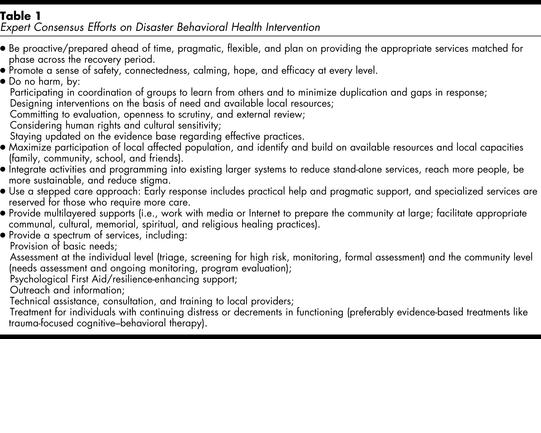
Since January I have been trying to articulate the best practices in doing trauma recovery or trauma healing work in international settings. The foundation of this approach to trauma recovery is, (a) Listen first to the needs, resources, and concerns of a community(b) identify local leaders who can be trained to be the primary trauma recovery workers (rather than outsiders being the primary clinicians), (c) tailoring interventions to the needs of  the community, and (c) above all…do no harm by over-promising, under-delivering, etc.

Today, I opened up my most recent American Psychologist (66:6, September 2011) and found my thinking confirmed in Watson, Brymer, and Bonanno’s Postdisaster Psychological Intervention since 9/11 (see citation at the bottom of the page). On page 485 they list what experts consider an appropriate steps to take in postdisaster behavioral health interventions. Now, most of you don’t probably get excited about research articles like this but I can tell you I did. Here’s the chart (click to see a larger image)

It is nice to find confirmation for something I was thinking but hadn’t read elsewhere.

From: Watson, P. J., Brymer, M. J., & Bonanno, G. A. (2011). Postdisaster psychological intervention since 9/11. American Psychologist, 66(6), 482-494. doi:10.1037/a0024806

1 Comment

Filed under Abuse, counseling science, Post-Traumatic Stress Disorder, Psychology, trauma, Uncategorized

Churches taking abuse prevention seriously? YES


We counselors rarely note, in public, the positive actions of churches who take seriously the call to care for the least of these. All too often we hear and repeat the news of churches who fail to enact prevention efforts or who botch responses to abuse within the church community.

So, this short blog is to remind us that many churches do work to prevent child and adult abuse and who respond well to abuse confessions or allegations. Today I participated in a phone call where one such church was looking for ways to take their existing practices and policies and make them even better. It won’t make the 6 pm news or the next Christianity Today because there is no scandal to report.

In honor of this church, let me give a couple of suggestions to others who might like to enact their own policies and practices

  • Determine the organization’s foundations and values for policies and responses to alleged abuse

You might think this a strange place to start but it is my experience that if a church/org doesn’t name their controlling values, another set of values will rule the day–and often without anyone knowing it. I have seen churches who make decisions on the basis of limiting liability. I would suggest a better value is protecting the vulnerable from abuse and standing for truth, justice and righteousness. I have also witnessed unspoken values of “fairness.” Since everyone is a sinner, then no sinner can be called out and restricted in their access. Since both victim and offender are sinners, then the blame is to be equally shared, even if the offender is a pastor.

  • Begin with some key theological principles. Study them. Engage in churchwide discussions

Key topics to consider: nature of evil, abuse, impact of sexual abuse; theology of reconciliation, restoration, forgiveness, and repentance (these topics are all different and not to be confused); theology of the state (too many churches see the State as evil and thus they do not begin to think about reporting child abuse)

  • Identify a team to develop policies and to handle abuse allegations and to identify potential risks
  • Craft policies for lay counselors, pastoral staff, child care workers, those who have been accused or found to have committed abuse (e.g., can they attend church; do they need a care team to bring church to them?)
  • Staff to explore how to make the church friendly to current and past abuse victims; consider sermon and Sunday School topics to set agenda and tone
  • Make clear abuse reporting policies to the church (even if not required by local jurisdiction) because of the moral call to protect the weak
  • Background checks for all staff, including pastoral staff
  • Finally, locate capable individuals who can assess, consult, and treat specific individuals in need of help (offenders or victims)

There is more to be done but this is a good start and will take some time to do it. Of course I can’t end without suggesting that churches seek out GRACE for help on either the prevention or response side of things.

Leave a comment

Filed under Abuse, Christianity: Leaders and Leadership, church and culture

Do therapy dogs in the courtroom create an undue benefit for the prosecution?


Check out this NY Times article about the use of therapy dogs in the courtroom. They are being used to comfort someone testifying about their sexual assault. In the article, it tells of the dog Rosie who provided a girl some measure of comfort as she testified against her father about his rape of her. She would pause or delay her answers and the dog would sense her pain and nuzzle her.

Seems like a good thing! But wait, the defense doesn’t think so. Each time the dog comforts the child, the jury sees her distress more clearly and develops sympathy for the client. Does such a dog sway the court toward conviction? The defense worries that the girl might be under distress from lying and thus the dog might aid her to tell a better lie.

I’m sure that these dogs are providing a wonderful service that ought to be continued. Someone with a bright mind will figure out how to have the dog in the courtroom and yet shield the jury from seeing the dog do his or her work. And other bright minds will try to craft ways to eliminate the dogs and give the defense the upper hand again.

1 Comment

Filed under Abuse

When someone you love suffers from PTSD?


Has anyone read this book? The full title is: When Someone You Love Suffers from Posttraumatic Stress: What to Expect and What you Can Do  (By Claudia Zayfert and Jason DeViva (Guilford Press).

If so, any thoughts on it? I do not yet have it in my possession. One of the areas I found wanting re: PTSD is a good book for spouses of survivors of sexual abuse. There was a book that I would use but is no longer in print. Some do read “Stop Walking on Eggshells”, a book about living with Borderline Personality Disorder. While there are relational behaviors commonly seen in people with either complex PTSD or BPD, the two problems are different and sadly, those with complex trauma reactions get stigmatized with the BPD label.

So, if anyone has seen this and wants to lend their comments, I would welcome them here.

4 Comments

Filed under Abuse, Post-Traumatic Stress Disorder, Psychology, ptsd, Uncategorized