
The website, www.christianpost.com has picked up one of my recent blog posts about whether our bodies can cause us to sin. Never heard of the site before but nice to be noticed. You can see the post here if you missed it on my site: http://blogs.christianpost.com/guest-views/can-your-body-cause-you-to-sin-11696/
Tag Archives: Psychology

Critical Incident Stress Debriefing: Does it work?
As someone who wants to advance faith-based global trauma recovery efforts, I am always on the prowl for effective interventions that could be sustainably used by local caregivers. However, it is always important to ask whether a popular or up-and-coming intervention has been fully vetted. Sadly, “does it work?” and “does it work here?” are often not fully answered before an intervention is promoted as the next best thing.
One of the most popular forms of immediate trauma intervention is called “Critical Incident Stress Debriefing,” a one time group intervention designed to forestall long-term trauma due to stressors. When you think of CISD, think of interventions with police or fire fighters or military after a traumatic experience.
But, does it work? This post here provides a helpful summary of the critique, even though it was published 2 years ago. As I read this I remembered an American Psychologist article on the same topic–but for the life of me I can’t find it. My recollection of this fantasy article is that these interventions seem to be helpful for about 50% of those who participate but that at this point it is not possible to tell which 50% will find it helpful. And further, a portion of the other 50% are actually harmed by it.
Share this:

Filed under counseling, counseling science, counseling skills, Psychology
What is therapeutic presence?
If you go to a counselor, you’d probably prefer that person to be awake versus asleep, to pay attention to you versus check their smart phone, to respond to what you are talking about versus make non sequitur responses. As I’ve noted here before, it is probably better to have a counselor who cares about you than one who has a big bag of techniques–though most of us would prefer our counselors to care AND be competent.
Therapeutic presence is a way of talking about the act of being with our clients in such a way as to build safe, trust-filled relationships where clients can grow and change. I think most people can easily identify failures of therapeutic presence. Try these on for fun:
CLIENT: I’m just so depressed.
THERAPIST: You think you are depressed? Let me tell you about depression. I have a client who just lost job, family, church, home. Now, that is something to be depressed about. You just had a bad day, that’s all.
Or,
CLIENT: I don’t understand why God would take away this job from me.
THERAPIST: Well, theologically speaking, God does things for all sorts of reasons. He sometimes does this to cause us to trust him more, to reveal some sin, to give him glory.
Notice how both responses fail miserably to be either therapeutic or present with the person in the moment of counseling. Not hard to miss, right? So here’s a question: Why do so many of us counselors, even seasoned ones at that, fail the “presence” test?
My answer? When we fail to be present in helpful ways, it reveals a lack of preparation and a lack of attention to purpose.
Shari Geller and Leslie Greenberg (in Therapeutic Presence: A Mindful Approach to Effective Therapy. APA, 2012) define the building blocks of therapeutic presence as
- how therapists prepare for being present (in personal life and in session)
- the process (or therapist activities) of being present (aka purposing to be present)
- the experience of being present
Sound like mumbo-jumbo? Here’s another way of putting it. What does a counselor need to do to be ready to be in tune with their clients? What do they do to stay in tune when with clients, and are they aware of when they are failing to be in tune? (If I am unaware, then I am likely to get out of tune.)
Here are some things counselors ought to be asking themselves:
- Do I have adequate space to move from my private life to being present with my clients? Do I have enough space between clients? The answer is not always an amount of time, but what we do during the space between.
- As I prepare for sessions, what am I meditating and praying about? For example, if I pray for clients to be free from something that has them bound up, I could accidentally encourage myself to push for change or to talk about a subject that the client is not able or ready to talk about. I’m all for praying for healing. I just think we have other prayers to pray as well. “Lord, help me to be with the client today and not focused on my own personal goals for them.”
- Am I staying present with their mood, their cognitions, their silences in such a way that it is as easy to talk about what is happening in the session as it is to talk about what happened in the past or might happen in the future?
- When I sense a disconnect, am I quick to invite dialogue and learn (vs. avoid or defend/explain away)?
Therapeutic presence isn’t everything. I could be present with someone and no healing might take place. But without therapeutic presence, I will only be a barrier to whatever growth is taking place. When I do it well, I imagine that I might see just a tiny glimpse of how Jesus was with the woman caught in adultery, the Samaritan woman, or with Peter after he had abandoned Jesus.
Share this:

Can your body make you sin? Post on www.biblical.edu
Over at the faculty blog at www.biblical.edu I have this first post of two on the topic of how our bodies influence our behavior. I raise two questions:
1. Can our bodies cause us to sin?
2. If so, are we responsible or culpable?
Share this:

Filed under biblical counseling, Biblical Seminary, counseling, Psychology
Word choice matters!
Counselors often use what they call “additive” words to help flesh out the thoughts, feelings, and experiences of their clients. For example,
CLIENT: I feel so frustrated about how long it is taking for me to hear about the job I applied for.
COUNSELOR: You’re feeling anxious?
Certainly, my example is superficial and simple but you get the point. Frustrated doesn’t really adequately describe the true feelings of the client. We sometimes need help with defining what we really feel, think, or believe. This word addition happened to me today in a powerful way.
Today I was telling someone about a repeated discouragement I have experienced in recent months. In describing my experience I used the word “rumination” to describe the re-occurring thought pattern. She deftly said just one word.
“Grumbling?” [well, in fairness, that is what I remember]
That one word changes everything. When I choose to describe myself as having a repeating thought–a rumination–I am accurate if I am speaking only about the repeating part of the thought pattern. But notice that “rumination” doesn’t evaluate attitude or belief. What my trusted friend was trying to tell me was that I was allowing myself to have a pity party. I was accepting the disappointment feelings without any evaluation of what it was that I believed about the situation at hand. Truthfully, she was right. I was accepting the thoughts and feelings as accurate rather than interpretative of my situation.
Now, I am not arguing that those who have actual ruminations (a part of OCD) are all grumbling. But, it is a good reminder that the words we use do shape our perceptions of our life! We do not just respond to disappointments, we interpret them.
Share this:

Filed under Cognitive biases, counseling, counseling skills
In Counseling, Who is the Teacher?
Most counselors and therapists get into the field of counseling because they want to help people. This is a good thing! Imagine if they only wanted to make money or to be the center of attention. But, underneath the goal of wanting to help people lurks an insidious goal:
being seen as wise.
Being seen as wise (notice the difference between being wise and being seen as wise) tempts us to become the teacher, the teller, the obnoxious sage. Teaching, telling, training are all activities that may happen in counseling, but only when necessary. Truth be told, we counselors resort to teaching and telling because it gives us a job to do and makes us feel good. This is especially true when we work with the most severely traumatized people. Here someone is hurting in front of us. We can see that they are stuck. Who wouldn’t want to pull them out of the mud? Now, there may well be important teaching moments–gently instructing someone on the symptoms of trauma and/or the physiology of trauma. This might be important for the client who believes that the symptoms are really signs they are sinning and that they can just choose to stop being triggered.
In Counseling, Who is the Teacher?
“The patient is the ultimate teacher about trauma, and a good therapist is a good listener.” (Boskailo, p. 81)
While the counselor has much to offer in regard to teaching, training, and goal setting, we must remember that the client is the one teaching us about their trauma experiences and how much they can deal with at a given time. For example, Boskailo reminds us (see above link for book) that while telling the trauma story is an important part of the healing process, the “how” of telling (and the “how much”) is something each client will need to teach us. One client may need to tell and re-tell the same story each week. Another may be better helped by drawing. Still another may tell once and never again.
We counselors are the student in these kinds of matters. It is our job to listen well and learn well!
Share this:

Is your church prepared to handle an abuse allegation?
I’ve posted a blog for our Seminary’s faculty blog this morning. You can read it here. In it I give a few initial directions for churches seeking to prepare for the nightmare of an abuse allegation against a church member or leader. While these directions are very slim, they at least get congregations moving in the right direction. When we wait to decide how to act in a crisis situation, we are less likely to make good decisions. We may make decisions based on expediency, based on utility, or even based on quieting the problem (much like how the Catholic church handled their abuse cases).
For those wanting much more advice for church communities, consider taking our summer course on the subject: Preventing and Responding to Abuse in the Church.
Share this:

Filed under Abuse, christian counseling, Christianity, counseling
Translating EFT into Christian Psychology? Publication notice
My friend and colleague Mike McFee (Eastern University) and I recently had an article published in the latest edition of the Journal of Psychology & Christianity (v. 30, pp 317-328). In it we tried to tackle how someone from a Christian Psychology perspective might interact with Emotion-Focused Therapy, a popular treatment protocol.
Here’s how we started our paper,
Emotion-Focused Therapy (EFT) is a rapidly growing treatment system offering empirically based treatment for couples and families. As with many current secular theories of psychology, EFT is embedded in humanistic assumptions which propose a few challenges to the Christian practitioner…. Using the methodology of Eric Johnson…this essay explores the practices of translating EFT into a Christian Psychology.
Next we identify a problem for counselors. We say that being christian and thinking christianly is supposed to influence all that we do. But, the truth is much of what goes on in Christian counseling doesn’t look that much different from counseling from markedly different ideologies. Both are compassionate and use similar techniques. The problem isn’t always bad integration but that we haven’t defined well the various levels of translation between two languages (i.e., humanistic founded EFT and Christian psychology).
The rest of the essay explores the two languages and 3 kinds of translation possibilities depending on the context and need, rather than is a one-size-fits-all approach. We conclude with a case example and actual dialog to show one kind of translation work.
What are the 3 kinds of translation? You’ll have to read if you want to know? There has to be SOME mystery, right?
Share this:

Financial questions about becoming a Christian psychologist
Recently, I received a blog comment to an post I wrote a year ago about the decision process for those thinking about pursuing doctoral programs in psychology. You can read that old post here. In response, Emily asked,
I’m really wondering what you’re thoughts are on places like Rosemead and Fuller. They appear to be wonderful institutions but I have heard that students come out with $100,000+ worth of debt. Is that really worth it, or would it be just as well to get two separate degrees – one in psychology and one in theology. Doing my own research, I’ve discovered that to get a PsyD at Rosemead would cost me over $200,000 for 5 years. That includes tuition, miscellaneous fees, books, and the cost of housing in SoCal. I just can’t decide whether it’s worth it or not and I would love to know the thoughts of a Christian Psychologist on this.
Emily’s question is very important. Much of the time, we answer questions about doctoral training by discussing career goals, philosophy of education, and theological training. However, it is a huge oversight to ignore the high cost of a doctorate in clinical psychology. So, I want to respond to the issue of economics by raising a few questions for the person considering doctoral education.
What is your desired career outcome? Is it necessary to have a doctorate?
Wait, this doesn’t sound like an economics question, right? Well, if you are thinking about taking on a sizable debt then you ought to consider whether or not you absolutely need to do it. If you want to be a professor in a University, then you’d better be looking for a PhD (probably over a PsyD which tends to cost more). If you want to counsel people, you might not need a PhD or PsyD. You might be fine with a Masters’ degree and really good supervision by a doctoral level psychologist. If you really want the extra years of training and the possiblity of supervising others, then maybe the doctorate is right for you. If you don’t know if you need a doctorate for what you want to do, then find out first before you take on the debt load.
Can I find a cheaper PhD/PsyD program?
Some of the Christian programs tend to be longer and therefore more costly. The reason is that these programs believe (rightly so) that theological training is essential. While I am a proponent of an integrated (theological and psychological training), you may be able to find cheaper theological training and mentoring in another format while completing a secular (and shorter) degree program in clinical psychology. It is possible that a seminary degree or certificate in theological or biblical studies will provide you want you need. Or, you may be able to befriend a well-trained pastor or counselor who will mentor you for free or for a meal and and coffee. The question you need to evaluate is whether you want theological competency or a degree to show up on your vita? Do you need to get the official “blessing” of a degree to get a job? Are you prepared to complete a secular based psychology degree and confident that your value system will remain intact? If not, you could undertake some graduate training in theology first and then complete your doctoral training elsewhere.
What is the likelihood you can pay off your school debt quickly?
Will you be able to secure a job that pays well enough to pay off your debt, pay your living expenses and/or purchase a house at the same time? Are you wanting to be a missionary psychologist with a 200K debt? Do you know what the going salary is for individuals working in the field you want to enter? You should check out www.apa.org for some very helpful data (search their site for “salary” and check out the information) such as this link or this one on the current debt load and salaries of the field. Some psychology grads have been able to land jobs that enable them to pay off federal loans in an abbreviated fashion in return for their years of service in an underserved population.
One way that students reduce their debt is by (a) marrying someone rich (just kidding…though I was married to someone able to command a great salary), (b) working full-time while going to school full-time, (c) reducing expenses by living in a communal setting, or (d) getting work study for tuition reduction. Options A and D may be limited. Option B is possible but may drive you insane as you do it.
Finally, do you have family/friends who want to give to your educational needs?
I know of a student who held a dinner for important friends/family/church members in the church basement. After the meal, he made a presentation to all about his educational dreams and desire for training. He asked them to give…and they did. I imagine there might be some creative ways for people to give and get a tax credit for it. If what you want to do is important and will fill a void…someone might be willing to help fund you. Friends? Family? Church? Employer?
I was blessed by being able to get through a 5 year (4 years of coursework and 1 year postdoc year) program with no debt at all. We lived very frugally. My wife had a great job. We received some inheritance. I worked a couple of different part-time jobs. Somehow, we survived for a year of postdoc life with a newborn (adopted even! Thank goodness for adoption tax credits) on about 11,000 dollars of salary. The Lord provided. The degree was absolutely essential for what I wanted to do.
If you are thinking about this kind of major decision. Pray. Ask for those you trust to offer their advice and to pray with you for an open door.
Share this:

How to make almost nothing seem like something
Yesterday, I got an advertisement in the mail from ING Direct Orange Savings Accounts. If you click the link you will see their lovely advertisement on just how much more money you can earn if you put your money with them than if you just drop it into your local bank or money market account.
The chart says it all (chart from right is from a previous period when interest rates were actually even higher than today). You can make so much more money with them. The orange bar is so much bigger than the other 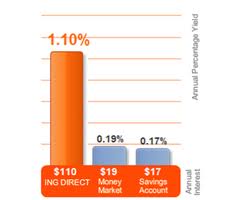 bars. But then read the fine print. Go with ING and you will earn $80 a year for every $10,000 you invest. 80? Sure, that is better than $10 you get at your bank for the same ten grand. But, will it really matter?
So, how do you make almost nothing seem like something? Build a great visual even if the differences are minimal.
Share this:

Filed under Psychology
 Musings on Faith and Psychology