Narcissism in the Bible? A sermon by Philip Ryken


A few weeks ago, I attended a conference at Westminster Seminary (Philadelphia) where Dr. Philip Ryken was speaking/preaching. Dr. Ryken is a friend from our student days at WTS and is now the president of Wheaton College. His sermon was on the first 10 verses of 1 Kings 1. While the purpose of the talk was not to identify narcissism in the bible, the passage clearly points to egocentrism and all of the distortions and deceptions that come with building one’s own kingdom.

In the passage we see that Adonijah sets himself up as king even has his father, David, is still alive. What does he do that reveals narcissism?

  1. “I will be King.” He demands power
  2. He does not know humility or correction (sadly the passage says that his father never confronted him thus probably building egocentrism)
  3. He gathers people of influence to promote his position
  4. He buys an entourage to improve his public standing
  5. He gives the illusion of submission and faith (sacrificing sheep to look like he is doing the right thing)
  6. He makes sure not to include people who will speak the truth (does not invite Nathan the prophet)

Let me encourage you to listen (for free) to Dr. Ryken’s message as he describes in better fashion these features of building our own kingdom.

1 Comment

Filed under Biblical Reflection, deception

The duty to confront your friends


You’ve probably read about the recent resignation of David Petraeus as Director of the CIA. While we could chalk this up to another episode of “be sure your sins will find you out” and explore the features of his downfall from squeaky clean (by appearance) to cheater, there is another angle you might consider. In the Sunday Philadelphia Inquirer, the paper included a sidebar to the story telling of several colleagues and friends who recognized a problem long before it came out. They saw some things that didn’t look right, that didn’t fit with his character. They saw him being too chummy and spending too much time with “the other woman.”

The big question: did they bother to confront him? The story doesn’t tell us this, but it surely is the question we ought to be asking, not only of them, but also of ourselves. When we see friends acting in ways that appear out of line, do we love them enough to tell them so? Do we love them enough to risk losing the relationship should they become angry with us? I, for one, have been guilty of not saying something when I saw a friend spending more time with a colleague than is wise. I have no idea if my friend engaged in inappropriate behavior. But even when someone doesn’t engage in sexual activity with someone other than their spouse, this does not mean the person isn’t putting their life, their marriage, their soul in grave danger. Emotional affairs have torn apart marriages just as physical affairs do.

We have a duty to not let our fear of man get in the way when we see things that signal to us a problem. We don’t need to become accusatory, but a few loving questions (and more than just one!) are in order.

2 Comments

Filed under adultery, Relationships

5 Approaches to Counseling and Christianity


There was a recent conference in Tennessee where the authors of the recently published, “Five Approaches to Counseling and Christianity” (IVP) presented their approaches, dialogued with each other, and showed brief vignettes of their counseling model in action. You might like to see some of the papers and slide presentations by each of the authors. Do so by following this link. At the bottom of each bio, you can find the link to their presentation. They do not have the video clips of counseling available. I, for one, hope they make them available for sale. Despite the diversity of theories, I suspect their actual counseling activities do not differ all that much.

Phil

1 Comment

Filed under biblical counseling, christian counseling, christian psychology, counseling, counseling skills

Animated Short Movie About Trafficking


For those interested in anti-trafficking media, you might check out this almost 4 minute animated movie about woman in Africa lured into a sex trafficking trap. http://www.youtube.com/watch?v=sVYqlUU_u2I

Warning: while it contains no graphic visual material, the content of the video may still be triggering for some.

UPDATE: I believe this link contains the full 6 minute movie: http://www.ecpat.org.uk/blog/dangerous-journey

Leave a comment

Filed under Abuse, Africa, Movies

Do you see or hear things that do not exist?


English: Neurologist and writer Oliver Sacks a...

English: Neurologist and writer Oliver Sacks at the 2009 Brooklyn Book Festival. (Photo credit: Wikipedia)

What does it mean if you hear things that no one else hears? Sees things that no one else sees? Does it mean you are having a spiritual experience? Or, do you have some form of psychotic disorder?Thanks to a student (HT Heather), I submit for your reading pleasure a NY Times essay by Oliver Sacks. Dr. Sacks suggests there may be some other possible reasons why you might hear or see or feel something that isn’t heard, seen, or felt by others. In fact, he points to research that a large portion of those who do have these experiences never tell others or doctors about them for fear of being labeled falsely with schizophrenia.

Ever had either hypnogogic or hypnopompic hallucinations (ones that happen just as you fall asleep or awaken)? Did is scare you? Can you imagine telling others about it? If you find these kinds of unusual experiences interesting, I encourage you to read any of Dr. Sacks’ books.

3 Comments

Filed under news, Psychiatric Medications, Psychology

The purpose of retreats in counselor education?


I have another post over at the Biblical Seminary faculty blog describing three reasons why we require our counseling students to attend our program retreat each fall.

1 Comment

Filed under Biblical Seminary, christian counseling, counseling

The priority of relationships in the mission of God


I teach at a missional seminary. You might wonder what “missional” is all about. Well, I’ve tried to articulate why missional is all about redemptive and redeeming relationships. Such relationships change the ways we relate to those we seek to serve, whether here in the U.S. or in any other part of the world. To read a bit about how missional relates to serving others in Africa, read this post over at the Biblical Seminary faculty blog. It came out on Halloween but Hurricane Sandy made her appearance a few days earlier so I doubt many saw this.

Leave a comment

Filed under Biblical Seminary, christian psychology, church and culture, Doctrine/Theology, missional

Book Note: A brief window into Palestinian life


English: Personal photo of Poet and Author Mou...

English: Personal photo of Poet and Author Mourid Barghouti, taken by Dia Saleh (Photo credit: Wikipedia)

Just finished Mourid Barghouti’s I Was Born There, I Was Born Here (2011, Walker & Co.; first published in Arabic, 2009). It is a set of short stories about the author’s experiences as a Palestinian making trips from Jordan back to his homeland in occupied territories (Ramallah). No matter your political leanings or support for Israel and/or a two state solution, you will find his descriptions of road blocks, walls, difficulties moving around, etc. a reminder of the fact that trauma can result not just from shocking and unexpected experiences (e.g., assaults, rape, domestic violence) but also from the daily grind of living in a police state without the right status. And lest you think he is only talking about living under Israel’s thumb, he also describes living under intimidation in Cairo as well,

No matter the differences in terms and methods from one Arab country to another, such people [those who had just taken his adult son] are always gracious when inviting their prey to be their guests and they will always be bringing them back in an hour or so at the most. Men and women have spent decades in the cells of the Arab regimes without ever finishing that damned cup of coffee.

We got the message.

The message of fear or, rather, of intimidation….

Thuggish authority is the same, whether Arab or Israeli. Cruelty is cruelty and abuse abuse, whoever is the perpetrator (p. 199)

His son was forced to leave the country of his birth (Egypt) since he was not Egyptian. Here’s what the author said,

What has stayed with me from this incident was my inability to protect my son. (p. 200)

Besides the descriptions of interminable waits at checkpoints, rude interrogations, refused entry to home villages for no apparent reason, Barghouti also describes the experience of being seen by others as a criminal, a possible thief, a terrorist instead of the poet that he is.

A worthy read to see life from another perspective.

Leave a comment

Filed under Good Books, Great Quotes, trauma

More on “Can Your Body Make You Sin?”


I’ve written about this topic here and here before. In those posts I argue that there is a better question for counselors to consider than the one of culpability. Last night, we started the 2012 edition of Counseling & Physiology with the question of culpability and whether or bodies/brains can cause us to sin outside of our will. We also looked at our tendency to focus on judging whether a person is culpable for their sins (e.g., someone with Tourette’s who swears, someone with a TBI who is easily enraged, someone who is chronically anxious or still another who falls prey to addictive behavior). One of my main goals was to get students thinking about whether they under or overestimate the body’s role in counseling problems.

In the second post listed above I indicate the possibility of a better question than culpability. However, one of my students last night raised a question that went something like this,

Doesn’t the fact that you will choose how to respond to a client indicate that you have to judge the cause of the problem? If you encourage a client to consider psychoactive medications, aren’t you suggesting it is a body problem? If you focus on habits or heart issues, aren’t you assuming the problem is primarily a spiritual, will or behavioral control problem?

This was a great question and my answer was something like the following.

No and yes. Functionally, you will choose an area to work first. This does not mean you think that the type of intervention you choose indicates the main problem. It may only indicate that you think one intervention is an easier entry gate to counseling than another.

Here’s an example. Even if my client is severely depressed and I believe that the primary cause of this depression is their longstanding bitterness and anger towards God, I may encourage a psychiatric evaluation and the consideration of an antidepressant. It may be that once their mood improves, we can make better progress in investigating some spiritual matters in their life.

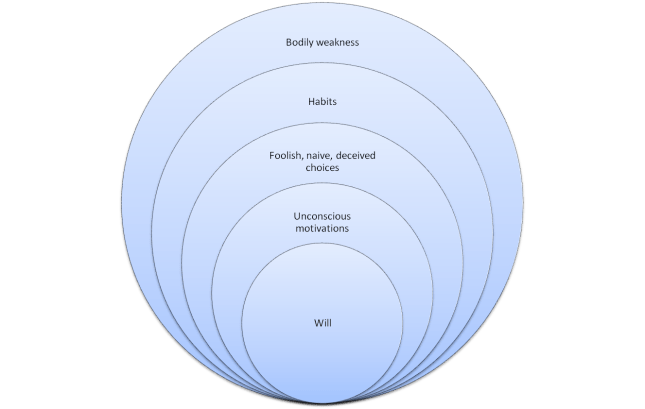
Human sins and weaknesses have multi-factored sources

Have you ever thought of the various sources of human sin? Here’s a visual of all of the things I think of that are a part of nearly every human sinful behavior. The sizes of the factors surely change depending on the situation. For some, will, high-handed rebellion, may be most of the pie. In other cases, bodily weakness may be the prime source. Also, some of these surely overlap and are not distinct. I may have started out in a rebellious state when I started doing drugs. Now, my body and psychological habits are equal players in why I maintain a drug habit.

What else would you add to this chart? Note that I place “will” in the smallest concentric circle. I imagine that we have far less conscious control over sin than we sometimes ascribe. Habits, unconscious motivations, and foolish (unthinking) choices probably dictate more of our behavior than our direct, willful, planned rebellion. Of course, none of this has ANY influence over culpability or morality as Scripture clearly indicates our guilt even when we are unaware of the Law’s commands. When Jesus says, “Father, forgive them for they know not what they do,” it tells us that consciousness of sin has little to do with our need for forgiveness.

5 Comments

Filed under biblical counseling, christian counseling, christian psychology, counseling, sin

The biological roots of PTSD…and resilience


Brain structures involved in dealing with fear...

Brain structures involved in dealing with fear and stress. (Photo credit: Wikipedia)

A good friend of mine pointed me to a recent Nature essay that describes the biological markers for PTSD and resilience–and provides some of the answer of why some seem to recover fairly quickly while others continue to struggle. Here’s a couple key quotes:

“Functional magnetic resonance imaging (fMRI), which tracks blood flow in the brain, has revealed that when people who have PTSD are reminded of the trauma, they tend to have an underactive prefrontal cortex and an overactive amygdala, another limbic brain region, which processes fear and emotion…”

“People who experience trauma but do not develop PTSD, on the other hand, show more activity in the prefrontal cortex.”

Of course, we need to understand that we are complex beings with complex histories and current social connections. We don’t only look at neural activity but with increasing understanding, we learn how experiences such as childhood trauma, poor social support influence brain activity.

Some worry that the discussion of biological features of PTSD will lead only to increasing chemical interventions (meds, surgeries, etc.). I do not believe this to be the case given that we are also learning about the ways that current relationships and psychotherapies are altering brain activity.

4 Comments

Filed under counseling, counseling science, Post-Traumatic Stress Disorder, Psychiatric Medications, Psychology