Category Archives: Psychology

Trauma recovery? Healing? Integration? Which words communicate a good outcome to you?


Recovery. Healing? Restoration? These words contain both information, movement, and emotion. What words do you like to use when describing the process of getting better after a traumatic experience? How do you communicate that you are better but not so much better that you have no more bad memories; that you have no more nightmares; that you are not triggered into panic when you see someone who abused you?

What words do you shy away from?

Let’s consider healing first.

I was and am being healed?

Some hear healing language as a completed task. “I have been healed.” Past tense. If I was in a wheelchair but now I walk…would I say I have been healed if I walk with a limp or need a walker to get around? Do you ever hear someone say, “I was healed, in part.” Would it be better to say I am being healed or I am recovering. Compared to Greek verb tenses, our English language doesn’t communicate well the ongoing state of something. In Greek, we can communicate a present perfect tense such as, “I was and am currently being healed” all in one verb form. But in English, we cannot communicate such an ongoing process without more words. Thus, when we use the shortcut, “I am healed,” it sounds like a finished job.

Recovery?

What about recovery? Restoration? Renewal? Recovery words are popular amongst former addicts. For them it connotes that they are no longer using but making the daily choice for sobriety. However, they recognize the danger exists of falling back into drunkenness and so they communicate that they are in a lifelong process. For some, however, recovery sounds like a failure–failure to find victory and failure to accept a new identity.  The truth is, few people outside of AA use the word recovery in every day speech. The other “r” words are more likely used in Christian circles but not so much in discussion of life after trauma.

Can you integrate trauma?

I have just finished reading Wounded I am More Awake: Finding Meaning after Terror by Julia Lieblich and Esad Boskailo (2012, Vanderbilt University Press). Julia helps tell Esad’s (a Bosnian doctor) experience of being held in 6 different concentration camps. He is now a psychiatrist in the US and works with trauma victims. However, he faced much brutality in being treated worse than one would treat an animal and so was not in good physical or psychological shape when he came to the U.S. I commend the book to those who want a basic understanding of trauma and of this thing we are trying to call healing and recovery. Listen to these quotes from Boskailo the psychiatrist,

 I can’t take away what happened” [said to another survivor]. But [I] can help [you] imagine a better future.

“You are fifty, not twenty-five. You will never be the person you were twenty-five years ago. Even if you didn’t have trauma, you would not be the same.”

What Boskailo is arguing for is integrating trauma into one’s present life. One cannot go back and recover what was lost. A trauma survivor is never going to be free from losses suffered. To do so would be to deny truth. Integration means allowing the reality of trauma and its losses while finding meaning and value to live in the present with hope and even joy. Integration requires acceptance and willingness to look for meaning and purpose.

I like the connotations of integration. But, I am not sure I like the word integration since it also doesn’t connote some level of arrival at a good enough place. What word would you use?

17 Comments

Filed under Abuse, counseling, counseling science, counseling skills, genocide, Post-Traumatic Stress Disorder, Psychology, ptsd

Benefits and liabilities of a benign dictator


I have been thinking about the value and danger of a benign dictator. No, I don’t have secret plans to take over the world. Well…maybe I do but I am well aware of the fact that no one will let me. The real reason I am thinking about this is the result of a book I am reading, called, The Science of Evil: On Empathy and the Origins of Cruelty, by Simon Baron-Cohen (Basic Books, 2011). In addition, I have been thinking about a couple of situations where systems revolved around one person, a cult of personality. These systems worked well and though no one would have referred to the leader as a dictator, the leader held the vast majority of the power and control of the system and, in fact, did dictate how others would function.

Benefits

When you think of a dictator, few positive images come to mind. Maybe you think of Hitler or one of the recently dead world leaders. Not too many warm fuzzies, right? However, dictators or system controllers do have positive value.

  • Things get done. When you don’t have to rely on a committee or a popular vote, you can get things done. The person in power decides something should happen…and it happens. No need for it to get balled up in red tape. If you have ever watched good ideas die in committee you probably fantasized about being given the power to make stuff happen.
  • Legalism can be avoided. We’ve all seen times where  the strict application of a law doesn’t make sense. One law-breaker should get leniency and another should receive the maximum penalty. Statutes and rules rarely give us the kind of wise latitude to make these decisions but a person in power can make decisions that are in the best interests of individuals and communities.
  • A little fear may motivate. Knowing that you serve at the pleasure of the president (or leader) may help you keep alert to slippage. If you know that your leader demands results and if you know that you can’t just lie around and get results, you will likely work a bit harder.

But of course with efficiency, wisdom, and power located in one person, liabilities become obvious,

  • Dictators rarely think their decisions are wrong. If you are inclined to trust your own wisdom, you are less likely to seek out opposing viewpoints. The inner circle of “friends” may not choose to point out when you are wrong for fear of losing status or more. The person in sole power believes they are making the right decisions for the right reasons and will not notice when wisdom fails–as it always does with human frailties.
  • Utilitarianism may not be a good long-term strategy. Powerful leaders may start out with good ideas: raise the status of the poor, achieve safety and stability, efficient production, etc. But finite human wisdom often leads to utilitarian decisions–doing what works or what gets the best result now. So, a president may decide to shut down opposition viewpoints because in doing so people stop bickering and start doing other things that might be more productive. A pastor may decide to coverup a date-rape by his cherished youth pastor. In doing so, he may maintain a sense of comfort for the whole church community. Parents may feel at ease around this leader, the youth group may grow, the media may see the church in a positive light. But, there will be collateral damage. Utilitarian decisions rarely weigh the consequences of those decisions.
  • Empathy erosion will happen. When minority voices are squelched and when groupthink of the inner circle helps a dictator continue to make utilitarian decisions based on short-term goals, the first thing that will die is empathy. The Science of Evil book gets at this issue of empathy erosion. The author explores empathy from biological and sociological perspectives. A worthy read as this author has looks at differences between zero empathy (positive) in individuals with autism and zero empathy (negative) in individuals with personality disorders. He explores how some are able to move from desire to demand and so ignore the impact of our actions on another.

4 Comments

Filed under Abuse, counseling science, Psychology

Summer counseling courses announced!


Biblical is offering 2 fantastic summer counseling courses for your consideration.  In both classes, you will walk away with practical tools! Both classes are hybrid (meaning you have both online and in person portions) and can be taken for 1 or 2 credits or for continuing education. Click the attached PDF  for more details: BIB-0112-BFINAL. The classes are:

One Session Coaching: Action Focused Change

Taught by Pam Smith, VP for Student Advancement and Coach

When? July 6-7 at Biblical Seminary: Who should take the course? Counselors and church leaders.

Abuse in the Church: Biblical, Legal, & Counseling Perspectives

Taught by my self and Boz Tchividjian (Liberty Law School, founder of GRACE, and a former child abuse prosecutor)

When? July 20-21 (at BranchCreek Church, Harleysville, PA) Who should take this course? Anyone who wants to see the church a safer place. Breakout sessions will focus on counselors and also church leaders.

Both courses are expected to fill up fast given their practical focus. Sign up ASAP by contacting either,

Leave a comment

Filed under Abuse, biblical counseling, Biblical Seminary, christian counseling, christian psychology, Christianity, counseling, counseling science, counseling skills, pastors and pastoring, Psychology, Uncategorized

Define peace? Define Joy?


There are certain words that are used within christian circles meant to communicate a particular mindset or way of living. Peace, joy, trust, love, faith are just a few of these kinds of words. We all know what we mean by these words, right? Or do we?

Consider “peace” for a minute. When you think of peace do you think of quietness? relaxation? calmness? Do you imagine lying in a hammock? Do you imagine total serenity?

Isaiah 26:3 says,

You will keep in perfect peace him whose mind is steadfast, because he trusts in you.

Perfect peace. Is that peace on steroids? Is it possible to have this peace in the midst of a battle? When you just found out your job has been eliminated? Would such a peace look different from peace on a vacation?

Here’s a question: Does Jesus lack such “perfect peace” when he cries out from the cross, “My God, my God, Why have you forsaken me?” If you believe, as I do, that Jesus was sinless and did not cave to human frailties, you might need to re-imagine “perfect peace” and define it in such a way that you can have it and be in utter emotional agony at the same time.

So, if perfect peace is more complex, it stands to reason that joy within sorrow, trust within questions and love without feelings are all quite possible.

How would you define peace in light of the realities of suffering and abuse?

8 Comments

Filed under christian counseling, Christianity, counseling, love, Psychology

New drugs for depression?


This morning, NPR’s Morning edition ran a news report on some medicines that may help in the fight against depression. What makes this an interesting story is that the drugs are not typical (a street drug and a motion sickness drug) and that they work quite quickly–some even in one day! In addition, these drugs do not appear to work on the neurotransmitters serotonin or norepinephrine–the focus of most of our current antidepressants–but on glutamate, another neurotransmitter.

Listen to or read the story here.

Ketamine (known on the street at Special K) may have some capacity to form new connections between neurons. The assumption is that those who suffer with depression have had significant loss of neural connections.

Like with every drug, there may be some serious side effects with Ketamine: experiencing light trails (hence why clubbers use it) and foggy memories.

Findings, however initial, should (a) encourage us that better relief may be possible for millions of people, (b) remind us how little we really know about the brain, and (c) remember that those who suffer from serious depression and who seek medical treatment also must suffer with the experience of being a guinea pig of practitioners. This last point cannot be underscored enough. Medicines are never a panacea. And, we rarely can tell why one drug seems to work with some and doesn’t with others. In fact, much of what we know about drugs is shrouded in theory. Give a serotonin boosting compound to depressed people and they seem to get better suggests that the problem is that depressed people have too little serotonin in their synaptic clefts. Of course, this is mostly theory since some data may suggest that some have lower levels of serotonin and are not depressed at all.

4 Comments

Filed under Depression, Psychiatric Medications, Psychology

Painting in your good clothes and other self-deceptions


“Hi, I’m Phil and I have a confession to make: I paint in my good clothes.”

I live in a one hundred year old house where plaster walls crumble and where 2 active boys do things that cause the woodwork and doors to chip. So, routinely, I need to break out the paint and touch up holes and chips. This weekend, I needed to fix an area (approximately 1.5 feet by 3 feet) of plaster. Once the plaster was repaired, I needed to paint. I went to the basement, found a dropcloth (something I don’t always use), a brush, a stirrer, a screwdriver, and the paint and was soon back upstairs with brush in hand ready to paint. Within a few minutes, I was done the job.

Leaning back and admiring my work, I looked down and caught a glimpse of a few paint specks on my jeans. Looking a bit more, I found a smudge of paint on my pull-over–the good one I wear to work. Painting in my good clothes? What was I thinking to do something so foolish?

Some things ought to be obvious. Don’t poke a hornets’ next. Don’t drink and drive? Don’t air your dirty laundry on Facebook for all to see. Don’t take racy pictures of your self on your smart phone. And, don’t paint in your good clothes.

Funny thing, we do lots of things that we really know we ought not to do. But even more funnier…we do these things again even after prior epic fails. In essence, we don’t learn from our mistakes.  

Why is this the case? Why do we fail to grasp the obvious in the midst of our decisions? Why does our common sense fail us when 2 seconds of thinking will enable us to predict what will and what won’t turn out well. We overeat and gain weight. We gossip and ruin relationships. We cover up failures with lies and lose trust. We cheat and suffer with silent guilt and shame. We paint in our good clothes and ruin them.

Here’s a couple of reasons why we do these things:

1. We lie to ourselves. We tell ourselves we have it all under control. We won’t make any mistakes. We’ll be careful. No one will know.

2. We cut corners to get the things we want. We want satisfaction now so we post on Facebook what we are feeling without considering the consequences. We want to finish painting so we can do something more pleasurable and so we don’t change clothes.

3. We fail to identify the core problem after we’ve made a mistake. The main reason we don’t seem to learn well from our past mistakes is that we often only regret the outcome rather than come to grips with the source of our impulsive behavior.

I feel badly that I got paint on my pullover. But, do I understand that the reason I did so is because I have a habit of trying to complete tasks as quickly as possible–laziness–rather than a habit of doing a job the right way.

8 Comments

Filed under christian psychology, Christianity, counseling, Psychology, Uncategorized

Translating EFT into Christian Psychology? Publication notice


My friend and colleague Mike McFee (Eastern University) and I recently had an article published in the latest edition of the Journal of Psychology & Christianity (v. 30, pp 317-328). In it we tried to tackle how someone from a Christian Psychology perspective might interact with Emotion-Focused Therapy, a popular treatment protocol.

Here’s how we started our paper,

Emotion-Focused Therapy (EFT) is a rapidly growing treatment system offering empirically based treatment for couples and families. As with many current secular theories of psychology, EFT is embedded in humanistic assumptions which propose a few challenges to the Christian practitioner…. Using the methodology of Eric Johnson…this essay explores the practices of translating EFT into a Christian Psychology.

Next we identify a problem for counselors. We say that being christian and thinking christianly is supposed to influence all that we do. But, the truth is much of what goes on in Christian counseling doesn’t look that much different from counseling from markedly different ideologies. Both are compassionate and use similar techniques. The problem isn’t always bad integration but that we haven’t defined well the various levels of translation between two languages (i.e., humanistic founded EFT and Christian psychology).

The rest of the essay explores the two languages and 3 kinds of translation possibilities depending on the context and need, rather than is a one-size-fits-all approach. We conclude with a case example and actual dialog to show one kind of translation work.

What are the 3 kinds of translation? You’ll have to read if you want to know? There has to be SOME mystery, right?

7 Comments

Filed under christian counseling, christian psychology, Christianity, counseling, counseling science, counseling skills, Psychology, Uncategorized

Financial questions about becoming a Christian psychologist


Recently, I received a  blog comment to an post I wrote a year ago about the decision process for those thinking about pursuing doctoral programs in psychology. You can read that old post here. In response, Emily asked,

I’m really wondering what you’re thoughts are on places like Rosemead and Fuller. They appear to be wonderful institutions but I have heard that students come out with $100,000+ worth of debt. Is that really worth it, or would it be just as well to get two separate degrees – one in psychology and one in theology. Doing my own research, I’ve discovered that to get a PsyD at Rosemead would cost me over $200,000 for 5 years. That includes tuition, miscellaneous fees, books, and the cost of housing in SoCal. I just can’t decide whether it’s worth it or not and I would love to know the thoughts of a Christian Psychologist on this.

Emily’s question is very important. Much of the time, we answer questions about doctoral training by discussing career goals, philosophy of education, and theological training. However, it is a huge oversight to ignore the high cost of a doctorate in clinical psychology. So, I want to respond to the issue of economics by raising a few questions for the person considering doctoral education.

What is your desired career outcome? Is it necessary to have a doctorate?

Wait, this doesn’t sound like an economics question, right? Well, if you are thinking about taking on a sizable debt then you ought to consider whether or not you absolutely need to do it. If you want to be a professor in a University, then you’d better be looking for a PhD (probably over a PsyD which tends to cost more). If you want to counsel people, you might not need a PhD or PsyD. You might be fine with a Masters’ degree and really good supervision by a doctoral level psychologist. If you really want the extra years of training and the possiblity of supervising others, then maybe the doctorate is right for you. If you don’t know if you need a doctorate for what you want to do, then find out first before you take on the debt load.

Can I find a cheaper PhD/PsyD program?

Some of the Christian programs tend to be longer and therefore more costly. The reason is that these programs believe (rightly so) that theological training is essential. While I am a proponent of an integrated (theological and psychological training), you may be able to find cheaper theological training and mentoring in another format while completing a secular (and shorter) degree program in clinical psychology. It is possible that a seminary degree or certificate in theological or biblical studies will provide you want you need. Or, you may be able to befriend a well-trained pastor or counselor who will mentor you for free or for a meal and and coffee. The question you need to evaluate is whether you want theological competency or a degree to show up on your vita? Do you need to get the official “blessing” of a degree to get a job?  Are you prepared to complete a secular based psychology degree and confident that your value system will remain intact? If not, you could undertake some graduate training in theology first and then complete your doctoral training elsewhere.

What is the likelihood you can pay off your school debt quickly?

Will you be able to secure a job that pays well enough to pay off your debt, pay your living expenses and/or purchase a house at the same time? Are you wanting to be a missionary psychologist with a 200K debt? Do you know what the going salary is for individuals working in the field you want to enter? You should check out www.apa.org for some very helpful data (search their site for “salary” and check out the information) such as this link or this one on the current debt load and salaries of the field.  Some psychology grads have been able to land jobs that enable them to pay off federal loans in an abbreviated fashion in return for their years of service in an underserved population.

One way that students reduce their debt is by (a) marrying someone rich (just kidding…though I was married to someone able to command a great salary), (b) working full-time while going to school full-time, (c) reducing expenses by living in a communal setting, or (d) getting work study for tuition reduction. Options A and D may be limited. Option B is possible but may drive you insane as you do it.

Finally, do you have family/friends who want to give to your educational needs?

I know of a student who held a dinner for important friends/family/church members in the church basement. After the meal, he made a presentation to all about his educational dreams and desire for training. He asked them to give…and they did. I imagine there might be some creative ways for people to give and get a tax credit for it. If what you want to do is important and will fill a void…someone might be willing to help fund you. Friends? Family? Church? Employer?

I was blessed by being able to get through a 5 year (4 years of coursework and 1 year postdoc year) program with no debt at all. We lived very frugally. My wife had a great job. We received some inheritance. I worked a couple of different part-time jobs. Somehow, we survived for a year of postdoc life with a newborn (adopted even! Thank goodness for adoption tax credits) on about 11,000 dollars of salary. The Lord provided. The degree was absolutely essential for what I wanted to do.

If you are thinking about this kind of major decision. Pray. Ask for those you trust to offer their advice and to pray with you for an open door.

6 Comments

Filed under christian counseling, christian psychology, Christianity, counseling, counseling skills, Psychology, Uncategorized

Parent Coordination for divorcing parents: Guidelines published by APA


In the January issue of the American Psychologist¹, the APA published practice guidelines for the role of parent coordinator. Didn’t know of that job? Neither did I…at least by this name.

What is parent coordination?

Per APA, “parent coordination is a nonadversarial dispute resolution process that is court ordered or agreed on by divorced and separated parents who have an ongoing pattern of hight conflict and/or litigation about their children…” (p. 64) The focus is on the best interests of the children. The essay suggests that the process is not typically confidential since the coordinator may need to interact with judges and other allied health advocates.

What is the focus of these guidelines?

In lay terms:

Guideline 1: keep your roles clear. Example: don’t offer therapy and coordination to the same people.

Guideline 2: Coordinators understand the key issues that will be at stake (e.g., impact of separation on children, abuse symptoms, etc.)

Guideline 3: Don’t be a coordinator unless you have competency (aware of biases, understand the problem of siding with one parent) and supervision

Guideline 4: Child safety is the primary focus

There were 4 more guidelines (be culturally aware, keep good records, follow good case management and billing practices, develop good professional relationships) but the first four are most focused on the clinical practice of parent coordination.

While these guidelines are basic, it is a good warning to many therapists who try to play a neutral role in managing estranged parent conflicts even while providing therapy to one or the other. This dual role rarely works well. But, counselors ought to consider this role for couples wishing to parent their children well even as they have divorced or are separated and considering divorce. No matter your views on divorce, it can only be helpful to children if their parents argue less about how to parent their children.

¹APA (2012). Guidelines for the practice of parenting coordination. American Psychologist, 67, 63-71.

Leave a comment

Filed under counseling, divorce, parenting, Psychology

How to make almost nothing seem like something


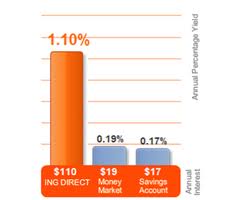
Yesterday, I got an advertisement in the mail from ING Direct Orange Savings Accounts. If you click the link you will see their lovely advertisement on just how much more money you can earn if you put your money with them than if you just drop it into your local bank or money market account.

The chart says it all (chart from right is from a previous period when interest rates were actually even higher than today). You can make so much more money with them. The orange bar is so much bigger than the other bars. But then read the fine print. Go with ING and you will earn $80 a year for every $10,000 you invest. 80? Sure, that is better than $10 you get at your bank for the same ten grand. But, will it really matter?

So, how do you make almost nothing seem like something? Build a great visual even if the differences are minimal.

1 Comment

Filed under Psychology