Category Archives: counseling

DRC/Rwanda Trip: Final Days


October 21-22, 2011, Kigali, Rwanda

Friday morning and we are up by 6 am. Have to pack this morning because we have to be out of our rooms. As soon as we finish the conference we must say our goodbyes and get to the airport. We have breakfast with Robert Briggs of the American Bible Society. He’s on his way to a United Bible Society meeting in Kenya. Our conference begins with Diane

Planning the next steps

Langberg and Carol King covering the topics of lament and grief. After their presentations, the participants practiced writing their own laments. We made time for sharing them with others. We concluded this section with a choral reading of Scriptural laments. This choral reading was compiled by Lynn MacDougall and quite moving for all. We had enough time before lunch for me to teach a bit on vicarious trauma.

After lunch, I did a short teaching on peer supervision. It is important for these caregivers to support each other and so I taught on how to do case consultations and to write-up case study/questions. After finishing this teaching, Baraka led the participants in a “What next” brainstorm. Their main recommendation was to form an association of counselor/caregivers–Rwandan Association of Christian Counseling as a place to get further support, training and to share resources. They wanted a website that would allow them to connect via social media. As they explored their current needs, many said that the number one need is ongoing mentoring. Others talked of finding ways to get paid for their work in counseling. Many spoke of the need for skills and training in dealing with drug and alcohol issues, sexuality, gender-based violence, depression, and anxiety. They asked for trainings 2 times per year. The group decided to appoint a few of the attendees to a committee to see these recommendations to completion.

We concluded our time by asking them to tell us what parts they liked the most. They liked the small group activities. They wanted these to go longer. They liked the role plays and want more. They would like PowerPoint slides (we didn’t do these but handed out outlines) and for speakers to speak slower English. We promised to send them a PDF of our talks and outlines for them to have in electronic form.

Our final activity was to hand out the certificates for real. I got the pleasure of doing this and getting a hug and a picture from each attendee. We said our goodbyes, made a quick change of clothes and headed off to the car to take us to the airport. Just as we were about to get in the car, we were given handkerchiefs each with notes and signatures from the attendees. A sweet parting gift!

Friday night at 7 pm, we boarded our plane (Brussels Air) to start the trip back home. The flight was full and our seats were all over the plane so no debriefing for us. For the next 10 hours (including a stop in Nairobi), I was jammed into a middle seat without leg room (front role of cattle class). Arriving in Brussels by 6 am, we managed to get coffee, chat a bit with each other, and buy some Belgian chocolates for the family. After a total of 28 hours of travel, we arrived back in Philadelphia, PA. 42 hours of no sleep (all day Friday and the night and then most of Saturday) but I arrived home wired and ready to tell my family about what I had seen. Funny, as I tried to tell them about my trip, I found I was having a hard time making sense of everything. I’m not sure it was just because I was tired but more because I had too many thoughts and feelings and was without words to express it all.

As I post this, I am now 1 month from the end of this trip. It is still hard to be concise about the trip. We learned much, saw much, and have ideas about how we can have an impact on future counseling training in Rwanda and the DRC. Clearly, we need to do more live vignettes for the counselor trainees. And we can impact the area by offering materials to existing schools.

I am blessed to have been able to do this work. Probably more blessed than the recipients! I couldn’t have asked for a more successful trip, better travel connections (well, unless someone has a teleporter lying around), or better travel companions. Can’t wait til the next time.

4 Comments

Filed under christian counseling, Christianity, counseling, counseling skills, Uncategorized

DRC/Rwanda Trip: Day 10


October 20, 2011, Kigali, Rwanda

The second day of our conference with NGO caregivers. Today Bishop Nathan Gasatura joined us from Butare. It is always a pleasure to meet with the Bishop. We had a good lunch meeting with him where we discussed future possibilities of counseling/trauma training in his city. I learned why the national university is not in the capitol but 3 hours south in Butare. When Rwanda and Burundi were one country,

The Bishop grooves to some Gospel

the capitol was Butare and thus it made sense to have the national university there. Oh, and another reason it is good to see the Bishop is that he can really dance.

Carol King and I started this morning’s session with a short counseling vignette. I counseled Carol in order to illustrate the skills of bad listening and then good listening, stabilization, and grounding during dissociation. We then talked with them about ways to get another person’s story in bits (rather than all at once) and with their lead (rather than having the counselor pull it out of them). The role play was something that few had ever seen and we had lively discussion afterward, including why I didn’t push Carol (she played a hesitant, fearful counselee) and the issue of exploring emotion. At the end of the conference we learned our role plays were some of the most important parts of the conference.

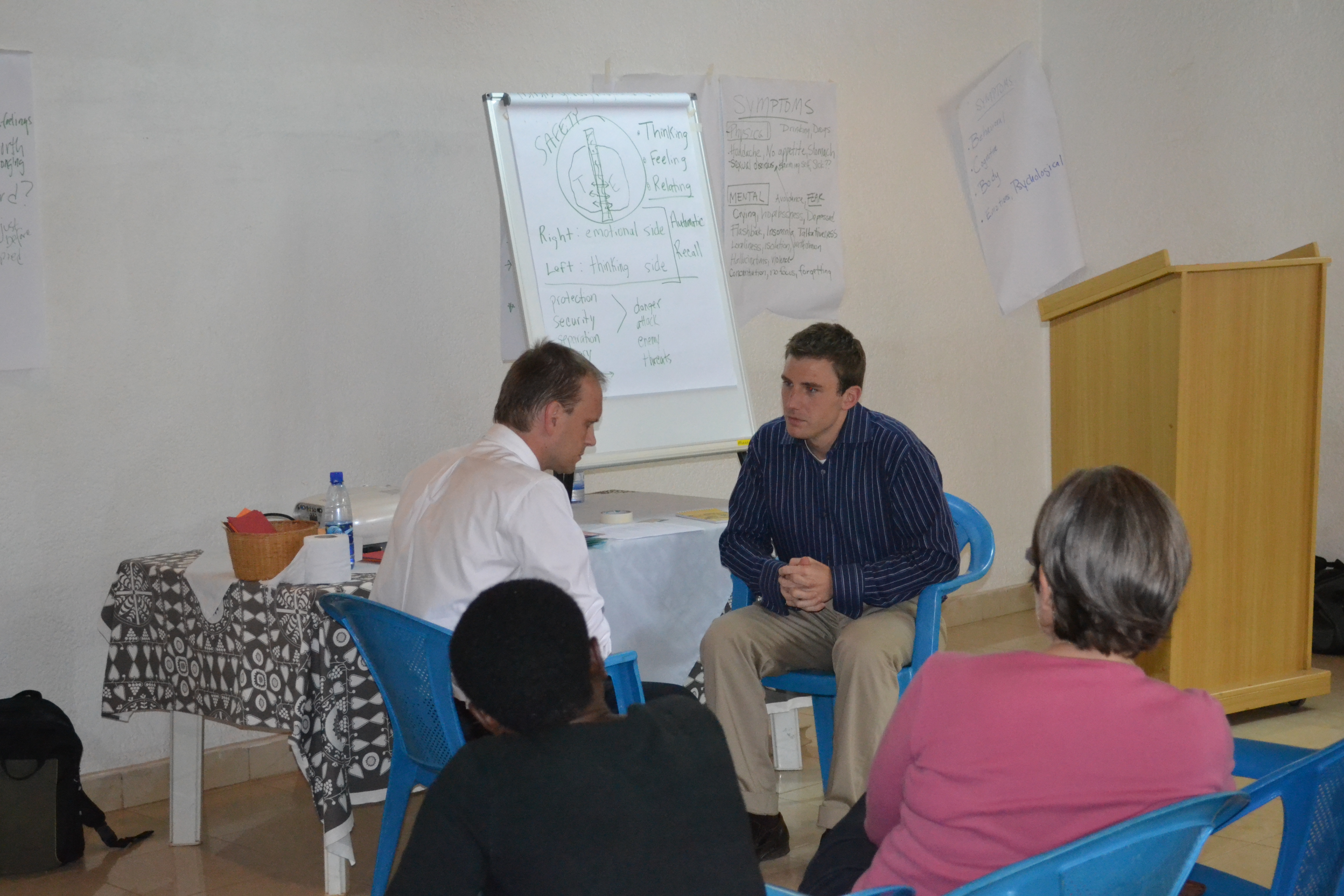
Later, Josh presented some material on trauma, attachment, and the impact on the brain. To make this presentation practical, we did another role play where I was the counselee and Josh the counselor. We illustrated (in a rather speeded up illustration) portions of the levels of repair: telling the story, re-framing the story (in a wider truth), re-writing the story

Josh counseling Phil

, and re-connection with others. We concluded this time by having them practice counseling each other with a focus on drawing out emotions in the story. We had another great discussion about culture and emotion as well as the cultural differences between the US and Africa (counseling as listening vs. counseling as advising and solving problems).

The evening concluded with a party and hors d’oeuvres. It was an amazing celebration where many of the women wore traditional attire. We danced (I tried), sang scripture songs, heard silly riddles, and cultural stories. Then, we concluded with a ceremony of giving out the certificates. Normally, we would do this on Friday night at the conclusion of the conference but many wanted to receive their certificate in their traditional dress and we were leaving immediately after the conference ended on Friday so we determined to do this tonight. It was a time full of celebration and joy and a wonderful reminder of one antidote to trauma–communal celebration.

2 Comments

Filed under christian psychology, counseling, counseling skills, Rwanda, Uncategorized

DRC/Rwanda Trip: Day 9


October 19, 2011, Kigali, Rwanda

Finally! Our conference begins. 19 separate group represented here for a total of 42 caregivers. Baraka Unwingeneye (IJM and lay counselor trainer) opened the conference with small and large group discussions on the causes, symptoms, and definition of trauma. The participants were active in discussions. The energy is high! Baraka concluded her section by reminding us all that everyone can be traumatized, even the strong in body and faith. Diane then spoke for 50 minutes or so on the nature of traumatic memory and an overview of the first two phases of intervention. Her voice was a bit weak as she came down with a cold but she delivered it well just the same. Her outline provided a useful reminder of treatment necessity: talking…tears…time. She concluded with some discussion of how having healing relationships, a purpose, and faith all play significant roles in the recovery process.

We ended the morning with a handkerchief project where participants created a depiction of their grief/suffering and then shared it with others. We knew this was going to be powerful and that it would take time. However, we were somewhat surprised at just how powerful it was and how much the participants valued telling others (in dyads and groups) a portion of their trauma story. Several told us that even though they had been counseling others since the genocide in 1994, they had never told anyone their own trauma story.

Our afternoon continued with small and large group activities/discussions and concluded with a question and answer session. The group is hungry for information and we do not have to do much to encourage conversation, discussion, and engagement. Our late afternoon and evening is spent resting, planning for tomorrow’s work and enjoying each other’s company. The food continues to be outstanding at Solace. The only complaint I have is how early the roosters and birds start calling. 4 am is way too early for this. Just outside my window is something sounding like a bird having swallowed a bugle. I later discover it is the gray crowned crane. Here’s a short video I shot from my balcony where I got it to “sing.”  (photos by Joshua Straub)

Leave a comment

Filed under AACC, counseling, counseling skills, Post-Traumatic Stress Disorder, Rwanda, trauma

DRC/Rwanda Trip: Day 8


Tuesday, October 18, 2011, Kigali

Today is our first relaxed day of the trip. We begin the day by having devotions with the staff at IJM. Josh led them in some thoughts from the book of James on themes of justice and justified. The Apostle Paul illustrates the payment (transaction) for justification found in the cross. James points us to the evidence (receipt) of our justification found in our works that prove we have been justified. There is no faith without works.

After devotions, we went to a very American looking cafe to have coffee and to go

Good coffee good colleagues

over the conference plans with IJM employee and counselor Baraka Unwingeneye. She and Josephine Munyeli (WorldVision) are our co-laborers and without them we would not be able to do this work. Our planning helps us nail down tomorrow’s conference efforts. We know we have good ideas for days 2 and 3 but we must be flexible and alter what we want to do for what can be done well.

Walked back to Solace for lunch and then out for a stroll of nearby streets with Carol. Just prior to dinner we received a visit from Rev. Nathan Ndyamiyemenshi at ALARM. He took us to see their retreat property on a lovely hill on the edge of Kigali. A beautiful spot for anyone who would want to take a group to Rwanda. One of the buildings had a plaque stating that it was a donation from Calvary Church of Souderton!

On the return to Solace, we stopped off to by Rwandan coffee beans to bring home. Speaking of home, I am getting homesick. While it is good to have a restful day, I am ready to get on with our conference and go home. Good that we start tomorrow.

2 Comments

Filed under counseling, Rwanda, trauma

The Mission of God to the Mentally Ill: What Role Does the Church Play?


The Mission of God to the Mentally Ill: What Role Does the Church Play?.


Check out my blog on Biblical Seminary’s new faculty blog. Addresses the most frequent search terms and comments on this blog.

2 Comments

Filed under biblical counseling, Biblical Seminary, christian counseling, christian psychology, Christianity, counseling, Psychology

How can you listen to trauma all the time?


How can you stand to listen to [traumatic] stories like these all day long?

This is a question I get from time to time, most frequently from someone who has just told me of the trauma in their life…and most frequently from someone who feels stuck in their responses to their abuse.  They know I see multiple clients in one day and imagine that listening to pain, heartache, abuse, neglect, and the like must be overwhelmingly depressing.

My answer is a little complicated, but here it is

1. You get used to it. This could sound callous and by this answer I do not mean you get numb  to trauma. If you get numb to trauma then it is time quit counseling. But, you do get a bit used to it.  You are less surprised by evil after you hear about it in so many different forms.

2. It is hard. Hearing about brokenness is difficult. It is even more difficult when those who should be responsible for protecting or at least dealing with the sins of others well do not do their job. When systems conspire to harm the victim that is hard to hear over and over again.

3. There is more hope in these stories than you might imagine. Yes, hearing about brokenness can be difficult but we see far more hope than you might imagine. We see more life and more growth despite pain and hurt. When someone abuses a child, that someone destroys another for their own purposes. But, time and time again we see resiliency–even when that person may have significant damage in their life. Often the abused person only sees their brokenness but we see how they are surviving and thriving. It reminds me of how I have seen trees growing up in the middle of abandoned parking lots. What was left as useless is supporting life, even developing an entire ecosystem.

4. You can only do this work if you also spend time with good things. One must imbibe in healthy and living things if one wants to work with death. This means spending time with creative things, with beauty, with life, with art, with music and the like. If you don’t do this, you will die on the vine and you are in great danger of hurting others.

Leave a comment

Filed under Abuse, counseling, counseling skills, Uncategorized

DRC/Rwanda Trip: October 14, 2011


Day 4:

A breakfast of coffee, fruit and egg and we’re off visiting rape victims and those who help them today. First stop is the DOCS hospital (Doctors on Call for Service) run by a gynecologist, Dr. Ahuka Ona Longombe. This hospital specializes in obstetrics and in fistula surgery for rape victims. Dr. Ahuka if a larger than life, forceful personality. The ABS has done some partnering to provide the hospital with some better equipment. After touring the facility, he took us to a room to show us his PowerPoint presentation on the causes of sexual violence, the impact on women and the work they do to repair. It was a difficult slide show (with a few pictures!). If you think of rape as forced intercourse only, think again!

He showed us current stats (42,225 cases of reported sexual violence as of 2 years ago). He pointed out how these stats are very likely LOW due to stigma, violence, and the complexities of multiple reporting agencies. Victims during the reporting period are 21% little girls, 56% young women, and 23% old women.

Only 25% get treatment within the desired 3 days.

While they do HIV/STD testing and treatment, medical, surgical, nursing, spiritual, and legal care, Dr. Ahuka repeatedly begged for help for the psychological damage. As a team we discussed whether it would be possible to send two high level interns (even post grads) for 6 months to focus on training nursing and doctor staff as well as lay people from local churches who might reach out and care for the spiritual needs of these terribly traumatized women. Interns would have to be able to speak French.

Diane holding the the hand of "C" (translator at center)

Typical home with lava chunk wall

Leaving the hospital we traveled some very bumpy roads to Sister Alvera’s home. Now, all roads are bumpy in Goma. But these roads were the bumpiest. I kept expecting to lose teeth or an axle. Sister Alvera, a nun who runs an orphanage and home for raped women, was not home but they were expecting us. We came for the express purpose of talking to two women who have been treated by Dr. Ahuka for fistulas and who were willing to tell their trauma story. We were most interested to hear how they are learning to cope. The first young woman, C, had bright eyes and passion all about her. We met in her small abode, something akin to a shed in this country. She told of her rape and her treatments. Through the translator we heard how she experiences both joy and deep pain (she has been rejected by her family because of the rape). She described her struggle with dissociation as, “getting lost in my mind.” Sleeping, talking to the local pastor and being prayed for were helpful interventions. Near the end of our time with C we heard her lament that she could not find her attacker in order to forgive him. The pressure to do so seemed to eat at her. She felt she could not rest until she forgave him. Diane had the presence to respond that while she wasn’t able to find him, God could see her heart and the forgiveness in it. This seemed very meaningful to C.

"X" and her adorable baby

The 2nd woman, X, had been raped and given birth to a child. The child had been rejected but lived in the compound. Sitting with X was her new little baby who played with nearby fingers and nursed when fussy. This woman was far more triggered during our conversations. Her eyes were missing light. She did not look present. However, she described a caring husband and pastor who helped her cope with her trauma experiences.

The rain, which had been pounding down for our interviews let up just as we were getting ready to run to our vehicles to leave. A view of several green cauldrons  came into view through the puffy clouds passing by. From the Sister’s place we traveled to the local bible society office. We got to see the bibles we would be giving out the next day as well as opportunity to meet the staff. I can attest to two things about the bible society. They keep amazing records on all the widows and children they serve (food, stuffs, etc.) and they do not spend their money on expensive property. Back in 2002, their offices were destroyed by the lava eruption and now they rent rather humble space. If you give the bible society, you can expect your money to go to people and services, not bricks and mortar!

We ended the day back that the hotel with a enjoyable dinner meeting with World Relief country director, Charles Franzen, and two of his staff. Our dinner was outside under a thatch canopy and just above the loud lapping waves of Kivu. I can only describe him as a character–in the best sense of the word. He speaks Swahili but not French and has lived for many years in East Africa. We had wide-ranging conversations about Africa, Baltimore (his home town), baseball (his dislike for Dustin Pedroia of the Red Sox) and football (soccer). And of course the work of trauma recovery was a central topic this evening.

3 Comments

Filed under Abuse, Christianity, counseling, counseling science, counseling skills, Democratic Republic of Congo

DRC/Rwanda Trip: October 13, 2011


Up by 5:30am, a nice breakfast (omelet, Nescafe, fresh avocado half, and bread with Nutella), and then a trip to the airport to catch another MAF flight hop south to Beni (3 hour stop) and then on to Goma in the afternoon.

The flight to Beni from Bunia lasts about 35 minutes and travels a over verdant landscapes criss-crossed with reddish dirt paths. Wish we could stop here and there to check out some of the remote places. We see frequent fires being used to burn vegetation to prepare the land for farming. We arrived on time to Beni, a tiny dirt-tracked airport. I do not believe the small building space we walked through had electricity. Surprisingly, the road outside the airport was paved. In fact, it was the best paved road I saw in all of the DRC. We hear that the Chinese built it. What is the pay off for them I wonder.

Our quick car trip takes us to UCBC, a bilingual christian university in the town. We met with a number of young teachers and staff along with Daniel Masumbuko Kasereka, the chaplain and an administrator. The school was running some intensive English language classes in preparation of the start of a new term. Here too we hear about the trauma in students and the negative impact on their learning. We also learn about their attempts to bring some trauma recovery to the community by hosting some seminars using the trauma/reconciliation materials of Rhiannon Lloyd. We hear of sex trafficking and abduction of women by militias. Our time is short but we do have some good conversation with them. Nice to meet Baraka Kasali, the son of the rector and someone who clearly was raised in the US but using his talents in this small area. Also, met an American, Bethany Earickson who teaches English here.

Our time is short so we say our goodbyes (after using the pit toilets), pile back in the car and head back to the MAF plane awaiting our trip to Goma. We arrive at Goma around 1:00pm. Sadly, it was raining and so we did not get a view of the massive volcano just outside Goma. Instead we dodged clouds, flew over high peaks and Lake Albert, and then flew just above the tree tops to avoid turbulence.

First sights at the airport are rusting UN aircraft, lookouts, someone who demands money for landing, and customs officials who laboriously re-enter all of our visa information. Our passports disappear and then reappear. Not sure what they do with them.The trip to the hotel is our first glimpse of this chaotic city. All streets are rutted with potholes and unpaved. Piles of lava chunks litter the streets. Besides potholes and lava, you see boys going in every direction pushing the congolese “bike” as they transport goods hither and yon?

We arrive at Hotel Linda by 2pm. Hotel Linda sits on the edge (literally) of Lake Kivu. It is a beautiful view and beautiful sound (waves). This will be our home base for the next several days. Kingfishers are sitting on flowers outside my room. I find that the hotel has a public computer and free (slow) internet so I quick pop off an email to my family to let them know we have arrived. We have time to rest and talk about what we have so far seen and heard and how we might develop a trauma curriculum for training the faculties of various schools. For dinner, I choose Capitaine fish (chunks not fillet) cooked in spices and a banana leaf. Excellent.

Tomorrow begins an intense time of listening to trauma workers and trauma victims.

Leave a comment

Filed under AACC, counseling, counseling science, Uncategorized

Back in the USA after whirlwind trip to DRC and Rwanda


Glad to have the trip to see the trauma recovery efforts and needs in the DRC and Rwanda. Glad to return home. It has been a whirlwind of experiences and emotions. I know many of you were in prayer for our trip so over the next 2 weeks I plan to post daily logs of our trauma recovery trip to the Democratic Republic of Congo (DRC) and Rwanda. I have some pictures and video that I hope to post but am still trying to figure out how to make some edits to the video clips I took each day.

Let me start by making a couple of observations about the things that were most noticeable–both in going to a new culture and in returning home. These are random…

  1. Chaos is the name of the game in the DRC. Nothing works well. Not customs, not roads, not electricity, not UN.
  2. Smooth roads in the DRC are few and far between. In Goma, they are TERRIBLE. Looks like they just carved them out of lava. What a wonderful place to live if you make your living replacing axles and struts.
  3. Electricity is spotty, internet slow…but most in Goma have 2 cell phones each. Why? Because they have two cell providers and at any time, one may be down
  4. The UN soldiers aren’t well liked in the DRC. Seen as either neutral (just observing not helping) or negative (participating in the raping of the Congo). Being a UN soldier may be one of the most mindnumbing job there is. Stand around. Do nothing for most of the time.
  5. Everybody walks everywhere
  6. Rwanda is developing by leaps and bounds. Not sure if all of it is good. On the one hand, massive construction in Kigali. Roads from Goma to the center of the country a delight. On the other hand, there are large sections that used to be slums in Kigali that are now green space/farming/nice properties. Where did those people go?
  7. Stereotyping: Congolese seem more open about their feelings than Rwandans.
  8.  We are so blessed in this country. We can count on our infrastructure.  We do not have to pay bribes. If we work, we probably will get paid.
  9. Despite their poverty, African worship is far more joyful and therapeutic (in a good way) than what we call worship in this country.
  10. I probably wouldn’t invite guests to my house if it were a 2 room board shack with no running water or toilet. Not the case for some in the DRC and Rwanda.
  11. Trauma is everywhere in Africa. Few resources to deal with it there, including the church

Day One: October 10-11; travel to Entebbe, Uganda

6 pm. Lift off on time from Philadelphia International Airport. Diane and I fly overnight to Belgium. It is always a challenge for me to get sleep on a plane so I got a prescription for Ambien to help. Learned that half a pill doesn’t much work for me. The total trip from Philadelphia to Uganda takes 18 hours of flight time. Add in the waits in Philadelphia, Brussels, and Kigali and you have 24 hours of travel, a long and painful trip. Yet, each leg went well and went off as planned. Two minor interesting experiences

  • Recognized a stewardess on the first leg who plied me with a few freebies to make the trip much more pleasant
  • Pretty sure I sat next to French journalist, Jean Hatzfeld, author of Machete Season and the Antelope Strategy on the trip to Kigali. Not sure since his English isn’t that good but he was editing proofs of a new book he said was about him and his role after the genocide. Wished I had determined for sure who he was and told him how I found his books so helpful.

Arrived in Entebbe at 9:45 pm, October 11. After that many hours, you feel rather fuzzy brained. But, we were met by someone from the Ugandan Bible Society who had us wait at the airport with him until Bagudekia Alobeyo, our American Bible Society friend, arrived on his flight some 45 minutes later. Once Bagu (our Congolese pastor/guide and friend) arrived we set off to a nearby hotel, the Imperial Beach Resort Hotel right on Lake Victoria. This turns out to be our best accommodations of the trip. First impressions right out of the airport. The lovely smell of charcoal cooking fires are quite prominent.

Off to sleep in hopes of good rest to be ready for our quick flight into the DRC tomorrow!

3 Comments

Filed under Congo, counseling, trauma, Uncategorized

Stopping addictive behavior: What works?


I taught Sunday School at my church a few weeks ago. The topic was finding practical and specific ways of escape from the cycle of addiction. If 1 Cor. 10:13 is accurate that there is “always a way of escape” for every temptation, then it was my suggestion that we ought to become experts at finding the gifts of escape offered by God.

I began with a reprise of the cycle of addiction that is often attributed to Patrick Carnes. That cycle goes something like this:

During a period of abstinence the person has the impression they would never fall prey to “old” temptations. But then,  triggers happen. These can be positive (a success) or negative (tired, hungry, lonely, angry, etc.). Triggers can be internal or external. These usually result in some immediate automatic thoughts/desires. We begin a script such as, “I need, I gotta have, if only, I can’t take this…” If we keep up the dialog for very long we find ourselves engaging in SUDs (Seemingly Unimportant Decisions). These behaviors aren’t addictive per se but they are the things we do in an unthinking way that set up us for use. So, the bored person just wants to surf the web and…surprise, surprise…they look at porn. Or, the person who has an alcohol problem is feeling lonely and so goes for drive and…surprise, surprise…they end up at their usual liquor store. After beginning to act out, the person often feels defeated and keeps engaging in the addictive behavior because they have already broken the promise they made to themselves and others. Finally, at some point the person breaks out of the acting out and often does some form of penance. This might include promising over and over to be good next time, doing good things for God and family, or punishing self to make up for the failure.

Stopping Addictions at the Last Minute

When addicts first begin to fight their cravings, they benefit from developing a list of many things they can do to avoid giving in. I recommend that individuals create very specific lists of things to do other than acting out. Most people aren’t good at brainstorming in a crisis so a solid, long list is essential. Items on the list can range from comfort actions (talking with a friend, a cup of  tea, a hot shower, listening to music, etc.) to distracting and positive activities (praying specific prayers, walks, exercise, etc.) to altruistic actions (doing something good for someone else). These lists work best when we share them with those who support our sobriety and who help us troubleshoot when the list doesn’t work well.

A Better way? Building a Different Narrative

But, aborting addictive behavior at the last-minute is a bit like running up to a cliff and hoping to stop before going over the edge. It is good to have a plan for how to stop but it is better to interrupt the cycle before it gets very far. To invoke another analogy, it requires that we change the script if we want to have a different outcome. I like the imagery of script because I think we tend to narrate our lives. Consider these examples of how we narrate life

  • Do you have a “pre-conversation” (fantasy dialog) with someone you know will be difficult? That “conversation” is rarely neutral. You imagine what you will say, what they will say, what you will say, etc. What you imagine is less about facts and more about how you have scripted them and yourself
  • Do you ever determine the unspoken motivations of another? “I know he meant to hurt me because he always does” is narrative. It may be accurate, but it is still your creation of a script and not the same as reality.
  • Do you ever replay a shame experience? A success experience? That is you narrating your life

“So, this relates to addictions how?” you might ask. Good question. Most of us script ourselves as either in a denial story or a despair story in regards to addiction.

  • Denial stories tend to focus on external causes to our acting out. It wasn’t me, it was the devil. I wasn’t going to do that but I was so tired from dealing with my mother. I was just checking ESPN when I clicked the wrong link and got to porn.
  • Despair stories tend to focus on failure and inadequacies. I’ve already failed so I might as well just keep on with my addiction. If anyone finds out I’ll ruin my reputation. No one else struggles like this.

Build A Better Narrative

  1. Identify the subtle ways you tell your own story (look at the typical thoughts, self-invalidations, fantasies, “if onlys”, comparisons, etc.). Find out how these story lines lead you down a four lane highway to your substance of choice.
  2. Practice telling new (and truthful) pieces of your story from God’s point of view. Check out with your trusted friends if they agree with these new pieces. For example, “I feel alone but what is true but God has put these people in my life. I feel like a failure the goal isn’t for me to rise above the struggle but to reach out in the midst of it.” “I am weak but God is present with me in my weakness and isn’t waiting for me to become strong.” Remember, you have practiced old and distorted story lines for many years so don’t expect that one or two attempts will dislodge solidified beliefs.
  3. These new story lines need new goals. The former goal of not using vs. getting “high” no longer works. The former goal of avoiding pain, guilt feelings, or quelling cravings do not work. New goals need to be crafted that work for you. Find one that works for you. Some create goals that focus on the next positive thing. Others focus on goals to stay connected to others during a craving. Still others focus on goals to meditate on something wholly other than their craving.

4 Comments

Filed under addiction, christian counseling, christian psychology, counseling, Uncategorized