Category Archives: christian counseling

Last Practicum Monday: Christian counselors in a secular world


Today marks the end of the 2007-8 school year for our MA Counseling students. Some have completed their final credits and others are half-way to their diplomas but I’m sure all are glad the school year is over.

Our students here do fieldwork in a variety of settings: churches, christian private practices, nonprofit social services (hospice, pregnancy centers), and secular or state/federal financed mental health facilities. Those who work in secular settings are often faced with questions about their faith from colleagues and supervisors. Are they going to try to get their clients saved? Will they leave their faith at the door? And students struggle to know what to do with helping clients in some ways (new communication skills) but not being able to help them in deeper ways (putting trust in God during difficult times). Just how should Christians working in secular mental health agencies function? 

First, I very much believe that Christians should be in all aspects of society if they have any hopes of being salt and light in the world. Far too frequently we sequester ourselves from the world and then wonder why they persist in using caricatures of us.

So, if we are going to be in the world but not of it, how might we do it as counselors in a secular setting? I suggest 3 things to consider as we interact with supervisors/colleagues, clients, and our own self:

1. When dealing with an  Agency/Supervisor/Colleague

  • Get to know your context and its/their history with Christians and Christianity
  • When you hear slams or other suspicious questions be sure to explore the “back story” and validate, if appropriate, the bad experiences with naive or offensive behaviors by Christians
  • Discern who you might be able to have a reasonable conversation with regarding the nature of faith and psychology, philosophy of science, ethical care of people (including the exploration of their faith traditions), and the fact that all counseling is evangelistic to some construct of health). In this conversation be sure to using starting points that the other will understand (e.g., ethics, empirical evidence, concerns, etc.) just as St. Paul does at the Areopagus.
  • Communicate that you do not see your job as coercing anyone. You are not responsible for our clients behavior, neither are we for their beliefs. When we raise questions about faith it is to provoke their thinking a bit further

2. When dealing with clients

  • Be sure to ask early in clinical work about faith traditions, current practices, and experiences. These questions fit with what the AMA suggest as important for healing, as community and spiritual resources are quite powerful in the medical literature
  • When given an opening (e.g., questions about God, faith, etc.) pursue gently NOT with statements but questions that may reveal further beliefs, fears, wants, desires, demands, etc.
  • Further, ask how they came to believe what they do believe
  • Point out inconsistencies in belief/behavior; raise possibilities, pros/cons, potential places for hope that may lead to further discussion of God’s handiwork in their lives; Point out places where they seem to recognize their inability to love enough, tolerate enough (gently of course)
  • Be wary of the habit of “telling” others the truth. Many times clients already know the “right” answer. Exhortations may be useful at times but more often than not they cause individuals to become passive–even when they agree with your point.
  • Be ready to answer their questions about YOUR faith with honesty (e.g., what does belief in God look and feel like when everything is caving in?). Be sure not to sugarcoat the Christian life. Be ready to talk about your hope in a broken world (not just for eternity but for now)
  • And if you do talk about your faith, immediately turn it back to them for them to react, explore, challenge, etc.

3. To ourselves

  • Answer the following questions
    • Can I work with integrity within this system?
    • Is giving a “cup of cold water” (e.g., better communication skills) enough for right now?
    • Can I defend what I do say about the Christian faith in my sessions?
    • Am I giving the impression that I believe that there are many ways to God?
  • Develop a theology of mercy ministry akin to God’s providing rain, sun, and health to the just and unjust alike

3 Comments

Filed under christian counseling, christian psychology, Christianity, church and culture, counseling, counseling and the law, counseling science, counseling skills, Evangelicals, philosophy of science, Psychology, teaching counseling

Are counselors and psychologists an impaired lot?


We’re closing in on the last of the school year. Two weeks to go. Tonight in our ethics class we’ll be discussing the matter of abuse of power, impaired clinicians, and similar issues. In the world of counseling we discuss the problem of impaired counselors/students/trainees when we talk about those who,

(a) do not have the requisite skills, 
(b) have character/attitude deficits, or
(c) reactions to current crises,

AND are unwilling or unable to repair the situation.

First, we ought to be aware of those who are attracted to being counselors. Jeffery Barnett, et al, report the following data from other studies (as cited in the 2007 Professional Psychology: Research & Practice, 38(6), pp 603-612):

  • 70% of female psychologists had been either sexually or physically abused as children
  • 33% of male psychologists report the same
  • 33% of psychologists report being abused as adults
  • They feel the effects of these difficulties (and other family crises) just as non counselors
  • They may be less likely to get help due to knowledge and professional identity
    • 60% acknowledged being significantly depressed during some point of their career
    • 29% reported being suicidal at some point
    • 4% had made suicide attempts

Gizara & Forrest (2004 Professional Psychology: Research & Practice,35(1), pp 131-140) reported supervisors experiences of trainee impairment in APA accredited internships (doctoral level). Many of the supervisors had a hard time defining impairment in counseling but had sort of what I call the “I know it when I see it” mentality. What they often described were the disruptive, persistent relationalconflicts that are obvious to most. They did identify that it is hard for supervisors to address these matters because they (a) are trained to be empathic and to try to save everyone, and (b) not wanting to deal with conflict, destroy a career, or make oneself vulnerable to attack that they are holier than thou.

But, I noticed not much discussion or research regarding the one who doesn’t have obvious abrasive relational skills who is prone to using clients and others to make themselves feel good. This kind of person is dangerous not because they disrupt the counseling center but because they are so well liked that they make others overlook “minor” ethical infractions. Further, the person is rarely cognizant of their using others for their own sense of well-being.

To answer my question. No, I don’t think counselors are an impaired lot–at least any more than others. If we are aware of what drives us to be counselors (the good AND the self-serving), are willing to be counseled, discipled, held accountable, etc. (are willing to be transparent), and see our work as God’s first, then I think we are rather a safe lot.

Watch out for those of us who think we have arrived or no longer need teaching. I’m reminded of Aslan’s question to Prince Caspian at his coronation:

Aslan: Do you feel yourself sufficient to take up the kingship of Narnia?

Caspian: I-I don’t think I do sir. I’m only a kid.

Aslan: Good, If you had felt yourself sufficient, it would had been a proof that you were not.     

9 Comments

Filed under Abuse, biblical counseling, christian counseling, christian psychology, counseling, counseling science, counseling skills, Psychology, Relationships, self-deception, teaching counseling

Take your first course at Biblical, get a free gas card!


Okay, so it might not be an even swap, but it will pay for your gas to get to Biblical this summer. If you’ve never taken a course at my fine institution, here’s a little incentive for you to do so. We’re offering 2 counseling courses (Leslie Vernick’s 1 weekend course on Destructive Relationships and another 2 weekend course on counseling people with addictions) and two other courses. One course is mostly on-line with just one campus visit (Group life in an eWorld). So, check out this PDF flyer for details or www.biblical.edu for more details such as class dates/times.

1 Comment

Filed under Abuse, addiction, Biblical Seminary, christian counseling, christian psychology, teaching counseling

Practicum/Ethics Monday: Multiple Relationships


All counseling ethics codes address the potential problem of multiple or dual relationships (when counselors have other relationships with their clients or former clients (e.g., counseling a friend or a child of a friend, having a former client as a business partner, etc.). Some codes make it appear that dual relationships are either always or likely wrong and so should be avoided. The AACC code is a bit more liberal in that it (rightly) defines the problem as increasing the problem of exploiting or harming the client. However, this code explicitly defends the biblical nature of dual relationships since we are all brothers and sisters of the same body. Other codes have recognized that it is not possible to always avoid dual relationships. But all codes remind the counselor that it is their duty to defend the healthiness of any dual relationship. In essence, it will be “guilty until proven innocent.”

There are 3 forms of dual relationships (sexual and client; nonsexual social and client; financial and client). Not every dual relationship is with the client (e.g., a counselor has a relationship with the mother of a teen client, a client is under discipline at your large church where you provide consultation to the elders). Dual relationships may happen AFTER counseling is over (begin a friendship with a former client). Finally, it is not merely harm or exploitation that may be the negative outcome of a dual relationship. A counselor may find that a dual relationship hinders or decreases her effectiveness to provide adequate care. [See Lamb et als article in the 2004 Professional Psychology: Research & Practice (35:3), pp 248-254 for a study on these issues].

This last one is the one I want to hang out with for a bit. I had a former client who I had known and highly respected before we started counseling. At the beginning we explored the potential harm that might come from this dual relationship. Both of us deemed that we could manage the slight dual relationship. And I think we did well and the client found the counseling helpful. However, there was a period in the counseling where the client became severely depressed and suicidal. I found myself less willing to hospitalize because I had an image of this client in my head that was much more stable than was actually true. Now, I never like or want to hospitalize. Most psych hospital stays provide protection but little more in the way of healing. But, I know I would have been much quicker to pull the trigger (bad pun I guess) if I hadn’t previously formed an opinion of health before starting the counseling relationship. We should not forget the possibility of reduced effectiveness in dual relationships.

Let me take this one step further. You may have a client who shares your same faith or doctrinal positions, graduated from the same school (but a different time). Any of these connections MIGHT cause you to be less effective in your work because of bias, groupthink, etc. These are not reasons to NOT counsel them but things to keep in mind. Reduced effectiveness because of dual relationships should not be neglected just because we are too busy talking about the rare counselor who decides to have sex with his clients.

2 Comments

Filed under christian counseling, christian psychology, counseling, counseling science, ethics, Psychology

Divorce & Remarriage VI: Paul in 1 Cor 7


We come to chapter 6 of Instone-Brewer’s Divorce and Remarriage where he discusses Paul’s words in 1 Cor. 7. Before he takes on the text, he surmises that Paul must have been married given that it was mandatory both for Jews (to be fruitful and multiply) and for Romans (made law by Augustus in 18 BC). He notes that Paul contradicts compulsory marriage by making it optional in this passage.

But does he speak against marriage? Well I-B suggests that at that time there was a severe famine going on and so it would be hard for people to care for family. This, he thinks, may have been the “present distress” mentioned in 7:26. Second, he believes that verse 1 of this chapter, “Now for the matters you wrote about: it is good for a man not to marry,” that the phrase “it is good…” is NOT Paul’s belief but only a repetition of what the Corinthians believed and were writing for him to clarify. The NIV study bible also raises this as a possibility since Paul speaks well of marriage elsewhere.

What about depriving each other of sex? What is this about? I-B says this,

Notice that Paul does not say that either partner can demand sexual love, because both should regard the other person as ruling over their body. Love is a matter not of taking but giving….Also, Paul does not define what this love consists of, because in some situations, a cuddle is a warmer expression of conjugal love than intercourse. (p. 73)

I-B mentions that Roman divorces were very easy. They also had no fault divorce. A person had only to leave and separate. One did not have to prove abuse or neglect. So, in verse 10, Paul (per I-B) is telling the Corinthians that they should not seek no-fault separations. If one does seek a separation, then that person should either remain unmarried or seek to reconcile. At this point he goes into some technical translation work about the word separate. Should it be translated as reflexive–separate oneself, or passive (be separated from by someone else’s act). Bottom line:

Paul’s point is that Christians should not use Roman form of divorce-by-separation because it is groundless, therefore it is too easy to divorce people against their will when they have done nothing wrong. Anybody could take it on themselves to separate, and their partner would suddenly find that they had been legally divorced whether they wanted it or not. (p. 77)

IB then asks, “But what if you have used divorce-by separation?” I-B says Paul is teaching that those who enacted separations without cause should seek to reconcile or remain unmarried. And if you are the victim of such a separation, you treat them as an unbeliever and let them go in peace.

He finishes with these concluding points:

1. Believers should never cause divorce (be the one to break the vows. He is not saying they shouldn’t seek a divorce because the other broke the vows).

2. Believers should not use groundless divorces.

3. But questions remain for later chapters: can a believer divorce a partner who breaks their vows unrepentantly; and can a believer remarry after a divorce.

I think I-B brings clarity to Paul’s seeming contradiction in this chapter. However, he may or may not be correct about the famine bit. One would think that if Paul were referring to something like a famine he might have mentioned it. Seems that he is saying something much more eternal. That is good to marry but it is also good to be single and be devoted to the Lord. I also liked what he had to say about our bodies not being our own. Sometimes that is used to demand sex from another. But if we heed this passage, we cannot demand anything at all but only seek to give kindness and love.

1 Comment

Filed under Biblical Reflection, book reviews, christian counseling, divorce, Doctrine/Theology, marriage, Relationships

Practicum and Ethics Monday: Deficient Trainees


Since both of these classes are in progress here at Biblical, I thought I’d bring up a rather touchy subject: impaired students. Ruth Palmer, Gwen White, and Walter Chung (a Biblical grad!) all of Eastern University have recently published an article in the Journal of Psychology and Christianity(2007, 27:1, 30-40) entitled, “Deficient Trainees: Gatekeeping in Christian Practitioner Programs.”

Palmer et al surveyed profs in master’s level counseling related departments at Christian colleges and universities to find out, 1. what percentages of students were perceived by the profs to be professionally deficient, to have received help or dismissal. 2. Whether or not the schools have formal gatekeeping procedures. 3. Whether senior level faculty and junior level faculty perceive the pressures of dealing with impaired students differently, and in part, 4. Whether views on grace, calling, and gifting have any effect on how faculty respond to deficient students.  Their study replicates one done on secular campuses.

Before I mention the results, it would be good to consider why this is important.

1. Because faculty are obligated to protect the public. The authors quote from the ACA code of ethics, “Counselor educators, throughout on-going evaluation and appraisal, are aware of and address the inability of some students to achieve counseling competencies” (ACA, 2005, Section F.9.b) (p. 31). This is a relatively new topic amongst programs. Previously, we merely taught our students but it was up to licensing boards to weed out incompetency. Not so any longer. And rightly so is this change. We have an obligation to remediate problems before sending folks to their fieldwork sites. When we bless a student with an internship, we are saying they are ready to work at an entry level. When we find students with significant relational, behavioral, motivational problems prior to graduation, the authors remind us that the data are “strongly linked to subsequent poor performance in clinical work. (p. 31)

2. Counseling programs tend to attract people who are working out their problems. In fact, the authors point to a study that reported first year counseling students showing more severity of problems on MMPI scales. (This may be partially explained away by the common tendency of students to think they have all the disorders of the DSM). While this isn’t necessarily a bad thing (could mean that students are more likely to be cognizant and empathetic to the trials of life), it becomes a problem when said students are either unaware of the extent of the problems, unwilling to work on these problems, or so overwhelmed in the moment as to not have the capacities to deal properly with the problem. I find most students very committed to personal growth and change. There are those, however, who are so desirous of the prestige of the position or of looking good that they cannot bear to admit their flaws. The authors point out the crux of the problem. “…there is a tendency of impaired students to resist submitting to ‘the very therapeutic process through which they wish to lead others,’… (p. 31)

3. Finally, turning a blind eye to student problems and/or mismatch in skill/profession/calling is akin to walking around the man and left to die on the side of the Jericho road (Luke 10).

Results of the study? The authors got responses only from 1/3 of the surveyed professors (the surveyees should be ashamed at their lack of cooperation with this important study! They ought to know better having all been through programs that value the research question). But from respondents they found,

  • Faculty of CCCU estimate an avg. of 10.9% of impaired students in their program (SD=9.89; I would have liked to see the modal response since the range was from 0% to 50%!! reported). This fits with the prior secular program survey.
  • Interventions with these impaired students only happens about 50% of the time (again a big SD with response rates ranging from 0% – 100% (yeah, right!)). 38% of faculty reported interventions less than 20% of the time.
  • What are some of the bigger reasons for not addressing these matters formally? Fears of lawsuits, institutional pressures (we need students to survive!), fear of poor teaching evals by junior faculty, and inadequate administrative support.
  • They suggest the need to have departments talk regularly about policies, students, and the need to follow-up with potential or actual problems.

Do we ever have impaired students at Biblical? Of course. But I am determined at dept chair to help those in need find help. I remember being a student at another seminary and seeing those that EVERYBODY knew should never be a pastor or a counselor and yet NOBODY (student or teacher) said a word. So, we have 6, 12, and 18 month evals collecting data from the student, profs of each class, peers, mentors, and supervisors to help catch a remediate problems when they exist and to encourage on-going personal growth even when they don’t exist. It still surprises me when I find counseling students balking about getting some of their own counseling. We really do want to be the one who has it together, don’t we. Me included.

3 Comments

Filed under christian counseling, christian psychology, counseling science, counseling skills, Psychology, teaching counseling, Uncategorized

Divorce & Remarriage V: Divorce on Demand?


In chapter 5 of Instone-Brewer’s (I-B) Divorce and Remarriage in the Church we come to Jesus’ reactions to the “any cause” debate raised by the religious leaders. I-B suggests that prior to the time of Jesus, divorce was only allowed for failure to provide clothing, sex, and food–and could be initiated by either a male or female (I am suspicious as to whether women really could initiate divorce…). But by the time of Jesus’ ministry, Hillel, a popularized the “any cause” divorce by his mis-reading of Deutronomy24:1. Hillel and his followers proposed two grounds for divorce: sexual immorality and “any cause” based on some fault other than immorality. I-B reports that women were in favor of the “any cause” clause. If a woman was divorced for immorality (or allegations thereof) she could be killed or at minimum lose her rights to her marriage inheritance. But the “any cause” divorce was quietly done and mean she would probably get some of her inheritance. I-B suggests that Joseph’s plan to divorce Mary quietly followed the “any cause” clause,

Joseph did not want to put Mary through the disgrace of a public trial, so he decided to use the quiet “any cause” divorce that did not require any proof of wrongdoing. Matthew considered that this would be the action of a “just man,” because Joseph could have ensured that he didn’t have to pay Mary’s marriage inheritance if he had decided to prove her guilty of adultery in court. (p. 57)

Countering Hillel was Shammai and his followers, who only saw sexual immorality as a reason for divorce. I-B reports that this controversy “was a matter of huge public debate” (ibid). So, we come to Matt. 19:3 where the rabbis ask Jesus his opinion on the matter. Is it lawful to divorce for any cause, they ask. I-B does not think that our commentators and translations get it right. The rabbis are not asking Jesus if divorce is okay but if “any cause” divorce is okay–based on his reading of this contemporary debate among the rabbis. But what of Mark 10 where the text doesn’t include the “any cause” type language? Here I-B suggests the analogy of someone asking if it is okay for a minor to drink. Here we all understand the question is about alcohol and not drinking liquid. I-B suggests the audience would never consider that what Moses enacted as law would be unlawful. Divorce is allowed, but is “any cause” divorce allowed?

Jesus ignores the debate and tells both groups their mistake per I-B. But when he directly answers, Jesus supports Shimmai’s position and rejects the “any cause” divorce.

I-B points out that most biblical scholars get hung up on the meaning of porneia and miss the context of the rabbinical debates of the day. Jesus, says I-B is only answering the specific question of how to interpret Deut 24:1 and NOT nullifying the other legitimate reasons for divorce that we looked at in previous posts (abandonment, failure to provide food, clothing, and conjugal love). Jesus answers the question at hand but focuses on marriage rather than divorce. I-B again uses the illustration of telling his wife to “just wear the dress” and having her think he means she shouldn’t wear shoes.

The rest of the chapter considers some other parts of Jesus’ teaching. He supports monogamy and when the rabbis try to suggest Moses commands divorce, Jesus retorts and says that Moses allowed it but did not command it (verse 8). I-B suggests that the rabbis heard the “because of your hardheartedness” like this: They heard him quoting Jeremiah 4:4 where divorce and stubbornness are mentioned together.

Jesus thought that people were being too quick to divorce, so he reminds them that Moses meant divorce to occur only when there was “hardheartedness”–that is, a stubborn refusal to repent and stop breaking marriage vows. (p. 63)

I-B reports that the disciples’ response reveals the bombshell of Jesus’ teaching (verse 10). If its like this, maybe it’s better not to marry.” Jesus is radical by suggesting that marriage was optional. Apparently, Jews always saw it as compulsory due to the command to be fruitful.

So, Jesus denies the “any cause” divorce and even suggests that attempts to divorce are not valid and therefore remarriage is an act of adultery. If you are following along in the book, be sure to re-read I-B’s summary of what he thinks is going on in Matt 19 on pp 65-66. He also reminds readers that the Gospel accounts cannot possibly contain all that was said but are shortened to get to the main point.

Mark wrote first and abbreviated the debate as much as possible, but Matthew wrote later, when the debate was more or less over and was less well known. He knew his readers might get confused, so he helped them out by putting a few details back in. (p. 67)

So, what do you do with these proposed ideas about the context in which Jesus is speaking? Are you suspicious that the church could have missed this context for so long? Even I-B raises this question and promises to answer it in a later chapter. If you do use this lens (that Jesus rejects the any cause divorce but supports the sexual immorality cause) then I think it begs the question whether Jesus would agree with hardheartedness as a cause for divorce as well (which I-B wants to have at the bottom of all appropriate divorces; we should forgive even adultery, but divorce only when stubborn refusal to repent is the issue). If that was his point, why was this not clearer in the text. On the other hand, contumacy has long been seen as the cause for divorce (excommunication) from the church. One is not cut off from the church because of any type of sin, but because of a pattern of stubborn refusal to repent and turn.

Leave a comment

Filed under Biblical Reflection, book reviews, christian counseling, divorce, Doctrine/Theology, marriage, Sex, sin

Divorce & Remarriage IV: Jesus and the OT


Chapter 4 of Divorce and Remarriage in the church is quite short and has one primary point: Just because we live in the NT age, we do not ignore the OT. Jesus clearly comes to fulfill and to expand on the Law and does not speak against any of the OT–only against false interpretations of it. Some quotables:

Jesus called us to take note of every letter of God’s law, so we cannot simply ignore it. (45)

Jesus fulfilled the ceremonial parts of the law on the cross, but he wants us to fulfill the moral parts of the law, and he even said that he wanted us to be perfect like our Father…. he affirms the principles of these laws [in Matthew 5] and widens their application. (49)

Jesus never criticizes what the Old Testament says, though he frequently criticizes the way people interpret it. He condemns the way some people tried to sidestep the command about oaths by claiming that they were not making a real oath if they swore by “by heaven”… (50)

As you can see, Instone-Brewer is telling us that in the next chapters where we look at the NT data, it ought not be seen as in opposition to the OT but as further explanation of the underlying principles of the OT.

As an aside, he explores 3 possible ways people look at the relationship between the OT and the NT:

1. The OT contains ceremonial and moral laws. In the NT, Jesus fulfills the ceremonial by his sacrifice, leaving us with the moral parts. I-B says the problem with this is that we may not agree as to which is which.
2. Christians follow OT moral principles but not the details (e.g., we no longer stone individuals caught in adultery but we recognize the moral principle behind the prohibition).
3. Ignore any OT laws not mentioned in the NT. Problem here is that rape is not mentioned in the NT.

Finally, I-B warns the reader against seeing the OT as legalism and the NT as grace. God is just as forgiving in the OT as he is in the NT.

Not much for me to add to this except to underline his point about the NT expanding and highlighting the principles of holiness. We recognize that the sin behind adultery is in all who ever lust after another. This helps us avoid pride and arrogance. Now from here we’ll look at the NT writings that relate to divorce and remarriage.  

Leave a comment

Filed under Biblical Reflection, book reviews, christian counseling, divorce, Doctrine/Theology, marriage

Practicum Monday: Scott Stanley on Couple Conflicts


Last week in our staff meeting we listened to the end of Scott Stanley’s conference presentation on couples communication. You may remember I blogged previously on his funny but too-true analogy of dogs and marriage (We fall in love with the front end of the puppy/marriage, but they both have backs ends that need to be managed).

In this section of the presentation he makes this statement: events trigger issues. Couples tend to fight about events but really most conflicts are about issues that are deeper (e.g., Who gets the say around here, Do I have influence, Do you care, and other expectation clashes). The challenge is to get couples to see past events to the issues.

Problem: most couples only talk about issues during emotionally charged events. Why? It would be easy to say avoidance. But take that a step further. If the couple is no longer in conflict, why bring up something that is likely to trigger it? As Stanley says, “We’re really getting along right now, so I don’t want to screw it up by talking about a problem.” Seems good in the moment, but bad over time.

Stanley’s point is to deal with this problem by (a) handling events well (time out, staying in the moment, etc.), and (b) being proactive by maintaining safe, open communication about issues. This takes sacrifice, he says. Healthy sacrifice (not martyrdom) is pretty powerful and helpful in moving toward the desires of the other.

Here’s a couple of my thoughts:

Stanley has some great techniques and seems to have a good handle on what goes wrong in conflict. I think many couples can benefit from better care of the “back end” and making sure to remember and reinforce the front end as well. He rightly points out that we can easily miss the good sacrifices others do daily and then only recognize the good when it stops for some reason. If we’re not careful we take for granted the sacrifices of others and come to expect and even demand them as rights.

Stanley’s techniques seem not to work with couples where insight is low, trauma or violence has been a part of it, when folks have personality disorders, or when the couple are deeply entrenched in their bitterness towards each other. All events have meaning. The couple that is not willing to reconsider the meanings they apply to events (she is evil, that is why she leaves the kitchen that way), little couple work is possible. In fact, maybe even contraindicated. Techniques that should help become

weapons to hurt and destroy. Couple counseling is based on the capacity to observe self and other and to withhold judgment to see life from another perspective. Without this, it is hard to make much progress outside of painstaking experiential work.

2 Comments

Filed under christian counseling, conflicts, counseling, counseling science, love, marriage, Psychology

Practicum Monday: Choosing where to intervene


Most practicum students worry about their ability to do or say something intelligent in their counseling sessions. Will we have something to say? Will we know what to do? In order to know where to intervene, it may be helpful to think about various points in the counselee’s life that may need intervention–and then consider which point to choose and what kinds of interventions would be most helpful.

To help set the stage, I’ve constructed a few slides :

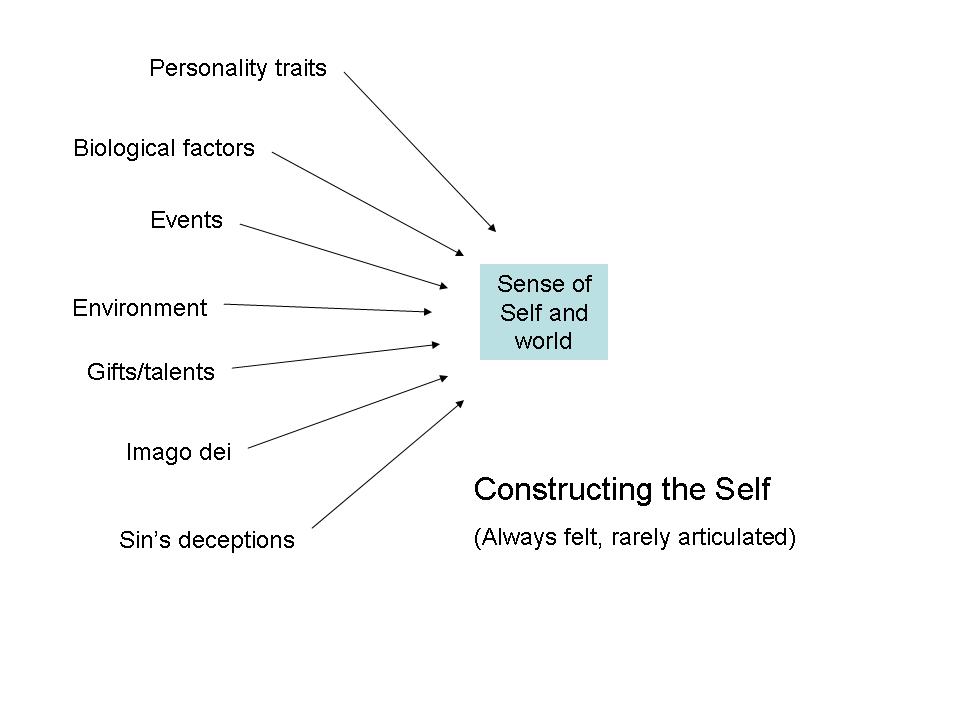
1. Every client constructs and maintains a sense of self and a sense of the world. A number of factors influenced that sense of self, some of which I’ve listed here:


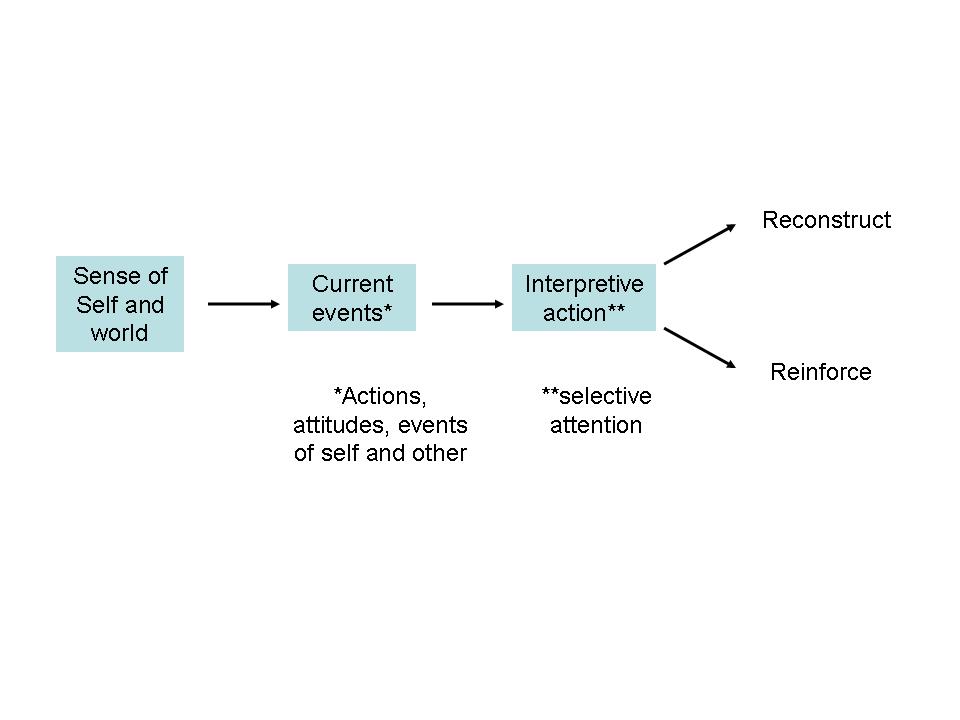
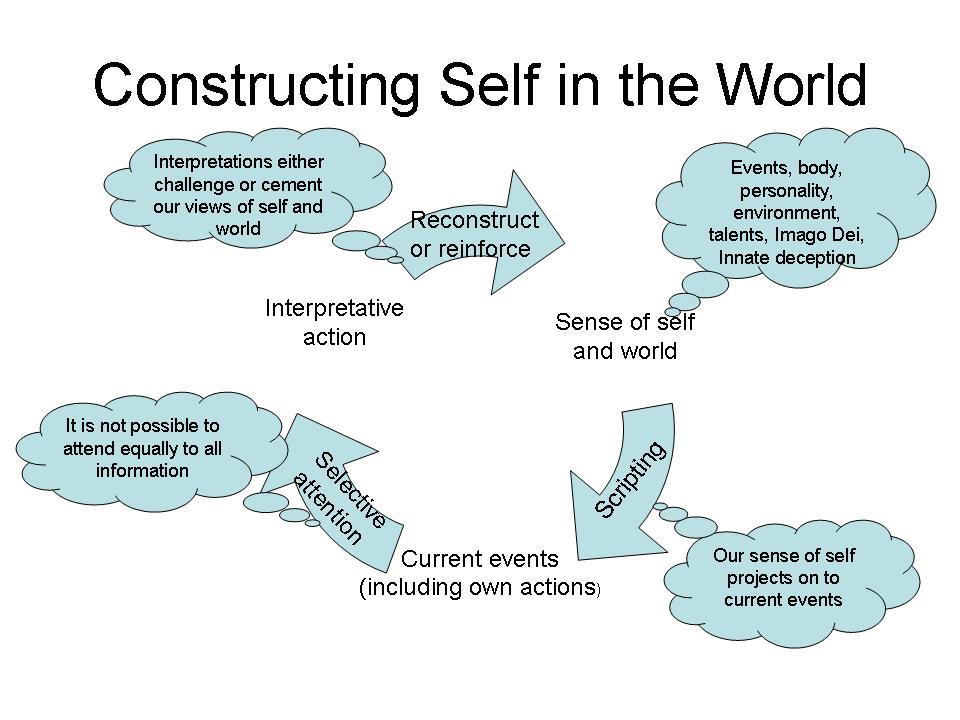
2. We shape and reshape that sense of self through experiences and interpretations that either reinforce or reconstruct/challenge our sense of the world and self:

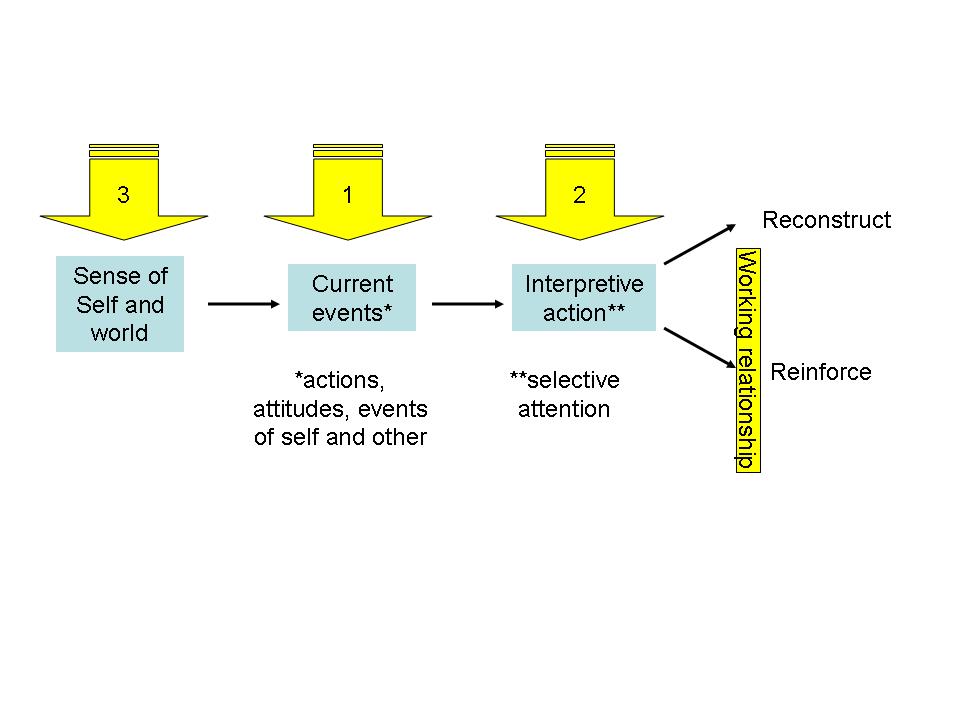
3. The counselor may wish to intervene in several places. (1) Stop and start behaviors; encouraging environmental changes; mercy ministries, (2) Challenging interpretations, Encouraging a change in what is attended to (mindfulness), and (3) Reflecting back on the sense of self and world (uncovering core beliefs and experiences). Note  2 things however. First, none of these points of intervention will be of much value if there isn’t a working relationship that enables the client to trust the counselor enough to be vulnerable. Second, choosing a point of intervention is important but equally important is the kind of intervention (open or closed questions, reflections of content or feeling, advice/information, summarizing, confrontation, etc.)


1 Comment

Filed under christian counseling, christian psychology, counseling, counseling skills