
I have a short blog post over at Biblical Seminary’s faculty post explaining why the seminary is interested in global trauma recovery. You can check it out here.
Tag Archives: trauma

Job opportunity in trauma healing

American Bible Society (Photo credit: Wikipedia)
The American Bible Society has posted a job in the She’s My Sister and Trauma Healing Institute project. It is probably entry-level but will involve travel and close work with trauma healing projects around the world. The right person will need to be able to run projects, be organized and, of course, have a deep love for Jesus! Attached here is the job description. I know and highly respect Bagudekia and Harriet, the people leading this position.
Share this:

Filed under Uncategorized
Abuse in the Church Conference Slides and a Quote
A great start to our conference last night. Boz Tchividjian gave us some good things to think about in how predators in the church operate. He named 5 particular exploitations that are common
Exploitations of “religious cover” (aka religious activity); of faith issues (using distorted faith matters to abuse); of power (using authority, “God told me that…”); of trust (christian communities tend to be trusting); of need (churches work only through volunteers, thus the need).
Here’s the quote:
Everyone believes in child protection. But when the status of the alleged offender is high and the status of the victim is low, that is when people start looking for exceptions to their protection policies.
I have placed the slides of my 4 talks (last night’s and 3 from today) in my articles and slides page (scroll to the bottom, in right column). Boz Tchividjian will make his available here as well after the conference.
Share this:

Filed under Abuse
3 important goals for trauma recovery
In the last week we have been discussing the best words used to describe the process of trauma recovery (see related post below). While words are important and carry much meaning, it may be more helpful to consider what recovery goals are in order for trauma victims. While we know recovery road can be long and arduous, it helps to know when we make progress and a general sense of the direction we are headed. In the days before GPS, if you went on a long car trip you probably consulted a map on several occasions in order to make sure you were headed in the right direction. So also, when you are working to get better after a traumatic experience, you want some sense you are still working on good goals. This need is especially great if the traumatic symptoms are complex and the treatment not brief (think war, genocide, child sexual abuse, etc.)
What three goals?
Esad Boskailo, as noted on p. 94 in his memoir (written and reported by Julie Lieblich) works toward these three goals that in turn support the ultimate goal: thriving (notice that the goal is not being free of symptoms, free of triggers, or back to life as if the trauma did not happen).
- Acknowledge losses
- Foster resiliency (i.e., build the capacity to use current coping resources)
- Find meaning in life again
I think these do function well as helpful signposts or intermediate goals in the process of recovery from traumatic experiences. Now, I don’t believe these goals are necessarily in sequence. For some clients, they stumble on something that gives new meaning to life and thus are better able to acknowledge losses. Others get to work on building better coping mechanisms (e.g., a vet puts away items that cause him or her to dissociate, an adult victim of CSA stops cutting and develops acceptance strategies, etc.) and then can acknowledge losses.
So, in the murky water of therapy (and it surely is murky!), the trauma victim can find some comfort in activities pointing to these intermediate goals. Each day they reject self-condemnation for not being who they used to be before the trauma, they are moving toward thriving. Each day they embrace available coping resources (e.g., a friend who will call or pray), they are moving toward thriving. Each day they find one meaningful experience, they are moving toward thriving.
the how we meet these goals is, of course, the 64,000 dollar question…and not something we can set in stone. I will write on some general activities that are common in most treatment modalities in the coming days.
Related articles
- Trauma recovery? Healing? Integration? Which words communicate a good outcome to you? (wisecounsel.wordpress.com)
Share this:

In Counseling, Who is the Teacher?
Most counselors and therapists get into the field of counseling because they want to help people. This is a good thing! Imagine if they only wanted to make money or to be the center of attention. But, underneath the goal of wanting to help people lurks an insidious goal:
being seen as wise.
Being seen as wise (notice the difference between being wise and being seen as wise) tempts us to become the teacher, the teller, the obnoxious sage. Teaching, telling, training are all activities that may happen in counseling, but only when necessary. Truth be told, we counselors resort to teaching and telling because it gives us a job to do and makes us feel good. This is especially true when we work with the most severely traumatized people. Here someone is hurting in front of us. We can see that they are stuck. Who wouldn’t want to pull them out of the mud? Now, there may well be important teaching moments–gently instructing someone on the symptoms of trauma and/or the physiology of trauma. This might be important for the client who believes that the symptoms are really signs they are sinning and that they can just choose to stop being triggered.
In Counseling, Who is the Teacher?
“The patient is the ultimate teacher about trauma, and a good therapist is a good listener.” (Boskailo, p. 81)
While the counselor has much to offer in regard to teaching, training, and goal setting, we must remember that the client is the one teaching us about their trauma experiences and how much they can deal with at a given time. For example, Boskailo reminds us (see above link for book) that while telling the trauma story is an important part of the healing process, the “how” of telling (and the “how much”) is something each client will need to teach us. One client may need to tell and re-tell the same story each week. Another may be better helped by drawing. Still another may tell once and never again.
We counselors are the student in these kinds of matters. It is our job to listen well and learn well!
Share this:

Trauma recovery? Healing? Integration? Which words communicate a good outcome to you?
Recovery. Healing? Restoration? These words contain both information, movement, and emotion. What words do you like to use when describing the process of getting better after a traumatic experience? How do you communicate that you are better but not so much better that you have no more bad memories; that you have no more nightmares; that you are not triggered into panic when you see someone who abused you?
What words do you shy away from?
Let’s consider healing first.
I was and am being healed?
Some hear healing language as a completed task. “I have been healed.” Past tense. If I was in a wheelchair but now I walk…would I say I have been healed if I walk with a limp or need a walker to get around? Do you ever hear someone say, “I was healed, in part.” Would it be better to say I am being healed or I am recovering. Compared to Greek verb tenses, our English language doesn’t communicate well the ongoing state of something. In Greek, we can communicate a present perfect tense such as, “I was and am currently being healed” all in one verb form. But in English, we cannot communicate such an ongoing process without more words. Thus, when we use the shortcut, “I am healed,” it sounds like a finished job.
Recovery?
What about recovery? Restoration? Renewal? Recovery words are popular amongst former addicts. For them it connotes that they are no longer using but making the daily choice for sobriety. However, they recognize the danger exists of falling back into drunkenness and so they communicate that they are in a lifelong process. For some, however, recovery sounds like a failure–failure to find victory and failure to accept a new identity. The truth is, few people outside of AA use the word recovery in every day speech. The other “r” words are more likely used in Christian circles but not so much in discussion of life after trauma.
Can you integrate trauma?
I have just finished reading Wounded I am More Awake: Finding Meaning after Terror by Julia Lieblich and Esad Boskailo (2012, Vanderbilt  University Press). Julia helps tell Esad’s (a Bosnian doctor) experience of being held in 6 different concentration camps. He is now a psychiatrist in the US and works with trauma victims. However, he faced much brutality in being treated worse than one would treat an animal and so was not in good physical or psychological shape when he came to the U.S. I commend the book to those who want a basic understanding of trauma and of this thing we are trying to call healing and recovery. Listen to these quotes from Boskailo the psychiatrist,
I can’t take away what happened” [said to another survivor]. But [I] can help [you] imagine a better future.
“You are fifty, not twenty-five. You will never be the person you were twenty-five years ago. Even if you didn’t have trauma, you would not be the same.”
What Boskailo is arguing for is integrating trauma into one’s present life. One cannot go back and recover what was lost. A trauma survivor is never going to be free from losses suffered. To do so would be to deny truth. Integration means allowing the reality of trauma and its losses while finding meaning and value to live in the present with hope and even joy. Integration requires acceptance and willingness to look for meaning and purpose.
I like the connotations of integration. But, I am not sure I like the word integration since it also doesn’t connote some level of arrival at a good enough place. What word would you use?
Share this:

Taunting your Abuser?
Is it ever right to taunt your abuser? Is it Godly?
[WARNING: This is a thought experiment…not a recommendation!]
My wife is working on some presentations she’ll be making on the book of Habakkuk and so we have been looking at the book and talking about some of the difficulties in the text (She’s far more insightful on these things than I am!). The 2nd chapter contains a taunt against the oppressor/abuser Babylon. God is having a conversation with Habakkuk and the short version goes like this:
Habakkuk: Why are you allowing all this sin among your people? Do something!
God: I will. I’m sending Babylon and they will carry Judah off.
Habakkuk: Um…God…Babylon? Really? You do know they are like the most heathen people? You’re going to use the worst group of people in the world to judge us? You know we’re not THAT bad?
God: Yup. I’m going to do something that blows you away. I’m up to something you can’t even imagine. I know that Babylon is proud. And here are the taunts you and everyone else is going to throw at them when I judge them.
At this point God appears to give them words to use when the time comes. Consider 2:15-16
Woe to him who gives drink to his neighbors, pouring it from the wineskin till they are drunk, so that he can gaze on their naked bodies. You will be filled with shame instead of glory. Now it is your turn! Drink and be exposed. The cup from the Lord’s right hand is coming around to you, and disgrace will cover your glory.
It would appear that God has no problem taunting humans in their rebellion and depravity. When God taunts, he is speaking truth. When we speak truth, along with God, about unrighteousness then maybe such a taunt is a possibility:
You’ve abused me but just you wait. God is in heaven above. He sees and he will judge. You will face the consequences of what you have done, either in this life or at the last day. There will be justice!
Just an Old Testament thing?
Are taunts only in the OT? Does Jesus do away with them when he tells us to love our enemies? Apparently loving one’s enemies does not mean not speaking a taunt. Notice that Luke records Jesus making ten different “woe to you” taunts against religious leaders and other unbelieving/arrogant people. Can Jesus be failing the second greatest commandment?
Clearly the taunts in the OT or Jesus’ curses of unbelieving religious leaders are not normative. We are not called to do this. But…maybe their existence does a couple of things for us.
- Give Godly words for the private and possibly public comments made by victims of abuse (note: these words do not approve of revenge, bitterness, or other ungodly motivations. But desire for justice is a good and Godly desire and should be expressed!)
- Allow others to validate victims’ experience of injustice without pressing for a quick Romans 8:28 response
A word of caution
Habakkuk 2 ends with a postscript to the 5 taunt songs against Babylon.
But the Lord is in his holy temple; let all the earth be silent before him
Judah was guilty of injustice (1:3). They did not have clean hands. They were not innocent. God did give them words of taunt to use against Babylon. Yet, before God they needed to be silent and humble. The cup of wrath that Babylon would drink is passed over God’s people–not because of their innocence but because of God’s providential love. Christ drinks to the dregs that cup of wrath in our stead. He gives us a better cup to drink. It is far too easy to consider ourselves innocent and our enemies guilty. We ought to stand in silence and awe because we have not been treated as we rightly deserve.
Share this:

Year-end giving opportunities for trauma recovery
Friends,
Just a few days before the end of 2011 some of you may be considering year-end charitable giving ideas. You may not 11.5 million dollars to give away (like Google did to orgs like IJM!) but every dollar counts. Below are some of my suggestions if you are looking to give to trauma recovery efforts both here and around the world. I am absolutely sure there are many more good places that are excellent choices than I list here but I include my favorites and you can feel free to add your favorites in the comments section. I also admit that the first two choices might just directly benefit the work I do.
1. Trauma Training Ministry
A. Biblical Seminary. Yes. Biblical Seminary is involved in global trauma recovery efforts. Readers here will remember my posts about our trip to the DRC and Rwanda this fall. We will be launching trauma recovery training in 2012 (continuing education and graduate studies) by the summer. Look for more info on this site. Read Biblical’s December 2011 appeal letter by me sent to Biblical’s friends and family (sorry didn’t have a pdf version with letterhead). Gifts will support training costs and research.
2. East African Trauma Recovery
A. She’s My Sister. The American Bible Society is using Scripture to engage individuals and communities suffering through the trauma of ethnic violence, especially women having been raped in the region. Their trauma healing workshops trains pastors and local leaders to be trauma healing facilitators in their own communities and in their own language. I can attest that those who go through the trainings are both active in giving away what they received and changed by what they learn. Click the “give” button on the side and choose how many women you wish to help.
B. DOCS Hospital. A medical ministry providing needed surgeries to women with fistulas as the result of rape in the DRC. They are doing fine work there and are serving many women who cannot control their urination without the repairs being done.
3. Domestic Trauma Recovery
A. The Place of Refuge. A counseling ministry to North Philadelphians. Specializing in trauma counseling work. I have known Elizabeth Hernandez since we first met in a counseling class in 1988. She is a fine woman, expert counselor, and an upright and godly person. Donations to Refuge will absolutely extend their ministry to many abused individuals.
B. GRACE. GRACE is a ministry to educate the christian community about the scourge of sexual abuse. GRACE is also involved in providing direction for victims of abuse and in bringing light to abuse cover-ups. As a board member I can attest to the fine work GRACE does with those reaching out for help in knowing what to do in preventing and responding to abuse in Christian settings.
4. Global Recovery Efforts
A. International Justice Mission. They may have received a large donation from Google for work done in India but they are fighting for freedom and justice for enslaved peoples around the world.
Whether you choose one of these fine ministries or one of your own, consider giving to trauma recovery projects this year.
Share this:

Filed under Abuse, Post-Traumatic Stress Disorder, Uncategorized
DRC/Rwanda Trip: Final Days
October 21-22, 2011, Kigali, Rwanda
Friday morning and we are up by 6 am. Have to pack this morning because we have to be out of our rooms. As soon as we finish the conference we must say our goodbyes and get to the airport. We have breakfast with Robert Briggs of the American Bible Society. He’s on his way to a United Bible Society meeting in Kenya. Our conference begins with Diane

Planning the next steps
Langberg and Carol King covering the topics of lament and grief. After their presentations, the participants practiced writing their own laments. We made time for sharing them with others. We concluded this section with a choral reading of Scriptural laments. This choral reading was compiled by Lynn MacDougall and quite moving for all. We had enough time before lunch for me to teach a bit on vicarious trauma.
After lunch, I did a short teaching on peer supervision. It is important for these caregivers to support each other and so I taught on how to do case consultations and to write-up case study/questions. After finishing this teaching, Baraka led the participants in a “What next” brainstorm. Their main recommendation was to form an association of counselor/caregivers– Rwandan Association of Christian Counseling as a place to get further support, training and to share resources. They wanted a website that would allow them to connect via social media. As they explored their current needs, many said that the number one need is ongoing mentoring. Others talked of finding ways to get paid for their work in counseling. Many spoke of the need for skills and training in dealing with drug and alcohol issues, sexuality, gender-based violence, depression, and anxiety. They asked for trainings 2 times per year. The group decided to appoint a few of the attendees to a committee to see these recommendations to completion.
We concluded our time by asking them to tell us what parts they liked the most. They liked the small group activities. They wanted these to go longer. They liked the role plays and want more. They would like PowerPoint slides (we didn’t do these but handed out outlines) and for speakers to speak slower English. We promised to send them a PDF of our talks and outlines for them to have in electronic form.
Our final activity was to hand out the certificates for real. I got the pleasure of doing this and getting a hug and a picture from each attendee. We said our goodbyes, made a quick change of clothes and headed off to the car to take us to the airport. Just as we were about to get in the car, we were given handkerchiefs each with notes and signatures from the attendees. A sweet parting gift!
Friday night at 7 pm, we boarded our plane (Brussels Air) to start the trip back home. The flight was full and our seats were all over the plane so no debriefing for us. For the next 10 hours (including a stop in Nairobi), I was jammed into a middle seat without leg room (front role of cattle class). Arriving in Brussels by 6 am, we managed to get coffee, chat a bit with each other, and buy some Belgian chocolates for the family. After a total of 28 hours of travel, we arrived back in Philadelphia, PA. 42 hours of no sleep (all day Friday and the night and then most of Saturday) but I arrived home wired and ready to tell my family about what I had seen. Funny, as I tried to tell them about my trip, I found I was having a hard time making sense of everything. I’m not sure it was just because I was tired but more because I had too many thoughts and feelings and was without words to express it all.
—
As I post this, I am now 1 month from the end of this trip. It is still hard to be concise about the trip. We learned much, saw much, and have ideas about how we can have an impact on future counseling training in Rwanda and the DRC. Clearly, we need to do more live vignettes for the counselor trainees. And we can impact the area by offering materials to existing schools.
I am blessed to have been able to do this work. Probably more blessed than the recipients! I couldn’t have asked for a more successful trip, better travel connections (well, unless someone has a teleporter lying around), or better travel companions. Can’t wait til the next time.
Share this:

Filed under christian counseling, Christianity, counseling, counseling skills, Uncategorized
DRC/Rwanda Trip: Day 10
October 20, 2011, Kigali, Rwanda
The second day of our conference with NGO caregivers. Today Bishop Nathan Gasatura joined us from Butare. It is always a pleasure to meet with the Bishop. We had a good lunch meeting with him where we discussed future possibilities of counseling/trauma training in his city. I learned why the national university is not in the capitol but 3 hours south in Butare. When Rwanda and Burundi were one country,

The Bishop grooves to some Gospel
the capitol was Butare and thus it made sense to have the national university there. Oh, and another reason it is good to see the Bishop is that he can really dance.
Carol King and I started this morning’s session with a short counseling vignette. I counseled Carol in order to illustrate the skills of bad listening and then good listening, stabilization, and grounding during dissociation. We then talked with them about ways to get another person’s story in bits (rather than all at once) and with their lead (rather than having the counselor pull it out of them). The role play was something that few had ever seen and we had lively discussion afterward, including why I didn’t push Carol (she played a hesitant, fearful counselee) and the issue of exploring emotion. At the end of the conference we learned our role plays were some of the most important parts of the conference.
Later, Josh presented some material on trauma, attachment, and the impact on the brain. To make this presentation practical, we did another role play where I was the counselee and Josh the counselor. We illustrated (in a rather speeded up illustration) portions of the levels of repair: telling the story, re-framing the story (in a wider truth), re-writing the story
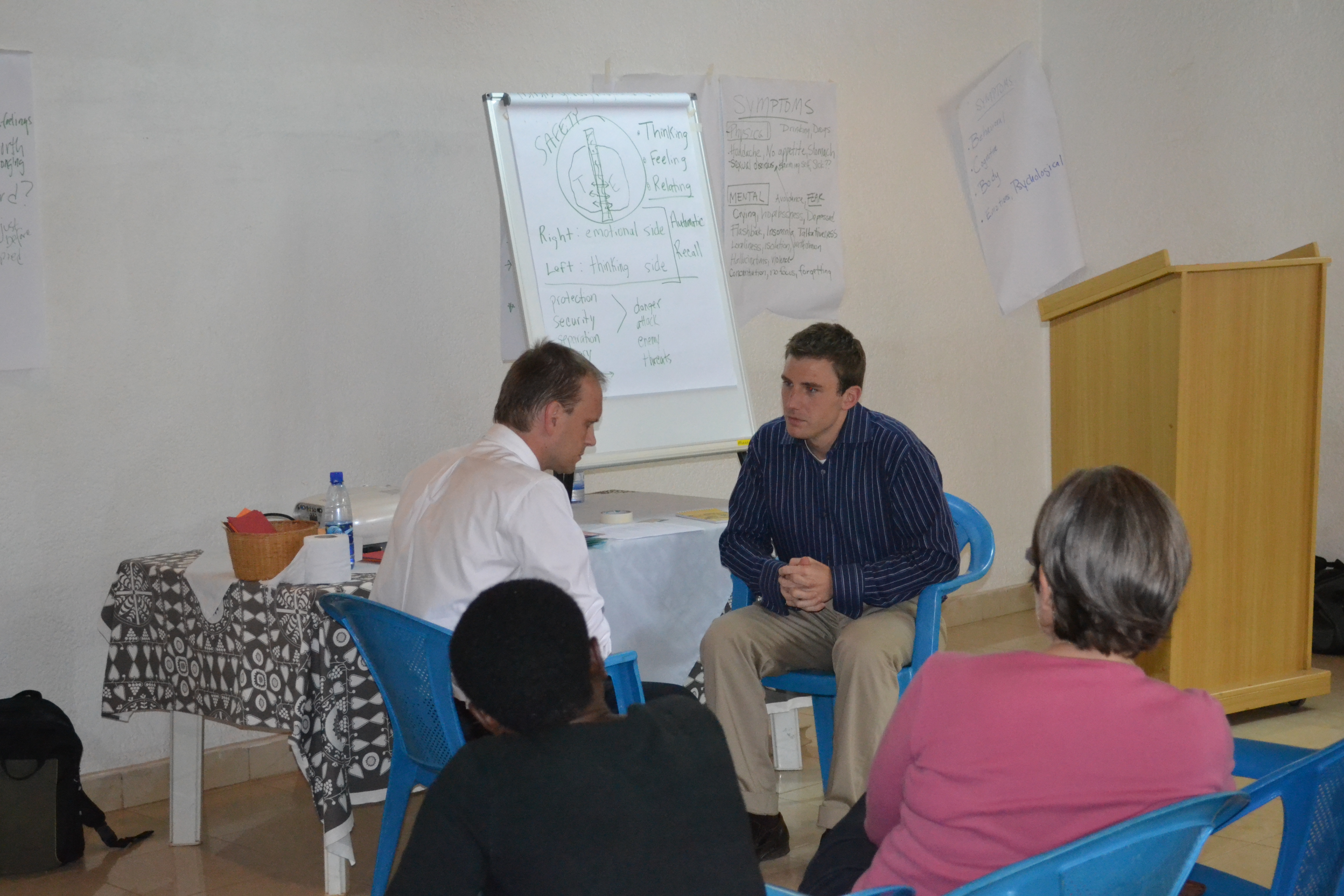
Josh counseling Phil
, and re-connection with others. We concluded this time by having them practice counseling each other with a focus on drawing out emotions in the story. We had another great discussion about culture and emotion as well as the cultural differences between the US and Africa (counseling as listening vs. counseling as advising and solving problems).
The evening concluded with a party and hors d’oeuvres. It was an amazing celebration where many of the women wore traditional attire. We danced (I tried), sang scripture songs, heard silly riddles, and cultural stories. Then, we concluded with a ceremony of giving out the certificates. Normally, we would do this on Friday night at the conclusion of the conference but many wanted to receive their certificate in their traditional dress and we were leaving immediately after the conference ended on Friday so we determined to do this tonight. It was a time full of celebration and joy and a wonderful reminder of one antidote to trauma–communal celebration.
Share this:

Filed under christian psychology, counseling, counseling skills, Rwanda, Uncategorized
 Musings on Faith and Psychology