Category Archives: counseling skills

Power grabs by therapists


We counselors and therapists have ways of asserting our power over our clients. Usually, we do it via subtle messages and phrases. I was reminded of this fact last week during a seminar by Paul Wachtel of CUNY. He told of a case he had of a semi paranoid and hostile client who made many complaints. After one such complaint against him, Wachtel responded with,

Isn’t it interesting that you see me as being just the way your father was

These type of insights offer pseudo-neutral “observations” that are really accusatory and given to show our intellect (but draws them away from their affective state). Further, when we are irritated and make a statement like this we are really saying that my frustration isn’t about me but is about you. I’m objective here, you are not.

When we give insights to clients we need to ask whether or not the client already understands them, will feel that we are working WITH them (not talking at them), and be motivated to do more exploration. As Wachtel stated, insights are often “implicitly adversarial” (never about us either!).

These kinds of linguistic power grabs aren’t just done by analytic oriented therapists (who might be inclined to make distant insights into clients’ unconscious). Cognitive therapists do the same by implicitly and explicitly telling clients that they are irrational and if only they could think like we therapists, they would be so much better.

Let’s not forget that the words we use with clients tell something about ourselves–maybe more than we wish they would.

13 Comments

Filed under christian counseling, christian psychology, Communication, counseling, counseling skills, Psychology

Another training opportunity…


I’m probably doing too many ads here but as I’m off today for conference with Paul Wachtel (see my “on my nightstand” for a link for his book), I thought I would tell you all about a conference this fall by CCEF. This year they are teaching on addictions. I, along with Diane Langberg, Leslie Vernick, John Freeman, and the usual crew of CCEF faculty, are going to be doing a number of great teachings on the problem of addictions. My talk will be for counselors trying to work with addicts. Check out www.ccef.org for more details.

CCEF Annual Conference

Leave a comment

Filed under addiction, biblical counseling, christian counseling, counseling, counseling skills, teaching counseling, Uncategorized

Last Practicum Monday: Christian counselors in a secular world


Today marks the end of the 2007-8 school year for our MA Counseling students. Some have completed their final credits and others are half-way to their diplomas but I’m sure all are glad the school year is over.

Our students here do fieldwork in a variety of settings: churches, christian private practices, nonprofit social services (hospice, pregnancy centers), and secular or state/federal financed mental health facilities. Those who work in secular settings are often faced with questions about their faith from colleagues and supervisors. Are they going to try to get their clients saved? Will they leave their faith at the door? And students struggle to know what to do with helping clients in some ways (new communication skills) but not being able to help them in deeper ways (putting trust in God during difficult times). Just how should Christians working in secular mental health agencies function? 

First, I very much believe that Christians should be in all aspects of society if they have any hopes of being salt and light in the world. Far too frequently we sequester ourselves from the world and then wonder why they persist in using caricatures of us.

So, if we are going to be in the world but not of it, how might we do it as counselors in a secular setting? I suggest 3 things to consider as we interact with supervisors/colleagues, clients, and our own self:

1. When dealing with an  Agency/Supervisor/Colleague

  • Get to know your context and its/their history with Christians and Christianity
  • When you hear slams or other suspicious questions be sure to explore the “back story” and validate, if appropriate, the bad experiences with naive or offensive behaviors by Christians
  • Discern who you might be able to have a reasonable conversation with regarding the nature of faith and psychology, philosophy of science, ethical care of people (including the exploration of their faith traditions), and the fact that all counseling is evangelistic to some construct of health). In this conversation be sure to using starting points that the other will understand (e.g., ethics, empirical evidence, concerns, etc.) just as St. Paul does at the Areopagus.
  • Communicate that you do not see your job as coercing anyone. You are not responsible for our clients behavior, neither are we for their beliefs. When we raise questions about faith it is to provoke their thinking a bit further

2. When dealing with clients

  • Be sure to ask early in clinical work about faith traditions, current practices, and experiences. These questions fit with what the AMA suggest as important for healing, as community and spiritual resources are quite powerful in the medical literature
  • When given an opening (e.g., questions about God, faith, etc.) pursue gently NOT with statements but questions that may reveal further beliefs, fears, wants, desires, demands, etc.
  • Further, ask how they came to believe what they do believe
  • Point out inconsistencies in belief/behavior; raise possibilities, pros/cons, potential places for hope that may lead to further discussion of God’s handiwork in their lives; Point out places where they seem to recognize their inability to love enough, tolerate enough (gently of course)
  • Be wary of the habit of “telling” others the truth. Many times clients already know the “right” answer. Exhortations may be useful at times but more often than not they cause individuals to become passive–even when they agree with your point.
  • Be ready to answer their questions about YOUR faith with honesty (e.g., what does belief in God look and feel like when everything is caving in?). Be sure not to sugarcoat the Christian life. Be ready to talk about your hope in a broken world (not just for eternity but for now)
  • And if you do talk about your faith, immediately turn it back to them for them to react, explore, challenge, etc.

3. To ourselves

  • Answer the following questions
    • Can I work with integrity within this system?
    • Is giving a “cup of cold water” (e.g., better communication skills) enough for right now?
    • Can I defend what I do say about the Christian faith in my sessions?
    • Am I giving the impression that I believe that there are many ways to God?
  • Develop a theology of mercy ministry akin to God’s providing rain, sun, and health to the just and unjust alike

3 Comments

Filed under christian counseling, christian psychology, Christianity, church and culture, counseling, counseling and the law, counseling science, counseling skills, Evangelicals, philosophy of science, Psychology, teaching counseling

Are counselors and psychologists an impaired lot?


We’re closing in on the last of the school year. Two weeks to go. Tonight in our ethics class we’ll be discussing the matter of abuse of power, impaired clinicians, and similar issues. In the world of counseling we discuss the problem of impaired counselors/students/trainees when we talk about those who,

(a) do not have the requisite skills, 
(b) have character/attitude deficits, or
(c) reactions to current crises,

AND are unwilling or unable to repair the situation.

First, we ought to be aware of those who are attracted to being counselors. Jeffery Barnett, et al, report the following data from other studies (as cited in the 2007 Professional Psychology: Research & Practice, 38(6), pp 603-612):

  • 70% of female psychologists had been either sexually or physically abused as children
  • 33% of male psychologists report the same
  • 33% of psychologists report being abused as adults
  • They feel the effects of these difficulties (and other family crises) just as non counselors
  • They may be less likely to get help due to knowledge and professional identity
    • 60% acknowledged being significantly depressed during some point of their career
    • 29% reported being suicidal at some point
    • 4% had made suicide attempts

Gizara & Forrest (2004 Professional Psychology: Research & Practice,35(1), pp 131-140) reported supervisors experiences of trainee impairment in APA accredited internships (doctoral level). Many of the supervisors had a hard time defining impairment in counseling but had sort of what I call the “I know it when I see it” mentality. What they often described were the disruptive, persistent relationalconflicts that are obvious to most. They did identify that it is hard for supervisors to address these matters because they (a) are trained to be empathic and to try to save everyone, and (b) not wanting to deal with conflict, destroy a career, or make oneself vulnerable to attack that they are holier than thou.

But, I noticed not much discussion or research regarding the one who doesn’t have obvious abrasive relational skills who is prone to using clients and others to make themselves feel good. This kind of person is dangerous not because they disrupt the counseling center but because they are so well liked that they make others overlook “minor” ethical infractions. Further, the person is rarely cognizant of their using others for their own sense of well-being.

To answer my question. No, I don’t think counselors are an impaired lot–at least any more than others. If we are aware of what drives us to be counselors (the good AND the self-serving), are willing to be counseled, discipled, held accountable, etc. (are willing to be transparent), and see our work as God’s first, then I think we are rather a safe lot.

Watch out for those of us who think we have arrived or no longer need teaching. I’m reminded of Aslan’s question to Prince Caspian at his coronation:

Aslan: Do you feel yourself sufficient to take up the kingship of Narnia?

Caspian: I-I don’t think I do sir. I’m only a kid.

Aslan: Good, If you had felt yourself sufficient, it would had been a proof that you were not.     

9 Comments

Filed under Abuse, biblical counseling, christian counseling, christian psychology, counseling, counseling science, counseling skills, Psychology, Relationships, self-deception, teaching counseling

Practicum and Ethics Monday: Deficient Trainees


Since both of these classes are in progress here at Biblical, I thought I’d bring up a rather touchy subject: impaired students. Ruth Palmer, Gwen White, and Walter Chung (a Biblical grad!) all of Eastern University have recently published an article in the Journal of Psychology and Christianity(2007, 27:1, 30-40) entitled, “Deficient Trainees: Gatekeeping in Christian Practitioner Programs.”

Palmer et al surveyed profs in master’s level counseling related departments at Christian colleges and universities to find out, 1. what percentages of students were perceived by the profs to be professionally deficient, to have received help or dismissal. 2. Whether or not the schools have formal gatekeeping procedures. 3. Whether senior level faculty and junior level faculty perceive the pressures of dealing with impaired students differently, and in part, 4. Whether views on grace, calling, and gifting have any effect on how faculty respond to deficient students.  Their study replicates one done on secular campuses.

Before I mention the results, it would be good to consider why this is important.

1. Because faculty are obligated to protect the public. The authors quote from the ACA code of ethics, “Counselor educators, throughout on-going evaluation and appraisal, are aware of and address the inability of some students to achieve counseling competencies” (ACA, 2005, Section F.9.b) (p. 31). This is a relatively new topic amongst programs. Previously, we merely taught our students but it was up to licensing boards to weed out incompetency. Not so any longer. And rightly so is this change. We have an obligation to remediate problems before sending folks to their fieldwork sites. When we bless a student with an internship, we are saying they are ready to work at an entry level. When we find students with significant relational, behavioral, motivational problems prior to graduation, the authors remind us that the data are “strongly linked to subsequent poor performance in clinical work. (p. 31)

2. Counseling programs tend to attract people who are working out their problems. In fact, the authors point to a study that reported first year counseling students showing more severity of problems on MMPI scales. (This may be partially explained away by the common tendency of students to think they have all the disorders of the DSM). While this isn’t necessarily a bad thing (could mean that students are more likely to be cognizant and empathetic to the trials of life), it becomes a problem when said students are either unaware of the extent of the problems, unwilling to work on these problems, or so overwhelmed in the moment as to not have the capacities to deal properly with the problem. I find most students very committed to personal growth and change. There are those, however, who are so desirous of the prestige of the position or of looking good that they cannot bear to admit their flaws. The authors point out the crux of the problem. “…there is a tendency of impaired students to resist submitting to ‘the very therapeutic process through which they wish to lead others,’… (p. 31)

3. Finally, turning a blind eye to student problems and/or mismatch in skill/profession/calling is akin to walking around the man and left to die on the side of the Jericho road (Luke 10).

Results of the study? The authors got responses only from 1/3 of the surveyed professors (the surveyees should be ashamed at their lack of cooperation with this important study! They ought to know better having all been through programs that value the research question). But from respondents they found,

  • Faculty of CCCU estimate an avg. of 10.9% of impaired students in their program (SD=9.89; I would have liked to see the modal response since the range was from 0% to 50%!! reported). This fits with the prior secular program survey.
  • Interventions with these impaired students only happens about 50% of the time (again a big SD with response rates ranging from 0% – 100% (yeah, right!)). 38% of faculty reported interventions less than 20% of the time.
  • What are some of the bigger reasons for not addressing these matters formally? Fears of lawsuits, institutional pressures (we need students to survive!), fear of poor teaching evals by junior faculty, and inadequate administrative support.
  • They suggest the need to have departments talk regularly about policies, students, and the need to follow-up with potential or actual problems.

Do we ever have impaired students at Biblical? Of course. But I am determined at dept chair to help those in need find help. I remember being a student at another seminary and seeing those that EVERYBODY knew should never be a pastor or a counselor and yet NOBODY (student or teacher) said a word. So, we have 6, 12, and 18 month evals collecting data from the student, profs of each class, peers, mentors, and supervisors to help catch a remediate problems when they exist and to encourage on-going personal growth even when they don’t exist. It still surprises me when I find counseling students balking about getting some of their own counseling. We really do want to be the one who has it together, don’t we. Me included.

3 Comments

Filed under christian counseling, christian psychology, counseling science, counseling skills, Psychology, teaching counseling, Uncategorized

Practicum Monday: Choosing where to intervene


Most practicum students worry about their ability to do or say something intelligent in their counseling sessions. Will we have something to say? Will we know what to do? In order to know where to intervene, it may be helpful to think about various points in the counselee’s life that may need intervention–and then consider which point to choose and what kinds of interventions would be most helpful.

To help set the stage, I’ve constructed a few slides :

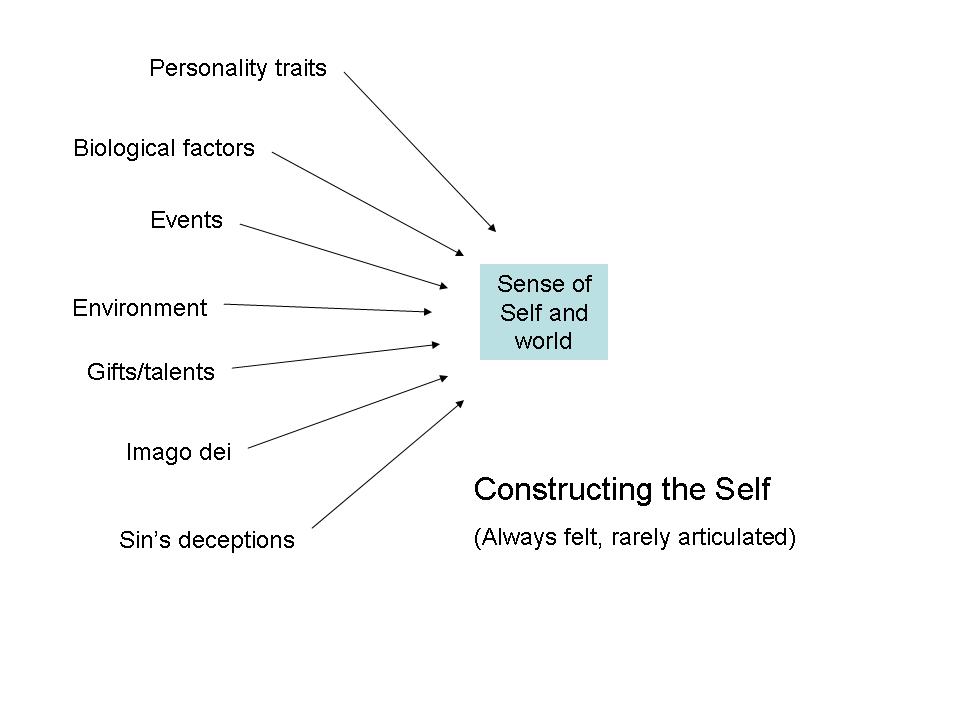
1. Every client constructs and maintains a sense of self and a sense of the world. A number of factors influenced that sense of self, some of which I’ve listed here:


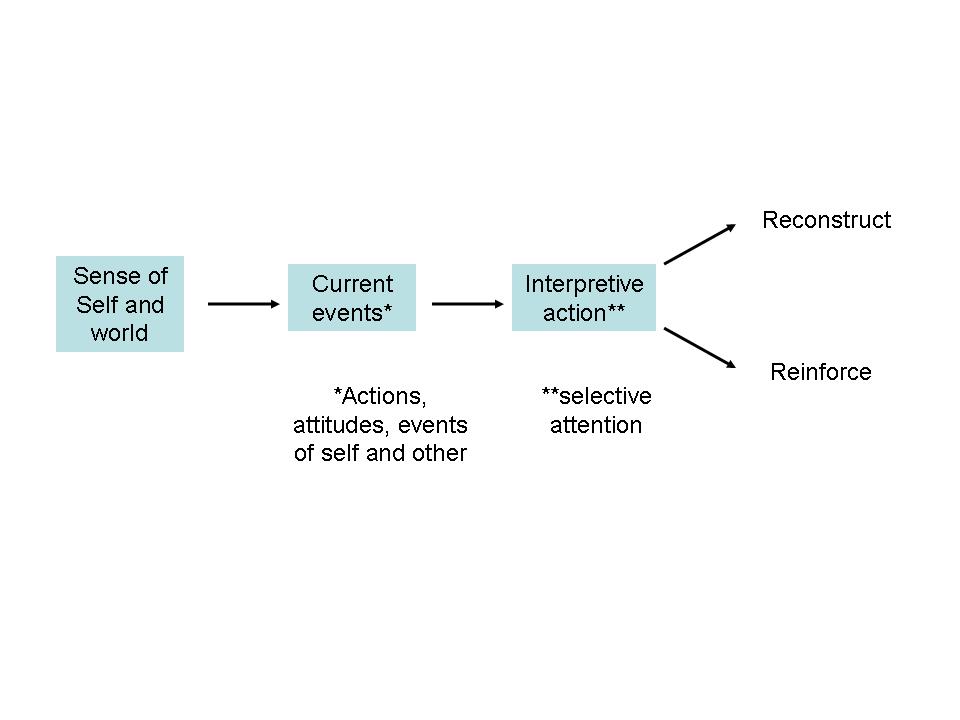
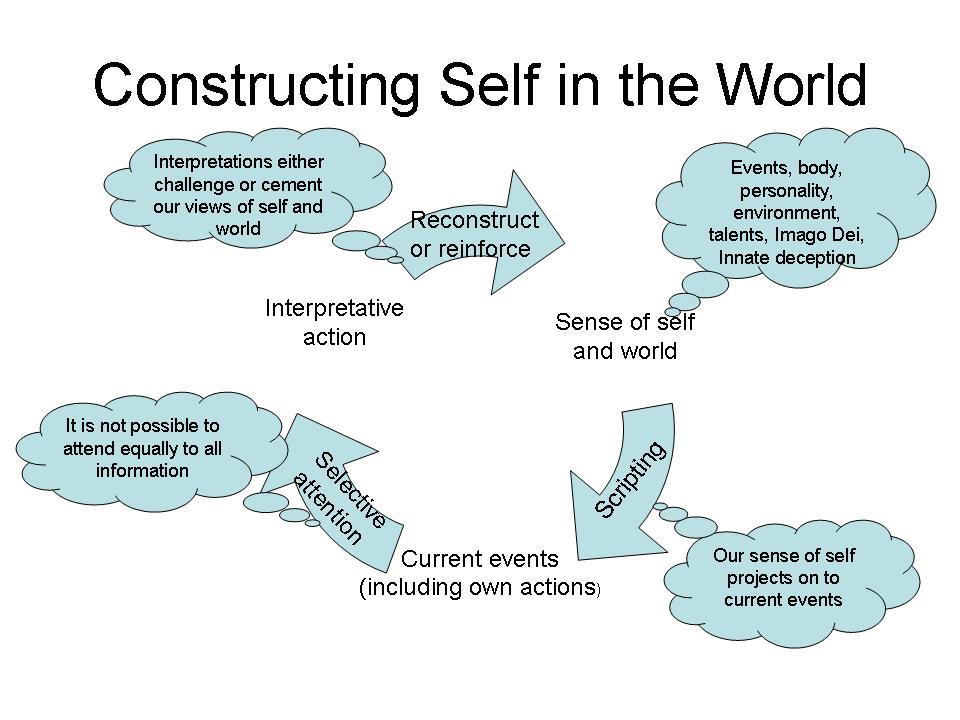
2. We shape and reshape that sense of self through experiences and interpretations that either reinforce or reconstruct/challenge our sense of the world and self:

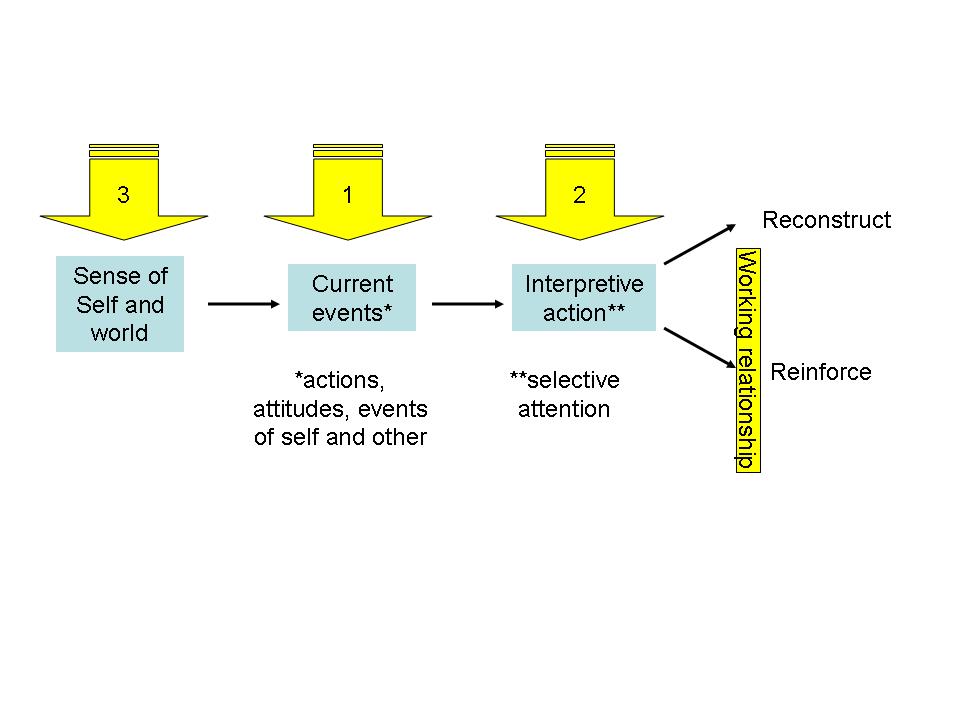
3. The counselor may wish to intervene in several places. (1) Stop and start behaviors; encouraging environmental changes; mercy ministries, (2) Challenging interpretations, Encouraging a change in what is attended to (mindfulness), and (3) Reflecting back on the sense of self and world (uncovering core beliefs and experiences). Note  2 things however. First, none of these points of intervention will be of much value if there isn’t a working relationship that enables the client to trust the counselor enough to be vulnerable. Second, choosing a point of intervention is important but equally important is the kind of intervention (open or closed questions, reflections of content or feeling, advice/information, summarizing, confrontation, etc.)


1 Comment

Filed under christian counseling, christian psychology, counseling, counseling skills

Practicum Monday: Is conflict necessary in therapy?


In the latest edition of the Journal of Counseling Psychology (55:2, 172-184), Nelson, Barnes, Evans, and Triggiano have published an article on the inevitable conflict between supervisor and supervisee–what leads to it, how supervisors react to it as well as supervisor strategies for managing it.

But, these lines about therapy caught my eye:

It is likely that conflict is as difficult to manage in supervision as it is in psychotherapy. Yet addressing conflicts successfully can be a healing and educational venture. The work of “tear and repair” in therapeutic relationships suggested by Safran (1993) and Safran and Murran (1996, 2000) is thought to be critical to optimal outcome in psychotherapy. The capacity of therapeutic relationships to recover from relationship breaches is thought to enhance client trust that relationships can survive misunderstandings and disagreements as well as client confidence that he or she can successfully resolve them. A skillful therapist can guide a client through the process of accepting the therapist’s inevitable fallibility, thus enhancing client capacity to accept his or her own… (172)

What do you think? Is conflict necessary for healing? I think yes. Otherwise, the client and the therapist idealize each other and so become blind to reality.

However, not all relationship breaches are good and we don’t always respond well to them, making matters worse.

How do you feel about conflict with your clients? With your counselor?

6 Comments

Filed under christian counseling, christian psychology, conflicts, counseling science, counseling skills, Psychology

Integrative Psychotherapy XIII: Concluding Thoughts


We come to the concluding chapter of Mark McMinn’s and Clark Campbell’s Integrative Psychotherapybook. They remind us that it was their endeavor to detail their model of integration, psychotherapy, and Christian approach. By integration they meant that they wanted to thoughtfully integrate a variety of psychological theories (as opposed to mindless or even pragmatic eclecticism) as well as their theological views of persons. Their version of integration is best defined, so they say, by the term theoretical integrationism (TI). “[TI] occurs when a person begins with a particular theoretical starting point and then extends the theoretical base by incorporating one or more additional theories” (p. 386). What is the heart of the IP model found in this book? McMinn started with CBT and CT and has incorporated relational approaches more likely found in dynamic models of therapy. Campbell is reported to have begun with interpersonal and family models and incorporated and practiced CT. I would suggest that CT is the heart of the IP model with relational and interpersonal understandings of persons included. I would suggest that there is little evidence of family models in this book.

The authors make brief mention of their theological integration in this chapter. They admit that they take a rather narrow view of Imago Dei and apply that to personhood and psychotherapy by looking at the image of God through the lens of functionality, structure, and relationship.

IP attempts to address life both at the level of symptom reduction AND transformation. The authors recognize that many things lead to transformation–not just therapy. However,

“Psychotherapy is only one means of transformation, but in today’s society it has become an important and ubiquitous one. Even within the church there appears to be a strong and growing interest in counseling and psychotherapeutic ministries, though suspicions about psychology persist in many congregations and denominations. Church-based counseling ministries are now commonplace, most pastors and church leaders have a referral network of therapists in their community, seminaries offer courses and degrees in counseling, and support groups and peer-counseling ministries are being established in many churches. This trend is encouraging insofar as it helps the church care for whole persons as Jesus ministered to the spiritual, physical, relational and emotional needs he saw in others” (p. 388).  

Notice the word, “insofar” in the previous sentence. The authors see increased chance for harm if we “conflate” psychotherapy and the church. They are concerned about two problems: (a) making the gospel about us (self-actualization) instead of Jesus work, and (b) having untrained and undertrained individuals offering therapeutic help and so causing harm to vulnerable people. They do not want to see the Church compromised by becoming therapeutic nor do they want to see the profession of counseling dumbed down by removing the professional, academic, and scientific groundings.

Finally, they end the book by listing 6 ways their IP model is comprehensive: (a) includes both psychology and christianity, (b) consider multiple domains of persons, (c) multiple dimensions of therapy, (d) includes both scientific and relational approaches, (e) christocentric, and (f) usable with both christian and nonchristian clients.

So, now that we have concluded their book, what do you think? Did it make you more interested in viewing therapy through the symptom, schema, and relationship lenses? Did their model seem usable in your context? Were their Christian foundations necessary, or said differently, how did their Christian beliefs change how they function with clients? Would a Christian therapist who loves Jesus but sees their work as being a relational cognitive therapist act any differently? I’m curious if you have a reaction.

Some of my reactions:

1. This is probably the best Christian integrative book I have read. They work harder in this book to make sure that they acknowledge the all-too-common superficial use of Christian beliefs in building a model of care. They also display much humility and do not want the church to water down the Gospel. Therapy isn’t everything for them. Christianity is trump, in their eyes.
2. There is almost no negativity directed at any other model. Most of us use other models as foils for why what we do is better. I congratulate them on being able to map out a model without attacking others. When they do point out weaknesses, it is in their perception of the limits of cognitive therapy.
3. The book is now in need of a follow-up that more deeply illustrates case material. What does IP look like in an extended case study. I would love to see that as a follow-up text. What they did provide were little snippets that had a lot of realism to them. I just want more. Here’s one little question. Does Scripture only come into play at the symptom level of change? It seems to by the way they write and don’t write about Scripture. Does Scripture have anything to do with transformation and experience? Scripture is not merely a cognitive or intellectual enterprise (though we often use it this way).
4. I might quibble with them on their Christology, though I found their positions not quite clear and so may not differ as much as I think. Christ’s death and resurrection IS the power for change (2 Cor. 5:16f). His life does inspire us but we cannot love others merely because of his life. I think they might agree with this, but I’m left with confusion as to where they stand here.
5. As expected, this is a text for therapy trainees. It sets out boundaries for the profession. Lay and church leaders can learn from this model, say the authors, but ought to be careful not to function as a professional. Even though I am a professional and I have found in teaching counselors that it takes character, the Holy Spirit, skill acquisition, and much practice to be a wise counselor, I am always a bit troubled by the boundary setting. It seems we are trying to protect our own domain. I do think there are wise counselors who never had any academic psychological training. It may not be common, but let’s remember that pastoral care has been helping people long before clinical psychology developed into a discipline. I would have liked to see a bit more work in informing the reader (a psychology trainee) about the dangers in trying to function like a spiritual shepherd.
6. I’m in concert with their model as it functions in session. We are conduit for reconciliation. Therefor our working relationships matter almost as much as our words and interventions. When we can reduce symptoms of suffering, we should. But, we also recognize the insidious nature of sin in our lives and must seek transformation of our minds and experiences in submitting them to reality as seen through God’s eyes.

For those interested in Mark McMinn’s further work, you might check out his new book on sin, Sin and Grace in Christian Counseling (IVP, 2008). It is also written for the counseling practitioner.

6 Comments

Filed under book reviews, christian counseling, christian psychology, counseling science, counseling skills, Psychology, Relationships, teaching counseling

Practicum Monday: Basic Competencies


Today starts our 3rd trimester of the 2007-8 school year and Cohort 3 begins their Practicum and Professional Orientation course and first fieldwork experiences of the program. Last year I ran across an article (see reference at end) trying to articulate the domains and levels of competence in focus in a psychology practicum experience. Though the article is directed to doctoral level practicums, I think the domains fit for any level of trainee and are a good reminder for both practicum students and their professors. The authors summarize the “Practicum Competencies Outline” and in turn I will quote/summarize/highlight them below. Click here for the whole document.

  • Baseline Competencies (for entry to practicum)
    • Personality Characteristics
      • interpersonal skills (verbal and nonverbal forms of communication, open to feedback, empathic, respectful)
      • cognitive skills (intellectual curiosity, flexibility, problem-solving, critical thinking, organizing)
      • affective skills (ability to tolerate affect and conflict and ambiguity)
      • personality/attitudes (desire to help, openness to new ideas, honesty, courage, valuing ethics)
      • expressive skills (ability to communicate ideas, feelings, ideas in multiple forms)
      • reflective skills (ability to examine and consider own motives, attitudes and behaviors and recognize one impact on others)
      • personal skills (ability to present oneself in a professional manner)
    • Knowledge from the classroom
      • assessment and interviewing
      • intervention
      • ethics and legal issues
      • diversity
  • Skills to Develop during Practicum
    • Relationship/interpersonal skills
    • Applying research (less so for MA level)
    • Psych assessment (not for MA level)
    • Intervention
    • Consultation/interprofessional collaboration
    • Diversity
    • Ethics
    • Leadership
    • Supervisory skills (not for MA level)
    • Metaknowledge/metacompetencies

This second major bullet point (competencies built during practicum) is fleshed out further by listing levels of competencies. The article illustrates relationship/interpersonal skill competencies by listing how it will show up with clients (e.g., ability to form working alliances), colleagues (e.g., ability to accept feedback nondefensively from peers), supervisors (ability to self-reflect), support staff (respectful of support staff roles), clinical teams (participates fully in team work), community professionals (ability to further the work and mission of the site).

Hatcher, R.L, & Lassiter, K.D. (2007). Initial Training in Professional Psychology: The Practicum Competencies Outline. Training and Education in Professional Psychology, 1, 49-63.

Leave a comment

Filed under counseling, counseling skills, Psychology, teaching counseling

Integrative Psychotherapy XII: Soul Care Via Relationships


In the last substantive chapter of Integrative Psychotherapy, McMinn and Campbell explore relationship-focused interventions. As we have seen in previous chapters, their therapy model begins by addressing problems at the level of symptoms and ends with considering transformation of the person via soul care. Before describing soul care interventions the authors want to set out a few of their beliefs:

  • “One does not have a soul but is a soul” (p. 349)
  • The soul is not another word for personality or self or even person. Rather it is bigger because it encompasses meaning and relationship 
  • Soul care is based on the life AND work of Christ. Some use Jesus as an example for healthy relationships but stopping with Jesus’ behaviors misses out on Christ’s atoning work in redeeming us. His work is based on both grace and truth–both necessary in any human to human soul care work
  • There are multiple forms of soul care but one should not confuse or integrate spiritual direction and psychotherapy. “Christ is central to all soul care” (p. 356) but each version has differing goals and methods. They suggest these as some of the differences between the two:
    Spiritual Direction                         Therapy
    spiritual functioning                          psychological functioning
    lifelong spiritual transformation        transforming a specific problem area
    spiritual advising                               guided discovery
    spirit centered                                   problem centered
    God focused                                      client/counselor collaboration
    under church authority                     accountable to professional standards

Relationship interventions, per the authors, must be founded on therapeutic alliance (a safe trusting and collaborative relationship between counselor and client), therapeutic frame (“a setting conducive to change”–predictable, with clear expectations, roles, etc.), and relational dynamics (the inevitable “dance that occurs in any close relationship” (p. 363)).

The relationship oriented therapist pays attention to the alliance, the frame, and the dance because they do not merely talk about the client’s life but client and therapist experience life in the session and this experience enlightens, informs, and recreates patterns in the client’s life. These dynamics are commonly referred to as transference and countertransference.

While discussing alliance, frame, and dynamics are indeed therapeutic interventions (my view), McMinn and Campbell go on to discuss 4 relational interventions designed to, “provide simultaneous support and confrontation (grace and truth) designed to promote psychological growth” (p. 372).

  • Empathy. Having the capacity to experience the client’s world “as if” it were one’s own–and so communicate understanding. Why is this important? M & C say it provides, “safety necessary to keep the client’s defenses down” (p. 374).
  • Confrontation. “Gently pointing out inconsistencies or discrepancies to the client” (ibid). The authors remind the reader that individuals do not do well when they feel their whole person is being confronted. One suggestion is given to focus on the impact of one’s words or behavior more than intent (folks are much more likely to emphasize their intent and defend against impact).
  • Interpretation. “…Connecting current behavior, feelings, and images to previous ones in the client’s life….Whne clients re-create their interpersonal problems in therapy through reenactment, testing or transference, they are not aware usually of the connection between their current reactions and the coping strategies learned in childhood” (p. 376).These interpretations are not merely made to correct thinking but to be used in the counseling relationship.
  • Role behavior changes. We learn to play certain roles in life. While these roles may be adaptive or understood as part of a larger family system, they may become maladaptive later. When clients experience and understand their role rigidity, they then have the opportunity to try on new roles within the safety of therapy.

My thoughts? Notice the difference in details and concrete interventions between the treatment of automatic thought problems in domain 1 and relationship interventions here in domain 3. It’s no wonder some counselors are more attracted to “doing something” with cognitive therapy and so avoiding the vagaries of interpesonal processes. And yet, McMinn and Campbell are correct that the therapeutic relationship between therapist and client allows both to move beyond talking about problems to experiencing stuckness and healing–and so to have the opportunity to experience a different response to the self and the world. Boundary setting is an intervention and provides wonderful fodder for healing conversations. Far too many students see boundary setting as something to be done to avoid trouble rather than a primary tool for change. Second, these 4 interventions for a good start but we need much more exploration of relational healing interventions than is possible in this introductory work. One such deepening would be Marsha Linehan’s work in validation and irreverence as means to allow the “here and now” to provide feedback to the oft invalidated client.

While I am very supportive of their primary goal in this chapter I do have a couple of questions:

  • Can we really separate psychological growth and spiritual growth from each other? I think not. This makes it messy when trying to define the roles of a spiritual director and professional therapist. But, I think any role differences are somewhat artificial, based on “turf” wars. Wise and careful directors and therapists use the same frame, neither gets too far with exhorting (McMinn and Campbell call this advising), and Christians in both fields ought to submit themselves to God as well as government.
  • How does Jesus transform the world? By example? By love? By the cross? While I am thankful for their strong Christological focus for their soul care, they aren’t quite consistent in their description of Jesus’ work. They do recognize that merely looking at Jesus’ loving examples is not enough. We must see him as God in the flesh. But they also suggest on p. 351 that Jesus transforms, “the world through the power of relationship.” It seems they suggest that he transforms the world because he so moved and influenced the disciples to establish the church. Why? They consider the relationship with the apostles to be the primary reason. While we are designed for relationship, we are not healed through relationships because Jesus so influences us. No, we heal through relationships because we have been reconciled through the cross of Christ. 2 Cor. 5 16f make this very clear. So also does Romans 5. There is little mention of the cross of Christ throughout this book. Funny, the one place in this chapter where the cross appears is on p. 354 when they quote Alan Tjeltveit, “We stand in need of grace. Through the cross, grace is available to us, always.” It would be interesting to hear McMinn and Campbell discuss why they place more emphasis on Christ’s relationships and so little on the cross.

7 Comments

Filed under book reviews, christian counseling, christian psychology, counseling skills, Psychology