A few days ago I wrote this for our seminary’s blog regarding how counseling supports the global mission of the church. If you are interested in international counseling work…you need to read this blog and follow the link I promote.
Monthly Archives: November 2011
Failures to act: Why we don’t always blow the whistle on abuse
Outrage. Befuddlement. Demands for the heads of leaders who probably knew something but didn’t appear to act. Righteous indignation against those who merely met legal obligations to report abuse but failed moral obligations to stop abuse.
Right now, in most of the country but especially in Philadelphia, you cannot turn on the television or listen to the radio without encountering such comments about the Sandusky/Penn State sexual abuse scandal. In my county, democrats control the county leadership for the first time in 140 years but no one seems to give that much time because of the outrage about this case. What people are talking about is, (a) why didn’t those who knew something was amiss do more to investigate abuse, and (b) what should happen to those people who failed to stop the abuse.
What would you have done?
If you are like me, you imagine that you would have acted to stop the abuse. You would have grabbed the boy out of the shower. You would have screamed bloody murder until someone took notice. You feel righteous indignation that no one seems to have had the moral fortitude to deal with this issue head on.
And you would be right to feel this way. But while we are holding leaders accountable for their failure to act and to protect (as well we should!) let us take a moment and address some of the reasons why we might not be quite as action oriented as we imagine ourselves. By doing so, we may make it more likely that we will respond correctly should we face the unfortunate situation of reporting someone we know to the authorities.
Here are some of the reasons we fail to intervene when intervention is needed:
Self protection
Worry about personal consequences can hinder our taking action. Thinking about how we will be treated, viewed, responded to can cause us to pause and not act. What if I get fired? What if this abusive person targets me? What if someone were to make an allegation about me? I wouldn’t like that so I don’t want to stir up trouble for this person.
Have you ever wondered why so many drivers flee the scene of a pedestrian/car accident–even when they were not at fault? We want to avoid facing the possibility that we might have done something wrong.
System protection
We sometimes worry about how the organization will be treated or viewed if abuse comes to light. Far too frequently individuals have covered up the sins of church leaders for fear of ruining the reputation of the congregation. This reason is also seen in the next two reasons. We don’t want people to turn away from God so we cover up what happened.
Groupthink
We’d like to think that with a larger group of individuals, sensibility will prevail. But my experience with institutions dealing with a sensitive issue suggests that once a group is deciding how to respond to abuse, it devolves into who has the loudest voice in what should be done next. Unfortunately, the loudest voice may be about liability (vs. morality) or outer reputation (vs. protection of victims). Also, groups often fail to address pertinent issues and alternative responses due to groupthink. Some of the reasons why this is the case can be found in Wikipedia’s definition. One other thing about groups. We have ample evidence that individuals in a group setting are less likely to intervene when they witness violence happening to someone else. We’re more likely to act if we witness this when alone. Why is this? We may feel less responsibility when others are around.
Denial
We like to keep the good people good and the bad people bad. When those who are considered good do bad things, we can fall prey to denial. It is not possible. I know him. He couldn’t possibly do that. Thus, we deny what we have seen and that leads to the next reason.
Self doubt
Have you ever witnessed something troubling but then wondered if you really saw what you thought you saw? Maybe you catch a glimpse of an adult smacking a child in a parking lot as you drive by. Do you stop and confront? Well, maybe you didn’t really see that. Maybe there is some other explanation that might make this acceptable. When the abuse is done by someone we respect, it is easy to think we must have misconstrued it. And once we hesitate, it is that much harder to activate to do the right thing.
Winsomeness of the abusive person
It is important to remember that the most dangerous abuser is the person who is inter-personally winsome. The reason why a person can have access to others and can get away with abuse is often due to their capacity to put others at ease. Most abuse is not done by those who are revolting to others just because they don’t get opportunity. I know of individuals who were caught in acts of child abuse, questioned by authorities, and so winsome that the investigation was dropped before completed. They provide plausible even highly believable explanations that help the questioner feel at ease. They appear to be open and concerned. They are so good they convince most that such abuse could never happen by their hand. It takes a very expert examiner to catch them in the subtle lies they tell to themselves and to others. Check out Anna Salter’s book on predators if you want to see what she has learned from decades of interviewing known, convicted sex offenders.
It is easy for us to sit in the chair of judgment when we hear of cover-ups and failures to act. These failures to protect children do need to be judged and we ought not shrink back from administering restorative justice for abuse and for the inaction of others. However, let us remember that the work of being light in the midst of darkness has many enemies. Our own weaknesses plus the pressures of our community and the manipulative actions of offenders conspire to make inaction the easier choice.
May we take the high road as we encounter abuse in any form.

Filed under Abuse, Christianity, church and culture, Cognitive biases, Cultural Anthropology, deception
DRC/Rwanda Trip: Day 6
Sunday, October 16, 2011
Today is our last full day in the DRC. I woke up feeling quite refreshed, thanks to Ambien. I hadn’t slept well yet on the trip so I took one. Found out that if you stay up reading after taking an Ambien, you can have some interesting hallucinations. When the bed started moving, I decided it was time to go to sleep! Woke up several hours later and realized it would be good to turn of the light.
After breakfast, we traveled to a church Bagudekia had helped plant some years ago. We arrived ten minutes late. The church was filled with children and young adults. Very few older folks. We were ushered to the seats on the platform next to a window. The hymns were all sung in Swahili and were recognizable (e.g., Onward Christian Soldiers). There were at least 5 or 6 different choirs who sang beautiful scripture songs. 2 hours later, Bagu was able to get up to preach. Most memorable to me were the children looking in the church from the side door just a few feet from us. After the service we were invited to the pastor’s home “to rest.” We made our way over the broken lava to his home. It was approximately 20x 8 with a partition between the living room and kitchen and sleeping rooms. Doubt there was any bathroom or electricity. Several women then produced “something little.” We ate rice, a local donut, greens, beef, and peeled lemons. During this time I was praying fervently as I had been struggling with gastric problems. I was praying NOT to need a bathroom.
Finally returned to our hotel where I was immediately sick. Answer to prayer for sure that I was sick where I could be sick. While resting we had our usual downpour.
For dinner we returned to the Catholic retreat house where the trauma healing group was completing their training. There I had the most amazing experience. I got to interview two pastors from the Kobo tribe. These pastors are displaced from their village (now living in Goma) due to the ongoing violence. Until recently, they were an unofficial tribe–meaning no government had recognized their unique language. They told of terrible traumas and the opportunity to teach the Healing Wounds of Trauma using story based learning so that their people could hear about what God says about trauma, forgiveness, and healing in their own mother tongue. They were able to help there people learn to treat others well (e.g., a child born of rape who looked like an enemy ethnic group was no longer being abused for their looks), to learn to forgive, to learn that it is okay to cry, and to learn that it is okay to plan for future militia attacks (some thought that preparing for an attack was not trusting in God’s care). At the end of the interview, the pastors sang a couple of scripture songs in their own language. What a treat to hear. Turns out the story-based material does two things at once: introduces scripture/trauma material AND helps the support of the mother tongue (as displaced families are seeing their language die out due to use of French and Swahili).
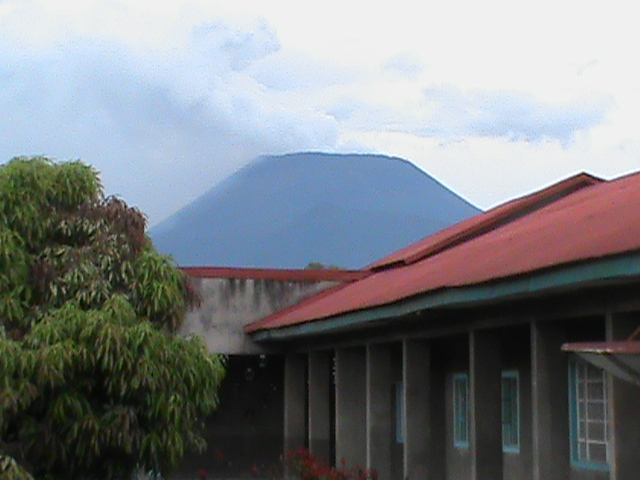
As dusk gathered this is the view we had of the local volcano. After dark, we could see the reddish glow against the clouds over the center of the volcano. Pretty cool!
Filed under Uncategorized
DRC/Rwanda Day 5
Saturday, October 15, 2011.
Awoke in the night with what is likely travel bug “sickness.” It is never fun being sick when away from home and doubly so when in as far away as another continent. Thankful for things like Cipro that can treat the symptoms quite quickly. While awaiting for my system to calm itself down I was reading in John. I’m struck by how skeptical many were of Jesus. The tendency to skepticism is quite profound and alluring even. It makes me feel intelligent and wise when I am skeptical of whatever everyone else is enamored with. However good it is to be skeptical of human promises and motivations, when we apply that to God’s activity we are dangerously wrong. Our problem is that we are not that good in discerning God’s vs. human activities on first blush. We often mis-attribute human behavior to God and vice versa. And we learn over and over that God uses the foolish to teach the wise.
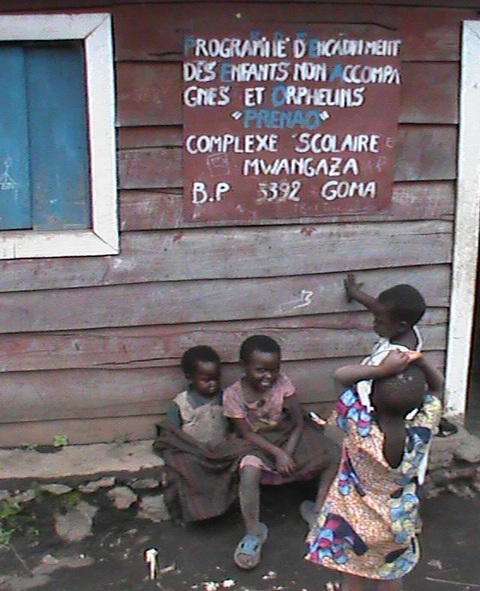
This day started out with a glorious sun. We traveled to the “Shining School Complex” where they teach 193 children, mostly orphans. This school, at the very edge of the airport, is a set of dingy buildings with a dirt/lava rock play area. There we gave out illustrated bibles in French to the children. These children live in abject poverty and for most this was their first very own book. At one point I got down on my haunches and began looking at the pages with one child. Pretty soon I was mobbed and had to get up so as not to be trampled. They crave the attention. After standing outside for well over an hour, I’m reminded how pasty I am and realize I will be having a sunburn later.
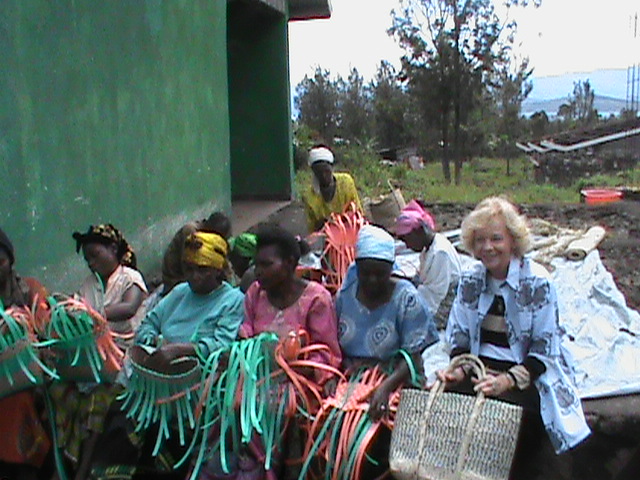
We then moved on to “Mama Jeans”, an orphanage and place for raped women to live. As we entered the compound we were met with singing and dancing. The feelings I had were quite mixed. I was in near tears by the sounds and the image of these impoverished people singing for us but also uncomfortable. Something didn’t feel right about the singing. Their bodies looked joyous but their eyes were dead. We saw the clothing that the widows and single mothers were making–men’s and women’s shirts, baby clothes and baskets. While there we heard the stories of several rape victims. A young mother who was a sexual slave of some soldiers from the ages of 6 to 15. She escaped, while pregnant, after seeing what happened to a friend of hers who was also pregnant. Later, after giving birth, she went back to her village only to be raped again and impregnated. Another told us of giving birth to triplets after rape. She had the
children with her. Another was dying of AIDS.
Late in the afternoon, we made our way across the city to see the conclusion of ABS’ trauma healing training. They use Healing Wounds of Trauma and spend the week training a small group of facilitators. Leading the training is Harriet Hill (ABS) and Margaret Hill (SIL), two of the authors of the book and seasoned trainers. This group of trainees was actually only half of the group. The other half was still in distant Isiro. The story of why the group was split up gives you a sense of Congolese life. Here it is. The entire group was in Isiro (some hours by flight away). The trainers learned that their tickets out were no longer valid and that the next flight would be 1 week later. Why were they not valid? Like Jerry Seinfeld’s show, sometimes a reservation isn’t a reservation. The seats had been sold to someone else. But, they could leave the next day if they wanted to get out early. So, instead of waiting a week, they brought half the class to the airport and were going to finish up the training in Goma. The group arrives at the airport and waits. And waits. The plane never comes. Something to do with the fact that the Congolese army comandeered the flight to send either soldiers or supplies elsewhere. Thankfully, the next they were able to fly out to Goma and finish the training.
We ended the day by having a late dinner of brochettes and some sort of cheese sticks. As I left the restaurant and headed up the stairs to my room, a young Congolese woman grabbed my hand and began to introduce herself to me. Seems she wished to make my acquaintance. Didn’t take me much time to size up the situation. Skin tight jeans and significant cleavage, something not seen in the Congo to this point. I retrieved my hand from hers and excused myself. This may be a common event as there are many UN contractors in our hotel and my room came with a supply of condoms. Rather uncomfortable feeling.
Filed under Uncategorized
The Mission of God to the Mentally Ill: What Role Does the Church Play?
The Mission of God to the Mentally Ill: What Role Does the Church Play?.
Check out my blog on Biblical Seminary’s new faculty blog. Addresses the most frequent search terms and comments on this blog.
How can you listen to trauma all the time?
How can you stand to listen to [traumatic] stories like these all day long?
This is a question I get from time to time, most frequently from someone who has just told me of the trauma in their life…and most frequently from someone who feels stuck in their responses to their abuse. They know I see multiple clients in one day and imagine that listening to pain, heartache, abuse, neglect, and the like must be overwhelmingly depressing.
My answer is a little complicated, but here it is
1. You get used to it. This could sound callous and by this answer I do not mean you get numb to trauma. If you get numb to trauma then it is time quit counseling. But, you do get a bit used to it. You are less surprised by evil after you hear about it in so many different forms.
2. It is hard. Hearing about brokenness is difficult. It is even more difficult when those who should be responsible for protecting or at least dealing with the sins of others well do not do their job. When systems conspire to harm the victim that is hard to hear over and over again.
3. There is more hope in these stories than you might imagine. Yes, hearing about brokenness can be difficult but we see far more hope than you might imagine. We see more life and more growth despite pain and hurt. When someone abuses a child, that someone destroys another for their own purposes. But, time and time again we see resiliency–even when that person may have significant damage in their life. Often the abused person only sees their brokenness but we see how they are surviving and thriving. It reminds me of how I have seen trees growing up in the middle of abandoned parking lots. What was left as useless is supporting life, even developing an entire ecosystem.
4. You can only do this work if you also spend time with good things. One must imbibe in healthy and living things if one wants to work with death. This means spending time with creative things, with beauty, with life, with art, with music and the like. If you don’t do this, you will die on the vine and you are in great danger of hurting others.
Filed under Abuse, counseling, counseling skills, Uncategorized
DRC/Rwanda Trip: October 14, 2011
Day 4:
A breakfast of coffee, fruit and egg and we’re off visiting rape victims and those who help them today. First stop is the DOCS hospital (Doctors on Call for Service) run by a gynecologist, Dr. Ahuka Ona Longombe. This hospital specializes in obstetrics and in fistula surgery for rape victims. Dr. Ahuka if a larger than life, forceful personality. The ABS has done some partnering to provide the hospital with some
better equipment. After touring the facility, he took us to a room to show us his PowerPoint presentation on the causes of sexual violence, the impact on women and the work they do to repair. It was a difficult slide show (with a few pictures!). If you think of rape as forced intercourse only, think again!
He showed us current stats (42,225 cases of reported sexual violence as of 2 years ago). He pointed out how these stats are very likely LOW due to stigma, violence, and the complexities of multiple reporting agencies. Victims during the reporting period are 21% little girls, 56% young women, and 23% old women.
Only 25% get treatment within the desired 3 days.
While they do HIV/STD testing and treatment, medical, surgical, nursing, spiritual, and legal care, Dr. Ahuka repeatedly begged for help for the psychological damage. As a team we discussed whether it would be possible to send two high level interns (even post grads) for 6 months to focus on training nursing and doctor staff as well as lay people from local churches who might reach out and care for the spiritual needs of these terribly traumatized women. Interns would have to be able to speak French.
Leaving the hospital we traveled some very bumpy roads to Sister Alvera’s home. Now, all roads are bumpy in Goma. But these roads were the bumpiest. I kept expecting to lose teeth or an axle. Sister Alvera, a nun who runs an orphanage and home for raped women, was not home but they were expecting us. We came for the express purpose of talking to two women who have been treated by Dr. Ahuka for fistulas and who were willing to tell their trauma story. We were most interested to hear how they are learning to cope. The first young woman, C, had bright eyes and passion all about her. We met in her small abode, something akin to a shed in this country. She told of her rape and her treatments. Through the translator we heard how she experiences both joy and deep pain (she has been rejected by her family because of the rape). She described her struggle with dissociation as, “getting lost in my mind.” Sleeping, talking to the local pastor and being prayed for were helpful interventions. Near the end of our time with C we heard her lament that she could not find her attacker in order to forgive him. The pressure to do so seemed to eat at her. She felt she could not rest until she forgave him. Diane had the presence to respond that while she wasn’t able to find him, God could see her heart and the forgiveness in it. This seemed very meaningful to C.
The 2nd woman, X, had been raped and given birth to a child. The child had been rejected but lived in the compound. Sitting with X was her new little baby who played with nearby fingers and nursed when fussy. This woman was far more triggered during our conversations. Her eyes were missing light. She did not look present. However, she described a caring husband and pastor who helped her cope with her trauma experiences.
The rain, which had been pounding down for our interviews let up just as we were getting ready to run to our vehicles to leave. A view of several green cauldrons came into view through the puffy clouds passing by. From the Sister’s place we traveled to the local bible society office. We got to see the bibles we would be giving out the next day as well as opportunity to meet the staff. I can attest to two things about the bible society. They keep amazing records on all the widows and children they serve (food, stuffs, etc.) and they do not spend their money on expensive property. Back in 2002, their offices were destroyed by the lava eruption and now they rent rather humble space. If you give the bible society, you can expect your money to go to people and services, not bricks and mortar!
We ended the day back that the hotel with a enjoyable dinner meeting with World Relief country director, Charles Franzen, and two of his staff. Our dinner was outside under a thatch canopy and just above the loud lapping waves of Kivu. I can only describe him as a character–in the best sense of the word. He speaks Swahili but not French and has lived for many years in East Africa. We had wide-ranging conversations about Africa, Baltimore (his home town), baseball (his dislike for Dustin Pedroia of the Red Sox) and football (soccer). And of course the work of trauma recovery was a central topic this evening.