Category Archives: Uncategorized

2011 the year of abuse and trauma? Or the year of speaking out?


In our 24/7 news saturated world, we are kept apprised of the traumas around the world: earthquakes, famines, nuclear catastrophes, mass murder, ethnic cleansing, rape as a tool of war. Of recent months, we have heard much about child sexual abuse. Most of what we hear has to do with abuse having taken place years before, sometimes decades ago.

Nonetheless, we could easily label 2011 as the year of abuse allegations against those who were thought to be respectful citizens. This year, the ones that got the most attention were male child sexual abuse allegations.

But I prefer to think about 2011 as the year where child sexual abuse reporting broke through the veil of secrecy. Abuse has been happening ever since our loss of Eden. And cover-ups are the norm. Maybe this year we saw a bit more willingness to speak out about past abuse. That would be a good thing if this continues.

Does it seem to you that we are having more abuse reports? Well, you are not alone in that opinion. Check out this recent Reuters reporting on the uptick of abuse calls to organizations like RAINN and the national Childhelp hotline after the Penn State and Syracuse abuse cases. RAINN reports a 54% increase in contacts and the Childhelp line reports a 20% increase.

Could there be an increase in false allegations? Sure. And every false allegation hurts not just the one being falsely accused but also every abuse victim who may not be believed. However, let us remember that when child abuse was first discussed in psychology (think Freud), it was treated as hysteria. Most allegations are true. It requires too much sacrifice of public dignity, too much loss of family relationships to have many false negatives.

An idea for 2012

How about this year we commit to child safety and prevention of abuse? 2012 as the year the church takes the lead in wholistic  care for abuse victims? This means we speak up when we see inappropriate behavior. We develop appropriate policies (and then carry them out) for all in the church, including pastors. This means we preach and teach on child protection. This means we assess our own attitudes and actions that might support child abuse (e.g., use of porn, failing to hold each other accountable, etc.). Finally, this means talking about restorative justice for victims, hope-building for victims, and care for those who abuse.

2 Comments

Filed under Abuse, Christianity, church and culture, Uncategorized

Year-end giving opportunities for trauma recovery


Friends,

Just a few days before the end of 2011 some of you may be considering year-end charitable giving ideas. You may not 11.5 million dollars to give away (like Google did to orgs like IJM!) but every dollar counts. Below are some of my suggestions if you are looking to give to trauma recovery efforts both here and around the world. I am absolutely sure there are many more good places that are excellent choices than I list here but I include my favorites and you can feel free to add your favorites in the comments section. I also admit that the first two choices might just directly benefit the work I do.

1. Trauma Training Ministry

A. Biblical Seminary. Yes. Biblical Seminary is involved in global trauma recovery efforts. Readers here will remember my posts about our trip to the DRC and Rwanda this fall. We will be launching trauma recovery training in 2012 (continuing education and graduate studies) by the summer. Look for more info on this site. Read Biblical’s December 2011 appeal letter by me sent to Biblical’s friends and family (sorry didn’t have a pdf version with letterhead). Gifts will support training costs and research.

2. East African Trauma Recovery 

A. She’s My Sister. The American Bible Society is using Scripture to engage individuals and communities suffering through the trauma of ethnic violence, especially women having been raped in the region. Their trauma healing workshops trains pastors and local leaders to be trauma healing facilitators in their own communities and in their own language. I can attest that those who go through the trainings are both active in giving away what they received and changed by what they learn. Click the “give” button on the side and choose how many women you wish to help.

B. DOCS Hospital. A medical ministry providing needed surgeries to women with fistulas as the result of rape in the DRC. They are doing fine work there and are serving many women who cannot control their urination without the repairs being done.

3. Domestic Trauma Recovery

A. The Place of Refuge. A counseling ministry to North Philadelphians. Specializing in trauma counseling work. I have known Elizabeth Hernandez since we first met in a counseling class in 1988. She is a fine woman, expert counselor, and an upright and godly person. Donations to Refuge will absolutely extend their ministry to many abused individuals.

B. GRACE. GRACE is a ministry to educate the christian community about the scourge of sexual abuse. GRACE is also involved in providing direction for victims of abuse and in bringing light to abuse cover-ups. As a board member I can attest to the fine work GRACE does with those reaching out for help in knowing what to do in preventing and responding to abuse in Christian settings.

4. Global Recovery Efforts

A. International Justice Mission. They may have received a large donation from Google for work done in India but they are fighting for freedom and justice for enslaved peoples around the world.

Whether you choose one of these fine ministries or one of your own, consider giving to trauma recovery projects this year.

1 Comment

Filed under Abuse, Post-Traumatic Stress Disorder, Uncategorized

Stopping seasonal high anxieties: Some strategies and a better goal


For most people, anxiety is a looped internal conversation. It just keeps starting over even when we don’t want to listen to it anymore.

The Christmas season we’re in can make anyone quite anxious. (Don’t think so, watch this fun video to remind you why.) Those of us naturally anxious and ruminative find the added responsibilities, family stresses, and disappointments just adding fuel to the fire. You try to take a moment to rest but all you can do is think about what is yet to be done or what you tried to do but failed. You pray but before you finish you are back to your worries. You distract yourself but the looped fears keep running in the background.

What helps you decrease your anxieties and repetitive worries? Can you really suppress them? Or should you have another goal in mind than just trying to shut them down? Are there any practical strategies that work?

Practical Strategies?

Daniel Wegner gave a short award address on this topic at the 2011 APA convention (now found in v. 66:8 of the American Psychologist, pp 671-680). In the address he tells us what we already know. It is hard to suppress thoughts in a direct manner (e.g., I won’t think about how much work I have to do). So, Wegner focuses on indirect strategies. Here is a sample of strategies with empirical support:

  • focused distraction
    • pre-planned alternative topic to think about when the rumination starts. Benefit? Avoids mind wandering which will more quickly return to the anxiety. Example: Every time I think about the conflict at work I will focus on a comforting favorite verse or an upcoming happy occasion.
  • Stress and load avoidance
    • Overall reduction of stress helps reduce unwanted/anxious thoughts. Focused distraction helps only to a point. Overwork which may provide some distraction will increase anxious thoughts over time.
  • Thought postponement
    • Choosing to postpone anxiety to a set time can work to reduce the amount of rumination experienced.  Example: I’ll spend time worrying about my visiting in-laws at 4:30 pm.
  • Acceptance
    • Instead of fighting and arguing with fears some find it helpful to observe fears without taking action. There is some evidence that those who accept the occurrence of unwanted thoughts have less distress than those who fight the thoughts.

Wegner goes on to mention other strategies (i.e., planned exposure, mindfulness, focused breathing, self-affirmation, hypnosis, and journaling) for reducing unwanted thoughts.

 A Different Goal?

What if the goal isn’t to remove or end unwanted thoughts and anxieties but to cope with them and not to be dragged along by them? Does this sound like failure to trust God? Failure to be at peace? if the goal is to trust God in the midst of uncertainty and anxiety, what would that look like? How would you know that you were doing well? To do this we would need to give up on the goal of having an absence of anxiety and to reimagine peace as something one can have in the midst of angst. After all, we are not seeking to be absent from this world but to live in the world that is full of chaos and uncertainty.

Here are two goals you might consider:

  • Being okay with things not done to perfection and with the disappointment of others who have come to expect perfection from you
  • Experiencing anxious thoughts as normal and yet savoring moments of rest when they present themselves
  • Using one strategy for anxiety reduction each day

So, how do you measure your seasonal high anxieties and what goal do you seek to reach during this Christmas season?

4 Comments

Filed under Anxiety, Psychology, Uncategorized

Does sympathy require action?


Can you experience true sympathy towards another but do nothing in response? When you watch people suffering the effects of famine, hear of genocide, see a homeless person begging for money, can you feel sympathy but not do something about the problem?

Consider these opening words of Octavius Winslow, 19th century preacher (in the US and London) in his The Sympathy of Christ with Man: Its Teaching and its Consolation New York: Robert Carter & Brothers, pp iii-iv.

Much that passes for sympathy, and is really so, as commonly understood, is deficient in this one essential element, and needs to be remodeled. There is poetry and there is beauty in real sympathy; but there is more- there is action. True sympathy may exist impotent to aid, we concede, and its silent expression may not, in some instances, be the less grateful and soothing; but the noblest and most powerful form of sympathy is not merely the responsive tear, the echoed sigh, the answering look- it is the embodiment of the sentiment in actual help.

In this book he takes up the action oriented sympathies of Christ. We have a high priest who sympathizes with our state AND acts to do something about it.

Does true sympathy lead to action?

I believe so. Now, I want to be clear that it does not always lead to removing the suffering. It does not always mean immediate and direct help. There are times where the help is indirect. Consider the Scriptures in that the Lord hears the cries of the Israelites enslaved in Egypt and rescues them…some 400 years later. We can’t say that his action was deficient.

Our sympathies may lead to,

  • speaking the truth in love
  • comfort
  • pursuing justice
  • educating others who can do something
  • praying
  • not rescuing someone too quickly from their own tragic choices
  • inviting another to get some help

So, if you feel sympathy and helpless about doing something of value. Think again. What action does the Lord enable you to do “at such a time as this”?

3 Comments

Filed under Christianity, Insight, Psychology, Uncategorized

Bookend sins?


Human moral frailty is never singular. Meaning, we don’t sin with just one sin. Every moral failing includes at least 3 parts: deception, action, cover-up. Think of deception and cover-up as bookends and the specific behaviors as the books in the middle. And just as it is hard to keep books on a shelf without bookends, it is hard to do what we know is wrong without deception of self and cover-ups.

What are your versions of bookends that give you “permission” to hate, to excuse, to overlook your faults?

Knocking down the bookends goes a long way to defeating outward sins like abuse as well as inward sins like festering bitterness.

1 Comment

Filed under christian counseling, christian psychology, Christianity, Uncategorized

DRC/Rwanda Trip: Final Days


October 21-22, 2011, Kigali, Rwanda

Friday morning and we are up by 6 am. Have to pack this morning because we have to be out of our rooms. As soon as we finish the conference we must say our goodbyes and get to the airport. We have breakfast with Robert Briggs of the American Bible Society. He’s on his way to a United Bible Society meeting in Kenya. Our conference begins with Diane

Planning the next steps

Langberg and Carol King covering the topics of lament and grief. After their presentations, the participants practiced writing their own laments. We made time for sharing them with others. We concluded this section with a choral reading of Scriptural laments. This choral reading was compiled by Lynn MacDougall and quite moving for all. We had enough time before lunch for me to teach a bit on vicarious trauma.

After lunch, I did a short teaching on peer supervision. It is important for these caregivers to support each other and so I taught on how to do case consultations and to write-up case study/questions. After finishing this teaching, Baraka led the participants in a “What next” brainstorm. Their main recommendation was to form an association of counselor/caregivers–Rwandan Association of Christian Counseling as a place to get further support, training and to share resources. They wanted a website that would allow them to connect via social media. As they explored their current needs, many said that the number one need is ongoing mentoring. Others talked of finding ways to get paid for their work in counseling. Many spoke of the need for skills and training in dealing with drug and alcohol issues, sexuality, gender-based violence, depression, and anxiety. They asked for trainings 2 times per year. The group decided to appoint a few of the attendees to a committee to see these recommendations to completion.

We concluded our time by asking them to tell us what parts they liked the most. They liked the small group activities. They wanted these to go longer. They liked the role plays and want more. They would like PowerPoint slides (we didn’t do these but handed out outlines) and for speakers to speak slower English. We promised to send them a PDF of our talks and outlines for them to have in electronic form.

Our final activity was to hand out the certificates for real. I got the pleasure of doing this and getting a hug and a picture from each attendee. We said our goodbyes, made a quick change of clothes and headed off to the car to take us to the airport. Just as we were about to get in the car, we were given handkerchiefs each with notes and signatures from the attendees. A sweet parting gift!

Friday night at 7 pm, we boarded our plane (Brussels Air) to start the trip back home. The flight was full and our seats were all over the plane so no debriefing for us. For the next 10 hours (including a stop in Nairobi), I was jammed into a middle seat without leg room (front role of cattle class). Arriving in Brussels by 6 am, we managed to get coffee, chat a bit with each other, and buy some Belgian chocolates for the family. After a total of 28 hours of travel, we arrived back in Philadelphia, PA. 42 hours of no sleep (all day Friday and the night and then most of Saturday) but I arrived home wired and ready to tell my family about what I had seen. Funny, as I tried to tell them about my trip, I found I was having a hard time making sense of everything. I’m not sure it was just because I was tired but more because I had too many thoughts and feelings and was without words to express it all.

As I post this, I am now 1 month from the end of this trip. It is still hard to be concise about the trip. We learned much, saw much, and have ideas about how we can have an impact on future counseling training in Rwanda and the DRC. Clearly, we need to do more live vignettes for the counselor trainees. And we can impact the area by offering materials to existing schools.

I am blessed to have been able to do this work. Probably more blessed than the recipients! I couldn’t have asked for a more successful trip, better travel connections (well, unless someone has a teleporter lying around), or better travel companions. Can’t wait til the next time.

4 Comments

Filed under christian counseling, Christianity, counseling, counseling skills, Uncategorized

DRC/Rwanda Trip: Day 10


October 20, 2011, Kigali, Rwanda

The second day of our conference with NGO caregivers. Today Bishop Nathan Gasatura joined us from Butare. It is always a pleasure to meet with the Bishop. We had a good lunch meeting with him where we discussed future possibilities of counseling/trauma training in his city. I learned why the national university is not in the capitol but 3 hours south in Butare. When Rwanda and Burundi were one country,

The Bishop grooves to some Gospel

the capitol was Butare and thus it made sense to have the national university there. Oh, and another reason it is good to see the Bishop is that he can really dance.

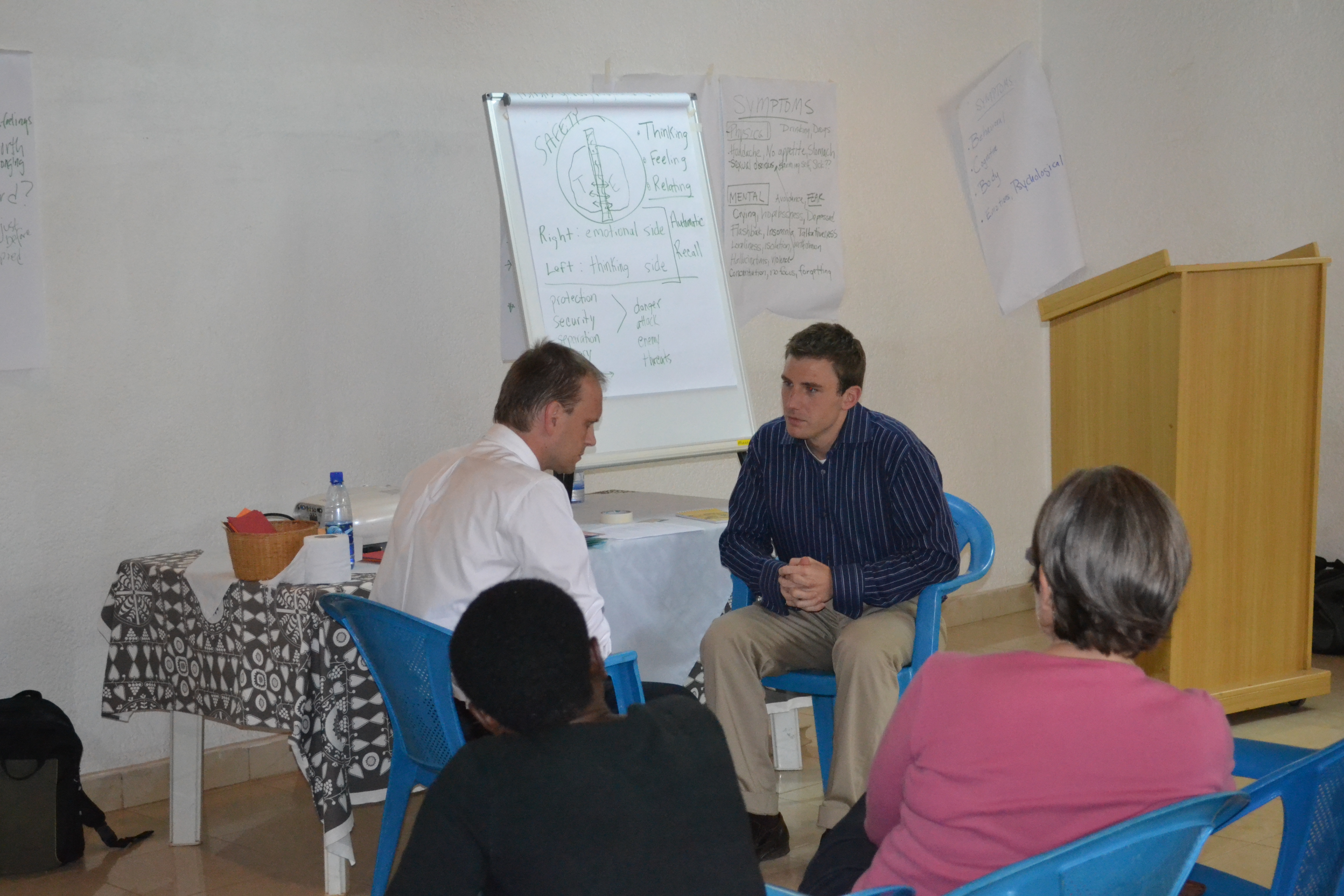
Carol King and I started this morning’s session with a short counseling vignette. I counseled Carol in order to illustrate the skills of bad listening and then good listening, stabilization, and grounding during dissociation. We then talked with them about ways to get another person’s story in bits (rather than all at once) and with their lead (rather than having the counselor pull it out of them). The role play was something that few had ever seen and we had lively discussion afterward, including why I didn’t push Carol (she played a hesitant, fearful counselee) and the issue of exploring emotion. At the end of the conference we learned our role plays were some of the most important parts of the conference.

Later, Josh presented some material on trauma, attachment, and the impact on the brain. To make this presentation practical, we did another role play where I was the counselee and Josh the counselor. We illustrated (in a rather speeded up illustration) portions of the levels of repair: telling the story, re-framing the story (in a wider truth), re-writing the story

Josh counseling Phil

, and re-connection with others. We concluded this time by having them practice counseling each other with a focus on drawing out emotions in the story. We had another great discussion about culture and emotion as well as the cultural differences between the US and Africa (counseling as listening vs. counseling as advising and solving problems).

The evening concluded with a party and hors d’oeuvres. It was an amazing celebration where many of the women wore traditional attire. We danced (I tried), sang scripture songs, heard silly riddles, and cultural stories. Then, we concluded with a ceremony of giving out the certificates. Normally, we would do this on Friday night at the conclusion of the conference but many wanted to receive their certificate in their traditional dress and we were leaving immediately after the conference ended on Friday so we determined to do this tonight. It was a time full of celebration and joy and a wonderful reminder of one antidote to trauma–communal celebration.

2 Comments

Filed under christian psychology, counseling, counseling skills, Rwanda, Uncategorized

DRC/Rwanda Trip: Day 7


October 17, 2011

Monday morning dawns bright and beautiful. By 9 am we are traveling the one mile to the border with Rwanda. At the border we have DRC officials stamp our passports with exit stamps and walk the thirty yards or so to the Rwandan border guard stations. There, they look in our bags for contraband and plastic bags (banned from the country). Once through the border, we board a private bus and begin the 3 hour trip to Kigali, the capital of Rwanda. The drive is beautiful. Immediately, you notice that the roads are paved, smooth, and the properties neat and tidy. We climb steeply among verdant hills covered with terraced gardens. Low hanging clouds sweep by and leave a misty residue. We see waterfalls as we climb higher. As I look at the beauty I keep imagining what it must have been like for nearly 2 million Rwandans fleeing to Goma to escape the violence back in 1994 and then again in 1996 when many were repatriated under pressure.

As always, Rwanda travel gives you many vistas as we make switchback turns. Around lunchtime we stop in Musanze area to eat at the Ishema Anglican hotel. This area is near where tourists come to plunk down $500 to go see silverback gorillas in the wild. This picture is off their website and is pretty much like the view we had in the restaurant, looking into a quiet interior garden. No windows or doors marking the room from the garden. Beautiful.

We traveled the rest of the way to the capitol without problems, said goodbye to the other members of the DRC trip (Bagu, Harriet, Margaret, and John), and moved on to Solace Ministries, a guesthouse and conference center in Kigali and our home for the next 5 days. As we traversed the city, familiar sights of places came into view. However, changes are quite obvious too. Several locations that held shanty towns in 2009 were green spaces now. I wonder what has become of those who lived there in abject poverty.

Entering the main building of Solace, we were greeted by our Rwanda trip partners, Josh Straub (AACC) and Carol King (Langberg & Associates colleague). They had arrived the previous Saturday and were in a meeting with some other trauma recovery counselors. We sat down and commenced 3 hours of meetings without hardly a breath. Later, our friends told us we looked rather haggard. I guess the DRC will do that to you. I remember having a hard time putting my thoughts together for Bishop Alexis in talking about possible next steps in our counselor training efforts. We ended the evening with a wonderful, 3 course meal. The cook at Solace provided incredible meals for us. We never ate better. Simple, delicate foods with an African touch. If you ever want to stay somewhere in Rwanda, I highly recommend Solace.

Leave a comment

Filed under Uncategorized

Counseling as Global Mission of the Church


A few days ago I wrote this for our seminary’s blog regarding how counseling supports the global mission of the church. If you are interested in international counseling work…you need to read this blog and follow the link I promote.

Counseling as Global Mission of the Church.

Leave a comment

Filed under christian counseling, christian psychology, Christianity, counseling science, counseling skills, Cultural Anthropology, ethics, Uncategorized

DRC/Rwanda Trip: Day 6


Sunday, October 16, 2011

Today is our last full day in the DRC. I woke up feeling quite refreshed, thanks to Ambien. I hadn’t slept well yet on the trip so I took one. Found out that if you stay up reading after taking an Ambien, you can have some interesting hallucinations. When the bed started moving, I decided it was time to go to sleep! Woke up several hours later and realized it would be good to turn of the light.

After breakfast, we traveled to a church Bagudekia had helped plant some years ago. We arrived ten minutes late. The church was filled with children and young adults. Very few older folks. We were ushered to the seats on the platform next to a window. The hymns were all sung in Swahili and were recognizable (e.g., Onward Christian Soldiers). There were at least 5 or 6 different choirs who sang beautiful scripture songs. 2 hours later, Bagu was able to get up to preach. Most memorable to me were the children looking in the church from the side door just a few feet from us. After the service we were invited to the pastor’s home “to rest.” We made our way over the broken lava to his home. It was approximately 20x 8 with a partition between the living room and kitchen and sleeping rooms. Doubt there was any bathroom or electricity. Several women then produced “something little.” We ate rice, a local donut, greens, beef, and peeled lemons. During this time I was praying fervently as I had been struggling with gastric problems. I was praying NOT to need a bathroom.

Finally returned to our hotel  where I was immediately sick. Answer to prayer for sure that I was sick where I could be sick. While resting we had our usual downpour.

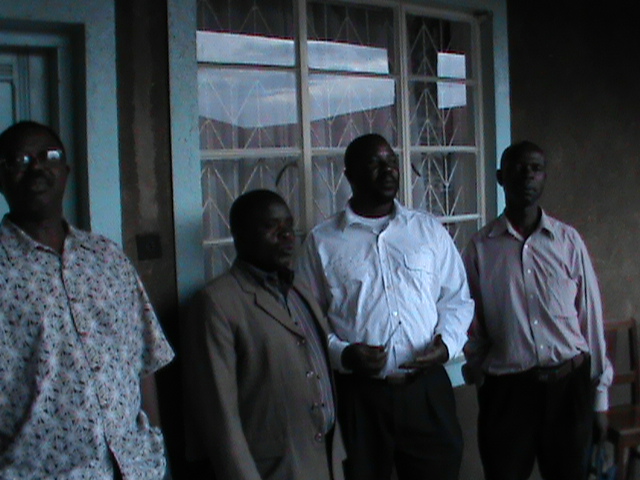
For dinner we returned to the Catholic retreat house where the trauma healing group was completing their training. There I had the most amazing experience. I got to interview two pastors from the Kobo tribe. These pastors are displaced from their village (now living in Goma) due to the ongoing violence. Until recently, they were an unofficial tribe–meaning no government had recognized their unique language. They told of terrible traumas and the opportunity to teach the Healing Wounds of Trauma using story based learning so that their people could hear about what God says about trauma, forgiveness, and healing in their own mother tongue. They were able to help there people learn to treat others well (e.g., a child born of rape who looked like an enemy ethnic group was no longer being abused for their looks), to learn to forgive, to learn that it is okay to cry, and to learn that it is okay to plan for future militia attacks (some thought that preparing for an attack was not trusting in God’s care). At the end of the interview, the pastors sang a couple of scripture songs in their own language. What a treat to hear. Turns out the story-based material does two things at once: introduces scripture/trauma material AND helps the support of the mother tongue (as displaced families are seeing their language die out due to use of French and Swahili).

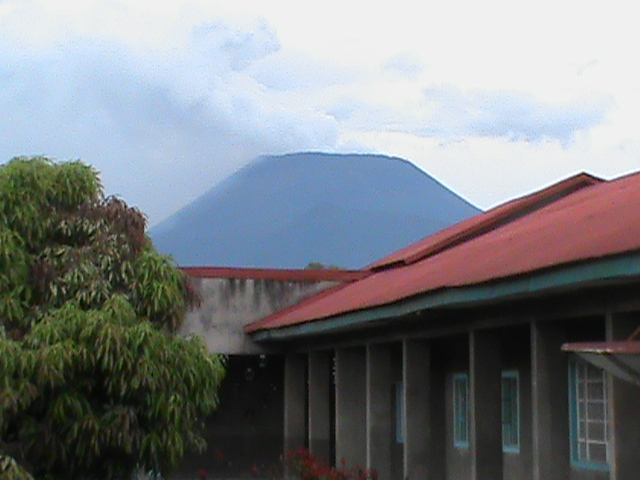
As dusk gathered this is the view we had of the local volcano. After dark, we could see the reddish glow against the clouds over the center of the volcano. Pretty cool!

Kobo Pastors

Mt. Nyiragongo


3 Comments

Filed under Uncategorized