Category Archives: counseling

Practicum Monday: Premature Termination in Counseling


Today in Practicum class we discuss matters around ending treatment or counseling relationships with our counselees. The one that causes interns most consternation is the premature termination by clients after only one session. The trainee is left to wonder why. “Did I fail to connect? Did I say something to offend them? What did I do wrong? Did they figure out I don’t know what I’m doing?” Usually, they report feeling like a failure. Here’s a secret: even experienced therapists feel this at times as well.

Well, let’s start with the murky data. Brogan, Prochaska & Prochaska (v. 36 (1999) of Psychotherapy: Theory, Research, Practice & Training, 105-113) report that various studies reveal a premature termination after just one session stands somewhere between 20 and 57%. Some 30-60% drop out before the counselor thinks they should. And a meta-analytic study (of 125 studies) reports a premature dropout rate of 47%. Even though our research in this area is still weak (we don’t really know what factors to use to report premature dropout), the numbers are pretty high.

So, why do people stop counseling before they should? Why do our clients not return? We really don’t know as much as we would like. We do know that individuals in certain demographics are more likely (lower SES, lower education, minority status) to drop out. But even here, we don’t really know why. Is it client-counselor mismatch? Lack of understanding of the process of counseling? Lack of hope?

We do know that several factors do NOT seem to relate to premature termination (therapy mode, setting, and ages of clients).

While our research is still cloudy, it makes sense to consider the combination of client factors (motivation for personal growth, ability to have insight), environmental factors (financial status, family support or detraction, cultural support), and counselor factors (capacity to empathize and connect with the client’s perceptions, diagnostic and listening skills).

Trainees can ask these questions in their postmortems:

1. Did we share an understanding of the type and severity of the problems?
2. Did I give evidence that I understand their experience (beyond saying so)?
3. Did I give some evidence of the path forward and hope for the future without overselling it?
4. Did I acknowledge potential pit-falls, hopelessness, fear?
5. Was my client the “customer” or was someone else demanding it (e.g. parent)?   

5 Comments

Filed under counseling, counseling science, Psychology, teaching counseling

Practicum Monday: Scott Stanley on Couple Conflicts


Last week in our staff meeting we listened to the end of Scott Stanley’s conference presentation on couples communication. You may remember I blogged previously on his funny but too-true analogy of dogs and marriage (We fall in love with the front end of the puppy/marriage, but they both have backs ends that need to be managed).

In this section of the presentation he makes this statement: events trigger issues. Couples tend to fight about events but really most conflicts are about issues that are deeper (e.g., Who gets the say around here, Do I have influence, Do you care, and other expectation clashes). The challenge is to get couples to see past events to the issues.

Problem: most couples only talk about issues during emotionally charged events. Why? It would be easy to say avoidance. But take that a step further. If the couple is no longer in conflict, why bring up something that is likely to trigger it? As Stanley says, “We’re really getting along right now, so I don’t want to screw it up by talking about a problem.” Seems good in the moment, but bad over time.

Stanley’s point is to deal with this problem by (a) handling events well (time out, staying in the moment, etc.), and (b) being proactive by maintaining safe, open communication about issues. This takes sacrifice, he says. Healthy sacrifice (not martyrdom) is pretty powerful and helpful in moving toward the desires of the other.

Here’s a couple of my thoughts:

Stanley has some great techniques and seems to have a good handle on what goes wrong in conflict. I think many couples can benefit from better care of the “back end” and making sure to remember and reinforce the front end as well. He rightly points out that we can easily miss the good sacrifices others do daily and then only recognize the good when it stops for some reason. If we’re not careful we take for granted the sacrifices of others and come to expect and even demand them as rights.

Stanley’s techniques seem not to work with couples where insight is low, trauma or violence has been a part of it, when folks have personality disorders, or when the couple are deeply entrenched in their bitterness towards each other. All events have meaning. The couple that is not willing to reconsider the meanings they apply to events (she is evil, that is why she leaves the kitchen that way), little couple work is possible. In fact, maybe even contraindicated. Techniques that should help become

weapons to hurt and destroy. Couple counseling is based on the capacity to observe self and other and to withhold judgment to see life from another perspective. Without this, it is hard to make much progress outside of painstaking experiential work.

2 Comments

Filed under christian counseling, conflicts, counseling, counseling science, love, marriage, Psychology

Practicum Monday: Choosing where to intervene


Most practicum students worry about their ability to do or say something intelligent in their counseling sessions. Will we have something to say? Will we know what to do? In order to know where to intervene, it may be helpful to think about various points in the counselee’s life that may need intervention–and then consider which point to choose and what kinds of interventions would be most helpful.

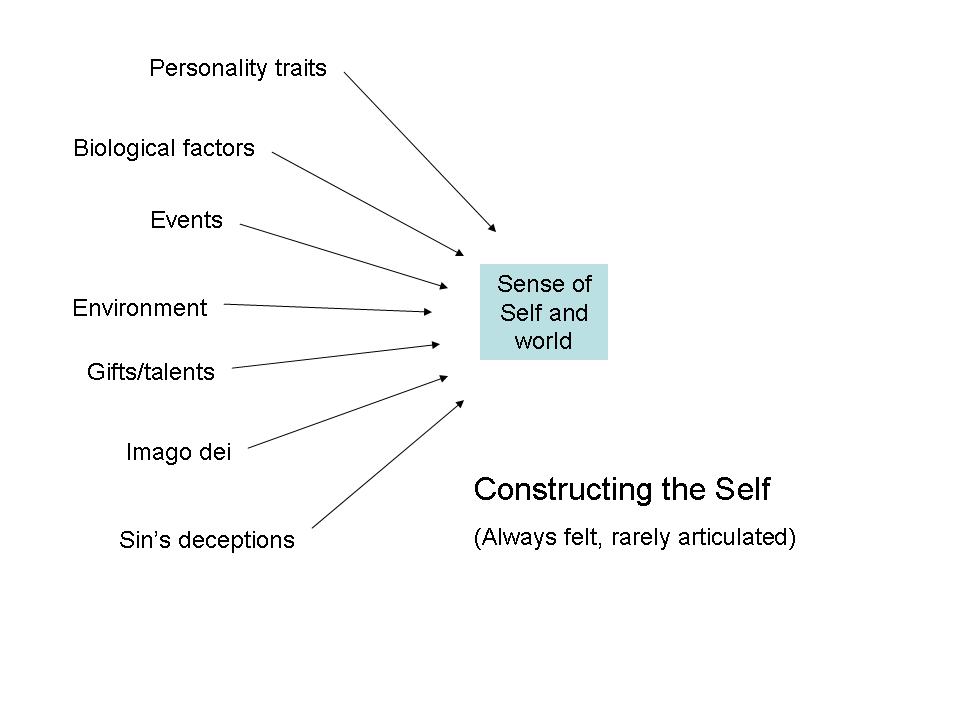
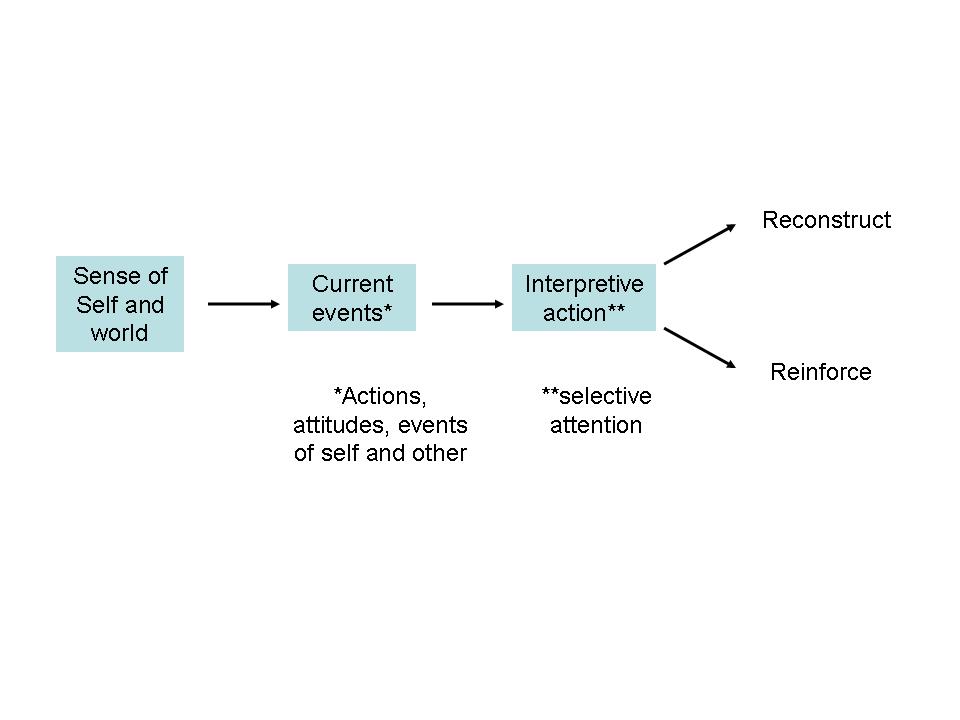
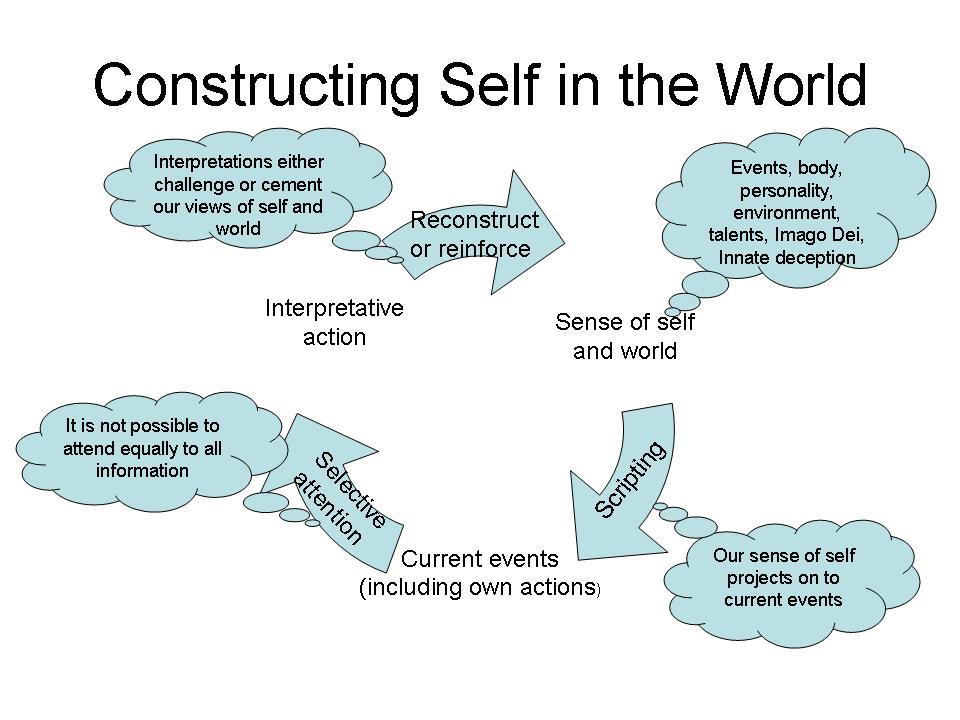
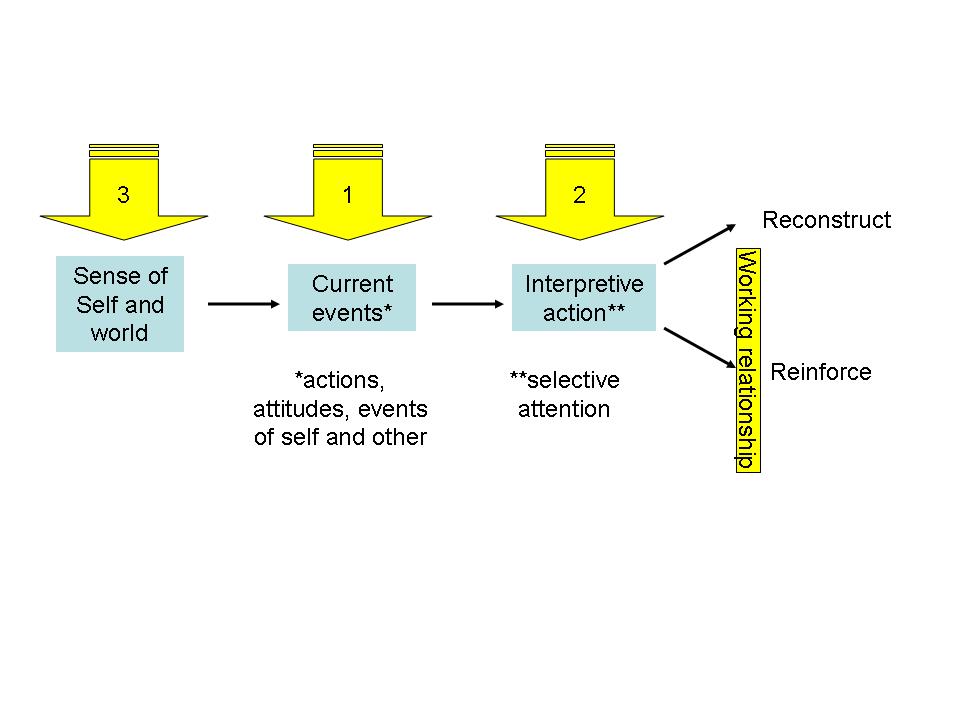
To help set the stage, I’ve constructed a few slides :

1. Every client constructs and maintains a sense of self and a sense of the world. A number of factors influenced that sense of self, some of which I’ve listed here:


2. We shape and reshape that sense of self through experiences and interpretations that either reinforce or reconstruct/challenge our sense of the world and self:

3. The counselor may wish to intervene in several places. (1) Stop and start behaviors; encouraging environmental changes; mercy ministries, (2) Challenging interpretations, Encouraging a change in what is attended to (mindfulness), and (3) Reflecting back on the sense of self and world (uncovering core beliefs and experiences). Note  2 things however. First, none of these points of intervention will be of much value if there isn’t a working relationship that enables the client to trust the counselor enough to be vulnerable. Second, choosing a point of intervention is important but equally important is the kind of intervention (open or closed questions, reflections of content or feeling, advice/information, summarizing, confrontation, etc.)


1 Comment

Filed under christian counseling, christian psychology, counseling, counseling skills

Practicum Monday: Basic Competencies


Today starts our 3rd trimester of the 2007-8 school year and Cohort 3 begins their Practicum and Professional Orientation course and first fieldwork experiences of the program. Last year I ran across an article (see reference at end) trying to articulate the domains and levels of competence in focus in a psychology practicum experience. Though the article is directed to doctoral level practicums, I think the domains fit for any level of trainee and are a good reminder for both practicum students and their professors. The authors summarize the “Practicum Competencies Outline” and in turn I will quote/summarize/highlight them below. Click here for the whole document.

  • Baseline Competencies (for entry to practicum)
    • Personality Characteristics
      • interpersonal skills (verbal and nonverbal forms of communication, open to feedback, empathic, respectful)
      • cognitive skills (intellectual curiosity, flexibility, problem-solving, critical thinking, organizing)
      • affective skills (ability to tolerate affect and conflict and ambiguity)
      • personality/attitudes (desire to help, openness to new ideas, honesty, courage, valuing ethics)
      • expressive skills (ability to communicate ideas, feelings, ideas in multiple forms)
      • reflective skills (ability to examine and consider own motives, attitudes and behaviors and recognize one impact on others)
      • personal skills (ability to present oneself in a professional manner)
    • Knowledge from the classroom
      • assessment and interviewing
      • intervention
      • ethics and legal issues
      • diversity
  • Skills to Develop during Practicum
    • Relationship/interpersonal skills
    • Applying research (less so for MA level)
    • Psych assessment (not for MA level)
    • Intervention
    • Consultation/interprofessional collaboration
    • Diversity
    • Ethics
    • Leadership
    • Supervisory skills (not for MA level)
    • Metaknowledge/metacompetencies

This second major bullet point (competencies built during practicum) is fleshed out further by listing levels of competencies. The article illustrates relationship/interpersonal skill competencies by listing how it will show up with clients (e.g., ability to form working alliances), colleagues (e.g., ability to accept feedback nondefensively from peers), supervisors (ability to self-reflect), support staff (respectful of support staff roles), clinical teams (participates fully in team work), community professionals (ability to further the work and mission of the site).

Hatcher, R.L, & Lassiter, K.D. (2007). Initial Training in Professional Psychology: The Practicum Competencies Outline. Training and Education in Professional Psychology, 1, 49-63.

Leave a comment

Filed under counseling, counseling skills, Psychology, teaching counseling

Note-taking in sessions?


Counselors have vastly differing styles of counseling. Some choose to be directive, others are remain passive even when the client wants them to give advice. We are different because of our varying theories and personalities. But I always assumed that most counselors do not take notes during sessions unless needing to record very specific details (say taking a family genogram or collecting details for a psychological report). But after having conversations in several different locations I learn that many write during the session. They write down key client phrases and other things that they wish to come back to and explore at a later date.

I’m curious about your experiences–either as a counselor or counselee. Was there note-taking going on during the session and was it helpful (for both)? Did it cause problems?

I don’t take notes in session so that I can stay engaged in good dialogue with my clientele. I don’t want to miss subtle details and I don’t want to break up the work by taking a note. It seems to me that if I take a note during the session, the client waits for me to do so and then they move out of an experience to only describing an experience–and so distance themselves from their feelings and thus any insight or intervention is also distant.

What do you think?

11 Comments

Filed under christian counseling, christian psychology, counseling, counseling skills

ER: Is it easier to feel guilt than forgiveness?


Someone sent me a link to a recent ER show where a dying man is talking to a chaplain about his guilt and whether or not he can be forgiven for his taking innocent life. While some of the chaplain’s comments are relativistic mumbo-jumbo, she has one very insightful comment.  The dying man says something to suggest he can’t make up for his sins. The chaplain says,

“[Sometimes I think] it’s easier to feel guilt than forgiven….that your guilt is your reason for living…but maybe you need something else to live for.”

I may not have gotten that quote just right at the end as I was scribbling it down. But, this line is very powerful. In fact, some make a living out of guilt, depression, hopelessness, etc. They can’t imagine life any different. Pride makes it hard to give up what feels to have become a central feature to their identity. While her counsel was terrible, she was right on the money about the nature of guilt and the difficulty in giving it up. He would have to accept that he received something he did not deserve and could never pay back.  

4 Comments

Filed under counseling, cultural apologetics, Forgiveness

Science Monday: Therapist characteristics that may lead to greater treatment success


Today in Psychopathology class we will be studying the anxiety disorders. In preparing for the class, I happened on an 2001 article by Huppert, Bufka, Barlow, Gorman, Shear, & Woods in the Journal of Consulting and Clinical Psychology (v. 69, pp747-755). FYI, David Barlow is a well-known anxiety researcher in the Boston area.

These authors researched how various therapist characteristics influence outcome in CBT for anxiety disorders.  While CBT has been found to be effective in treating anxiety, does it matter much what therapist you get?

What therapist characteristics were not found to be all that meaningful to outcome? Gender, age, and theoretical orientation did not seem to make any difference. The fact that theoretical orientation didn’t make much difference is quite interesting. This suggests that expertise in CBT may not matter as much as one might think. Anybody with a manual and a willingness to follow it can do it well enough–maybe.  

So what counselor characteristics do increase successful outcome for anxiety treatment? Experience. The more experienced therapists had clients who had less anxiety after treatment. Experience (number of years as a therapist) matters quite a bit. The authors did not find that experienced therapists were more apt to follow the treatment protocol as there were no differences between experienced and inexperienced therapists as far how they did in following the protocol.

So, what does experience mean? We’re not really sure but it probably has something to do with therapist flexibility while continuing to adhere to the treatment protocol. Those who followed the protocol but were more rigid may have communicated that rigidity to their patients and missed key interpersonal processes. This study didn’t explore this issue but I surmise that is part of the issue.

One funny finding was that more experienced therapists suffered the same drop-out rate as did the more inexperienced therapists. And yet, those who stayed in treatment had much lower anxiety when they were seen by the experienced therapists. So, just because you go to an experienced therapist, don’t assume that everything will go well. No, you have to want to be there and be willing to do the hard work. Also, you just may not click with the counselor.

Most of us counselors want to be skilled and have cool techniques. But once again we find that relationships matter more than technique.

1 Comment

Filed under Anxiety, counseling, counseling science

Opportunity for free career and resume consultation!


Part of Biblical Seminary’s advanced counselor training certificate for those pursuing licensure includes a course on career and lifestyle development. Led by two seasoned (experience…not old) career and job change counselors, the course includes a special free-of-charge career clinic on February 11 staffed by the students.

Appointments are available every half hour or so, and they recommend that you bring a résumé. They’ll help with questions you may have about getting a job, work situations, and overall career goals. If you are out of the area but would still like to take advantage of this opportunity, feel free to request that here in a comment and I’ll email you privately to get contact info. If you fax your resume to us, we’ll see about getting you a phone conference. Slots are limited.

Here’s a link to the flyer location on Biblical’s website that will give you more details:
http://www.biblical.edu/pages/embark/flyer_for_career_clinic.pdf

2 Comments

Filed under christian counseling, counseling

Mirroring yourself and why you can’t


We all believe we have a decent grasp on reality. We can read the emotions and motivations of others and accurately evaluate our self. But in point of fact, we operate mostly through assumptions and perceptions of others and our self. Some of us more closely approximate the truth, others less so. Those who have a better grasp of reality tend to be folks willing to test out their perceptions. Without becoming too dependent on the opinions of others, they ask what others are thinking and feeling without preemptive assumptions. When they hear these experiences, they spend more time trying to understand and less time defending their own opinion. They ask for feedback and consider what they hear without denial or acquiescence.

Why is it hard for some to avoid preemptive assumptions about self and the world? Why is it that some use repetitive relational scripts where they accept and play a role in most of their relationships? As children, our sense of self and other builds from our interactions with important figures in our lives. If we are exposed to relentless criticism (we are bad) or neglect (we don’t matter), we are likely to try to conjure up our own sense of self.  Some personality theorists call this a lack of appropriate mirroring.

Most then fall into one of two response types: I must be right all the time or not responsible for my failings (though I fear I will be found out to be a failure), or I am never right and am only worthy of shame (so I fear and avoid people at all costs or allow others to use and destroy me since that is all I am good for). Of course some vacillate between the two.   

Is there any hope for us who find ourselves trapped in these scripts? Some personality theorists would say no. But, they are wrong. There is hope for us, but it is not a hope in safety. What do I mean? There is some safety in playing out the script as we always have. We know we will be rejected, we know that we will be mistreated or misunderstood, and we know how we will respond. There is comfort in the known (even if we hate it at the same time). What is unsafe is to put down our repetitive thoughts about self, fears about what others think, and just begin to observe the other in our relationships. What is it that they think? Feel? Desire? Believe? I liken this to having conversations with another where we no longer talk to them with a mirror in the middle. When the mirror is present, we are relating to them but constantly assessing ourselves, noticing our feelings, etc. When we remove the mirror, we have the opportunity to only see them and have our self go to the background. This, of course, causes us to feel small and vulnerable. Hence why I said that it does not feel safe. And yet, the very act of connecting to another without the mirror positions us to potentially receive more accurate feedback about ourselves.

I’m reminded of the biblical text in James about the man who looks in the mirror and then promptly forgets what he has seen (1:23). We forget when we listen to things but “forget” because other things are speak more powerfully to us–seem to be more true. The text goes on to say that we remember what we have seen and heard when we are open to the the perfect truth. So, we will have God’s power to change from building our own mirror to that of a more truthful image when we keep ourselves close to God, his Word, AND when we connect to others who also reflect God’s true character.  Misappropriating CS Lewis, its not a safe option, but it is good. 

1 Comment

Filed under christian psychology, counseling

Ever hear of _____Therapy (the latest christian model)?


Someone recently mentioned “Creation Therapy” as the latest Christian counseling treatment. Ever heard of it? Is it any good?

You be the judge. Google it (with quotes) and tell me what your first impressions are of the several sites that mention it (and therefore impressions of the therapy). How would you go about evaluating the tools?

Tomorrow, I’ll make some comments on good ways to evaluate up and coming models of christian counseling.

4 Comments

Filed under christian counseling, counseling